
Beyond the Face: Enhancing Emotion Detection with Social Media Common Sense
Crawling to Improve Multimodal Emotion Detection
The paper introduces "emoCrawler," a multimodal fusion framework for emotion detection that integrates facial expressions, vocal acoustics, and semantic context gathered from social networks. By leveraging a neural network-based fusion of diverse sensory data, the system achieves a state-of-the-art average accuracy of 75% on the eNTERFACE’05 dataset.
TL;DR
In the quest for truly human-centered AI, analyzing just a smile or a tone of voice isn't enough. This paper presents a multimodal fusion system that combines facial capture, voice analysis, and a novel tool called emoCrawler. By querying Twitter in real-time to understand the "emotional weight" of specific words, the researchers boosted emotion detection accuracy from a mediocre 50% to a robust 75%.
The Problem: The Noise of Reality
Detecting emotion in a lab is easy; detecting it in a real human-machine interaction is not. Unimodal systems—those focusing only on one "sensor"—have fatal flaws:
- Face: Distorted by lighting, head movement, and the very act of speaking (mouth movements for words are often confused with emotional expressions).
- Voice: Heavily dependent on valence and often confused by background noise.
- Context: Most systems are "blind" to what is actually being said. If a user says "I am so sorry she died," a system seeing a neutral face might miss the profound sadness without semantic context.
Methodology: The Triple-Sensor Fusion
The researchers utilized the eNTERFACE’05 Audio-Visual Emotion Database and built a pipeline consisting of three distinct "sensors":
- eMotion (Facial): A 3D mesh-fitting algorithm to analyze facial expressions.
- Emo-Voice (Acoustic): An SVM-based classifier trained on vocal features.
- emoCrawler (Semantic): The "secret sauce." It extracts keywords from the user's speech, crawls Twitter for those terms, and analyzes the emotional frequency of the results to provide a "common sense" emotional baseline.
The Fusion Architecture
To combine these inputs, the team compared two neural network architectures: Feed-Forward Backpropagation (FFBPNN) and Probabilistic Neural Networks (PNN). These networks acts as the "brain," weighting the reliability of the face, voice, and semantics to reach a final verdict.
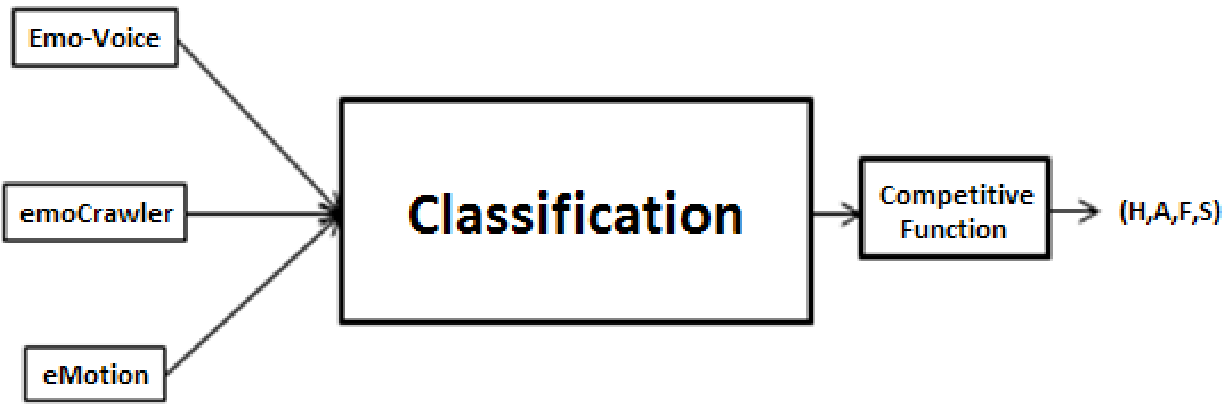 Fig 1: The Sensor Fusion process integrating the three modalities.
Experiments and Results: The Power of Context
The results were striking. When used in isolation, facial recognition performed poorly (averaging only 20% accuracy), largely due to the mechanical deformations of the face during speech.
However, when emoCrawler was enabled, the system's ability to identify difficult emotions like Fear surged from 20% to 80%. This suggests that while a person's face might not clearly show fear, the words they choose (and the social context of those words) are highly predictive.
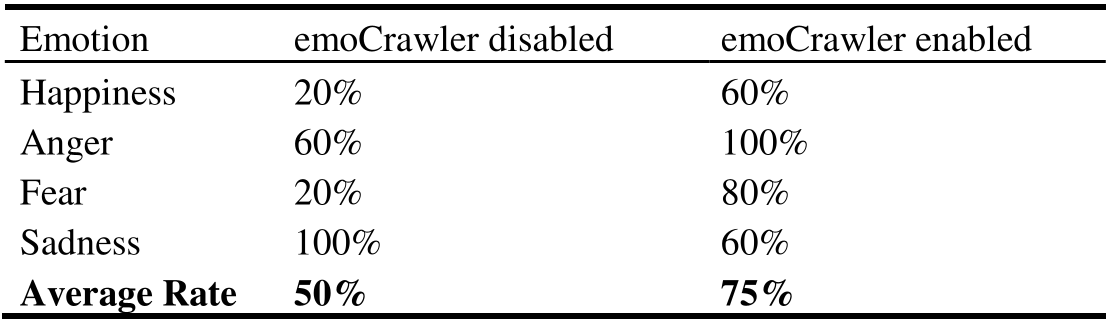 Table 1: The massive performance jump when enabling the emoCrawler (Semantic Context).
Key Findings:
- Average Rate: Jumped from 50% (Bi-modal) to 75% (Tri-modal).
- Anger: Achieved a perfect 100% detection rate when semantics were included.
- The "Sadness" Exception: Interestingly, accuracy for sadness dropped. The authors attribute this to "noise" in the social media data—Twitter's collective reaction to certain "sad" keywords might be too sarcastic or varied, confusing the model.
Critical Analysis & Conclusion
This work highlights a fundamental truth in Affective Computing: Emotion is contextual. By treating social media as a "global common sense database," the authors found a way to give AI a sense of what words usually mean to humans.
Limitations: The system is currently limited by the 140-character nature of Twitter (at the time of the study) and potential "data contamination" where social media noise leads to false positives in specific emotions like sadness.
Future Outlook: In the era of Large Language Models (LLMs), the "emoCrawler" concept could be evolved into using pre-trained embeddings or real-time RAG (Retrieval-Augmented Generation) to provide even deeper nuances. This paper proves that for AI to understand how we feel, it needs to stop looking only at our faces and start listening to the context of our world.