
Beyond Binary Labels: Mapping the Multi-Dimensional Intensity of Speech Emotions
Creation and Analysis of Emotional Speech Database for Multiple Emotions Recognition
The paper presents a new Japanese Speech Emotion Recognition (SER) database featuring multiple emotion labels and continuous intensity values per utterance. By extracting 2,025 samples from video works, the authors move beyond the conventional single-label paradigm to capture the complexity of human expression.
TL;DR
Current Speech Emotion Recognition (SER) systems are limited by "categorical thinking"—assigning one label like "Happy" or "Sad" to a sentence. This paper introduces a new Japanese audio database of 2,025 samples where every utterance is annotated with multiple emotions and continuous intensity levels, revealing that over 75% of emotional speech is actually a cocktail of different feelings.
Background: The "Single Emotion" Fallacy
In the landscape of Human-Computer Interaction (HCI), recognizing what is said is a solved problem, but recognizing how it is said remains a "Grand Challenge." Existing SOTA models (like ACRNN) achieve high accuracy on benchmarks like IEMOCAP or Emo-DB, but they operate under a fundamental flaw: they assume one utterance equals one emotion.
The authors argue that human speech is rarely pure. A frustrated "I'm fine" might contain traces of anger, sadness, and disgust all at once. Without datasets that capture these nuances, AI will remain emotionally "clunky."
Methodology: Crowdsourcing Complexity
To bridge this gap, the researchers abandoned scripted studio recordings in favor of "in-the-wild" audio extracted from Japanese TV series.
The Annotation Protocol
- Selection: 2,025 audio-only segments were extracted where emotions were clearly present.
- Categorization: Based on Plutchik’s Emotion Wheel, evaluators rated eight primary emotions: Anger (ANG), Sadness (SAD), Fear (FEA), Joy (JOY), Trust (TRU), Surprise (SUR), Disgust (DIS), and Anticipation (ANT).
- Intensity: Unlike binary "Presence/Absence" tags, evaluators assigned scores from 0 to 3.
- Averaging: The final label is a continuous value (e.g., an utterance might have an Anger score of 2.33 and a Disgust score of 1.0).
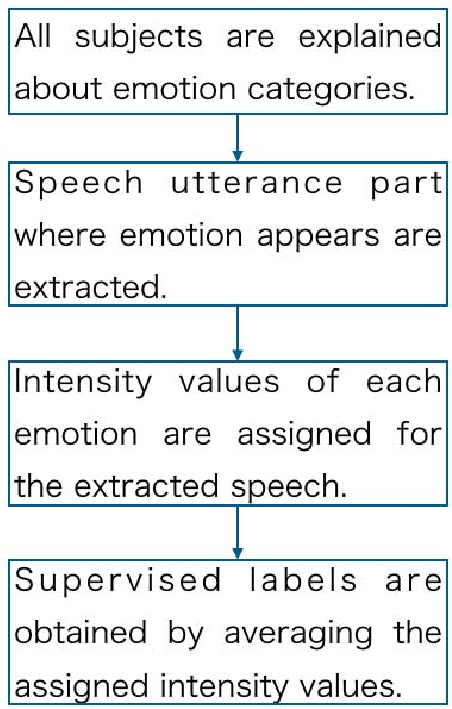 Fig 1: The workflow from audio extraction to multi-rater intensity averaging.
Key Insights from Statistical Analysis
The paper’s statistical deep-dive provides a fascinating look at the "hidden" structure of our emotions.
1. The Ubiquity of Multi-Emotions
The data confirms the authors' hypothesis: 75.3% of the samples contained more than one emotion. Most utterances actually contained 2 or 3 simultaneous emotions. Only 181 samples (less than 9%) were rated as having a single, pure emotion.
2. Emotional "Co-occurrence"
The researchers found strong correlations between certain emotions, many of which align with Robert Plutchik's theoretical "Emotion Wheel."
- Anger & Disgust: Shared a 36.7% co-occurrence rate.
- Sadness & Disgust: Shared 36.2%.
- Sadness & Surprise: These were the least likely to be seen together (only 4.8%).
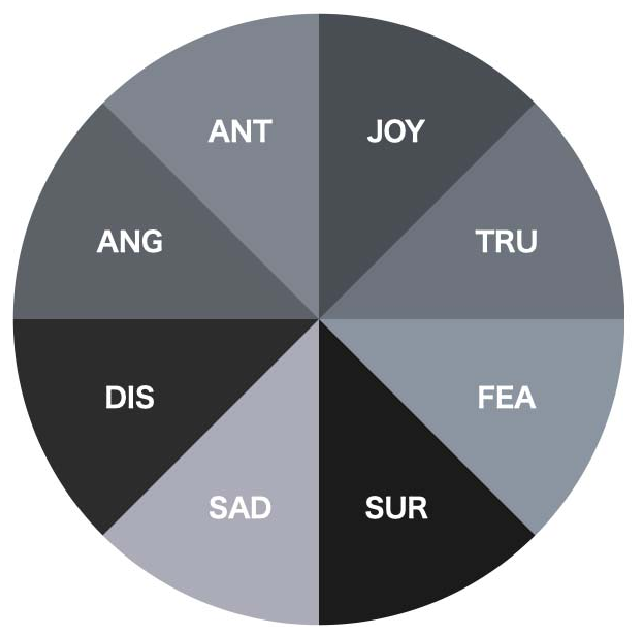 Fig 2: A simplified diagram of the Emotion Wheel used as the theoretical framework for the study.
3. Intensity Distribution
An interesting finding was that different emotions have different "intensity ceilings" in natural speech. As shown in the table below, emotions like "Trust" almost never reach high intensity (99% of samples are between 0 and 1), whereas "Anger" frequently spans the full 0–3 range.
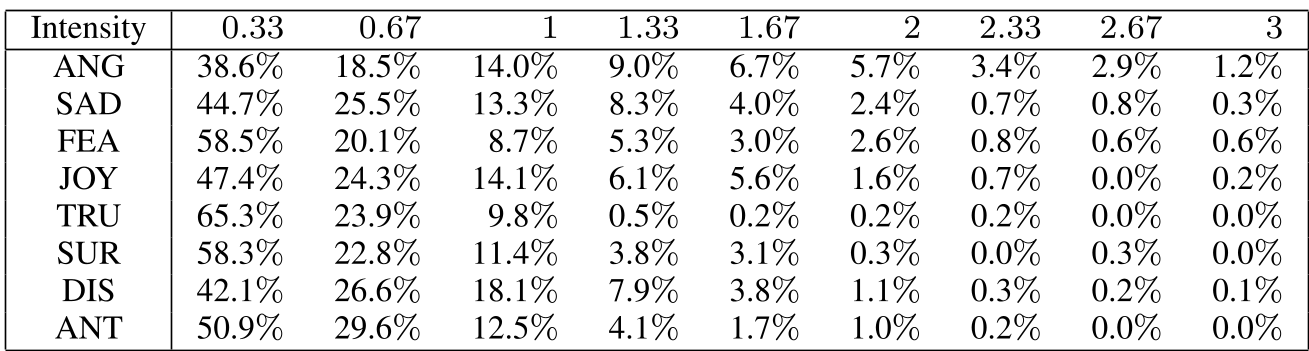 Fig 3: Percentage distribution of intensity values across different emotion categories.
Critical Analysis & Conclusion
This work provides a crucial stepping stone toward Natural SER. By providing a dataset that allows for continuous regression rather than simple classification, the authors enable models to learn the "shades" of human feeling.
Limitations: The current study uses a relatively small number of evaluators (3 per sample) and focuses only on Japanese speech. The subjective nature of emotion perception means that "Ground Truth" is always a moving target, reflected by the low "complete agreement" rates among evaluators.
Future Outlook: The real value of this database will be seen when used to train Multi-task Learning (MTL) models. Instead of a Softmax output layer, future SER architectures should likely use Sigmoid outputs for multi-label presence and an additional regression head for intensity—finally allowing AI to hear the "bittersweet" or "angrily surprised" tones in a human voice.