
Turning the Tables on APTs: Detecting Cyber Reconnaissance with Social Honeypots
Creation and Management of Social Network Honeypots for Detecting Targeted Cyber Attacks
This paper introduces a comprehensive framework for the creation, management, and monitoring of "Social Network Honeypots" designed to detect Advanced Persistent Threats (APTs) during the reconnaissance phase. By deploying realistic artificial profiles in professional networks like LinkedIn and Xing, the authors demonstrate a systematic approach to identifying targeted cyber-attacks before they penetrate organizational boundaries.
TL;DR
Researchers have developed a framework to trap Advanced Persistent Threat (APT) actors before they even touch a company's network. By deploying "Social Network Honeypots"—sophisticated artificial profiles on LinkedIn and Xing—organizations can detect attackers gathering intelligence. The framework doesn't just wait; it uses clever "wiring" algorithms to blend into the company's social fabric, successfully tricking both attackers and—interestingly—real employees.
Background: The Invisible Reconnaissance Phase
Most cyber defenses are built to stop an intruder who is already at the door. But APTs are patient; they spend months on Online Social Networks (OSNs) conducting reconnaissance. They map organizational hierarchies, find vulnerable employees, and craft perfect spear-phishing lures. Because this happens on platforms like LinkedIn, it remains invisible to traditional IT security. This paper argues that the only way to see this activity is to participate in it.
The "Anatomy" of a Social Honeypot
Creating a fake profile is easy; creating a survivable and attractive honeypot is high art. The authors' framework consists of a sophisticated pipeline:
1. The Realism Engine (HoneyGen)
Attackers are trained to spot "bot-like" behavior. The framework uses HoneyGen, which mines association rules from real crawled profiles to ensure that an artificial profile's education history matches its job title and age.
2. The Wiring Strategy
A profile with zero mutual friends is a red flag. The authors implemented a three-phase wiring algorithm:
- Collaborators: Linking to real, consenting security team members first.
- Highly Connected: Connecting to "LIONs" (LinkedIn Open Networkers) to boost friend counts.
- Insiders: Sending requests to real employees based on mutual friend counts.
 Figure 1: The architecture showing the interplay between OSN acquisition, profile generation, and dual-track monitoring.
Field Trial Insights: Why Does it Work?
The authors conducted an 8-month trial with a large European organization. The results were revealing:
- The "Gender Bias" of Infiltration: Female profiles (User_3) saw significantly higher acceptance rates and more incoming suspicious requests compared to male profiles.
- Employee Resilience (or Lack Thereof): Approximately 70% of employees accepted friend requests from a complete stranger (the honeypot) simply because it appeared to work at the same company.
- The Survival Rate: By limiting interaction frequency and mirroring organizational commonalities, 100% of the honeypots survived OSN bot-detection algorithms.
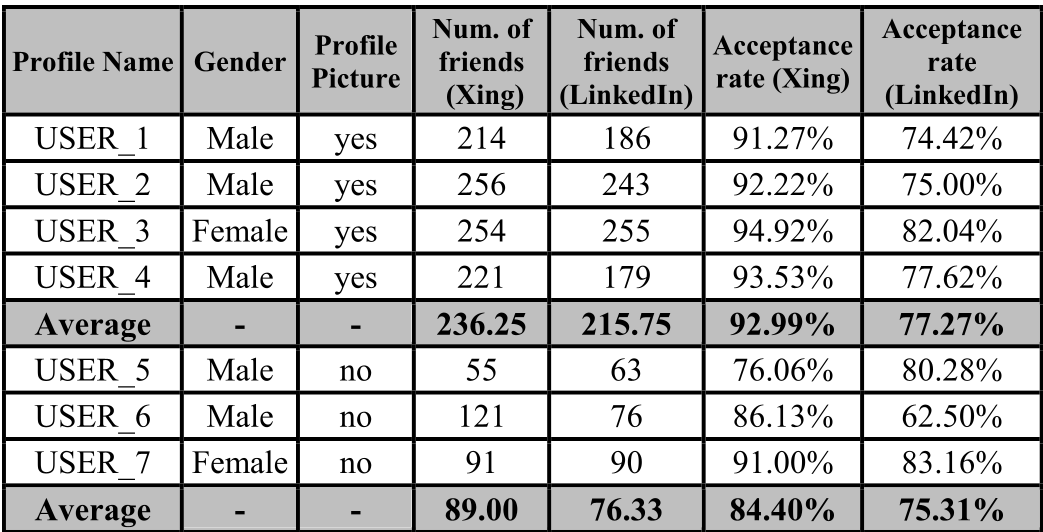 Table 1: User_3 (Female) showed the highest acceptance rate across platforms.
Critical Analysis: The Internal "Friendly Fire" Problem
One of the most fascinating findings was a challenge the researchers didn't fully anticipate: Employee Investigative Behavior.
During the trial, an observant employee noticed a honeypot profile and realized they couldn't find the "person" in the internal company directory. This led to an HR investigation into the "fake" colleague.
- Insight: For a honeypot to truly succeed, it must be integrated into the organization's internal infrastructure (Active Directory/Address Books) to avoid being "exposed" by the very people it is trying to protect.
Value & Lessons for the Industry
- Early Warning: Social honeypots provide a Discounted Cumulative Gain (DCG) for detection, proving they can identify suspicious activity in its infancy.
- Attractiveness Matters: Profiles with pictures and professional histories are significantly more effective at attracting "socialbots" used by attackers.
- The Spam Trap: Interestingly, the study found that exposing honeypots to general spam (signing up for newsletters) actually decreased their effectiveness in detecting targeted attacks because the signal-to-noise ratio became too low.
Conclusion
The "Social Network Honeypot" moves organizational defense from reactive to proactive. While the legal and ethical tightropes are narrow, the survival and assimilation of these profiles prove that "deception-as-a-service" is a potent weapon in the APT arms race. Future work will likely leverage LLMs to make these profiles even more conversational and "human-like," further blurring the line between defenders and the targets they are protecting.