
Creative Interaction: Transcending Classroom Borders via Mobile Social Networks
Creative interaction in social networks: Multi-synchronous language learning environments
This study investigates the impact of "Creative Interaction" within social networks on vocabulary acquisition through an Online Mobile Language Learning (OMLL) course. Using WhatsApp and GRE mobile applications, the researchers integrated synchronous and asynchronous environments for B1-level Iranian learners, achieving superior results compared to traditional classroom settings.
TL;DR
This research demonstrates that social media apps like WhatsApp, when repurposed for "Creative Interaction," significantly boost vocabulary retention compared to traditional face-to-face methods. By leveraging a multi-synchronous approach (combining real-time chat with self-paced app usage), the study found a 54% variance improvement in learner outcomes, particularly in contexts where traditional E-learning infrastructure is limited.
Problem & Motivation: The "Classroom Wall" Constraint
Despite the rapid evolution of CALL (Computer-Assisted Language Learning), language education in many developing sectors remains confined to physical boundaries. The authors identify a "motivation-infrastructure gap": while smartphones are ubiquitous, their use is often restricted to social recreation rather than pedagogical "Affinity Spaces." Traditional methods often neglect the emotional connection and immediate feedback loops that are vital for language acquisition. The core insight here is that the smartphone isn't just a tool for content delivery; it's a vehicle for social interaction that can lower the "affective filter" (anxiety) often present in physical classrooms.
Methodology: The OMLL Architecture
The researchers structured an Online Mobile Language Learning (OMLL) course that moved beyond simple "message sending."
1. The Multi-Synchronous Hub
Using WhatsApp, the experimental group engaged in:
- Synchronous Interaction: Real-time discussions and peer-to-peer assessment.
- Asynchronous Content: Accessing GRE vocabulary cards and online dictionaries at their own pace.
2. Systematic Task Design
Unlike unstructured chatting, the course used a B1-level curriculum (Top Notch 3B) delivered via mobile. The "GRE Vocabulary Application" served as the core MAVL (Mobile Assisted Vocabulary Learning) tool, allowing students to "Study, Play, and Make Cards."
 Note: The flow emphasizes the transition from human-computer interaction to ubiquitous social networking.
Experiments & Results: Quantifying the Shift
The study utilized a one-way ANCOVA to control for initial proficiency (pretest scores).
Key Findings:
- Performance Leap: The experimental group achieved an adjusted mean score of 26.97 on the posttest, significantly higher than the control group's 22.51.
- Effect Size: The Partial Eta Squared of .547 indicates that over half of the performance variance was directly attributable to the OMLL treatment.
- Qualitative Insights: Interviews revealed that students felt more "independent" and "confident" because the lack of physical eye contact reduced debilitative anxiety.
Performance Comparison Data
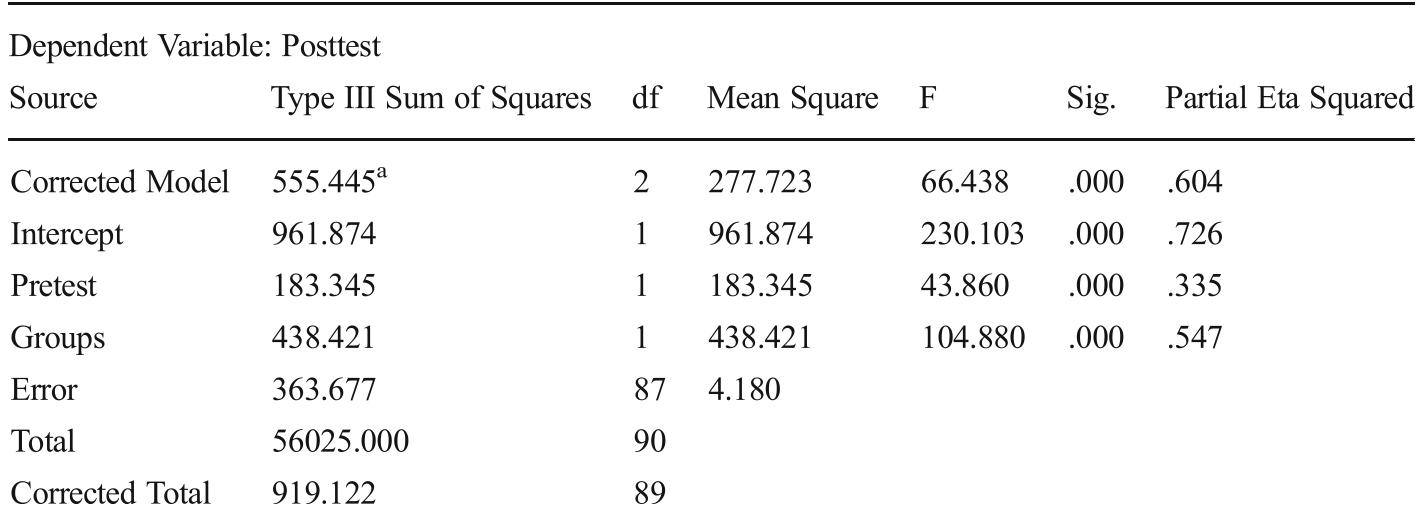 Table showing significant F-value (104.88) and low p-value (.000), validating the OMLL impact.
Critical Analysis & Conclusion
The Double-Edged Sword of "Freedom"
While the results are overwhelmingly positive, the authors provide a sobering look at the limitations. The "Creative Interaction" model requires high ICT Literacy. Without it, students are prone to distraction. Furthermore, the "Availability Trap" for teachers—where students expect 24/7 responses on WhatsApp—poses a risk of burnout.
Takeaway for Educators
This paper proves that social networks can create "Authentic Contexts" for learning. The future of distance education lies not in complex, proprietary LMS platforms, but in the "Pervasive and Portable" apps already in the pockets of our learners.
Future Outlook
The next frontier is determining how these mobile frameworks scale for Beginner levels (A1-A2), where the linguistic "load" might require more structured interventions than peer-to-peer social networking can provide.