
Beyond Productivity: The Material and Embodied Soul of the Design Studio
Creative Practices in the Design Studio Culture: Collaboration and Communication
This paper presents a longitudinal ethnographic study of academic and professional design studios to understand collaborative creativity. It introduces a framework centered on the use of artefacts, spatial resources, and "designerly practices" to achieve state-of-the-art insights for Computer-Supported Cooperative Work (CSCW).
TL;DR
Design is not just a series of tasks; it is an experiential journey. This paper dives deep into the "Design Studio Culture," revealing that the secret to creativity lies in the messy, material world of sketches, foam models, and "Artful Surfaces." By moving beyond functionalist productivity metrics, the authors propose a new paradigm for ubiquitous computing that respects the physical and embodied nature of creative work.
The "Functionalist" Trap
In the world of Human-Computer Interaction (HCI) and CSCW, we often treat collaboration as a problem of information exchange. We build tools for "efficiency." But for a product designer, efficiency is secondary to synthesis.
The authors argue that prior work misses the point: designers don't just think with their heads; they think with their hands and their environment. The pain point is clear—digital tools often "sanitize" the creative process, removing the tactile richness and spatial cues that trigger breakthrough thinking.
Methodology: The Ecology of Creativity
The researchers spent 250 hours embedded in professional and academic studios. They didn't just watch what designers did; they analyzed the ecology they built around themselves. They categorized these into three pillars:
1. The Power of the Artefact
Artefacts (sketches, clay models, prototypes) are not just outputs; they are "mediators." They allow for "thinking by doing." A foam model of a remote control isn't just a representation; it is a tool for a team to touch, feel, and critique together.
 Figure: The evolution of design artefacts from 2D sketches to 3D software and physical prototypes.
2. Space as "Artful Surfaces"
Studio walls are not just boundaries; they are "Artful Surfaces." Designers use them to establish "organizational memory." By pinning sketches and posters, they create a "dynamic wall" of current projects and a "static wall" of identity and inspiration. This spatial arrangement reduces cognitive load, allowing designers to "fly through" information at a glance.
3. Designerly Practices: The Moving Body
Innovation often requires "body-storming"—using the physical body to act out interactions. The authors found that gestures and role-play are essential for "geriatric sensitivity training" or understanding "emotional interaction."
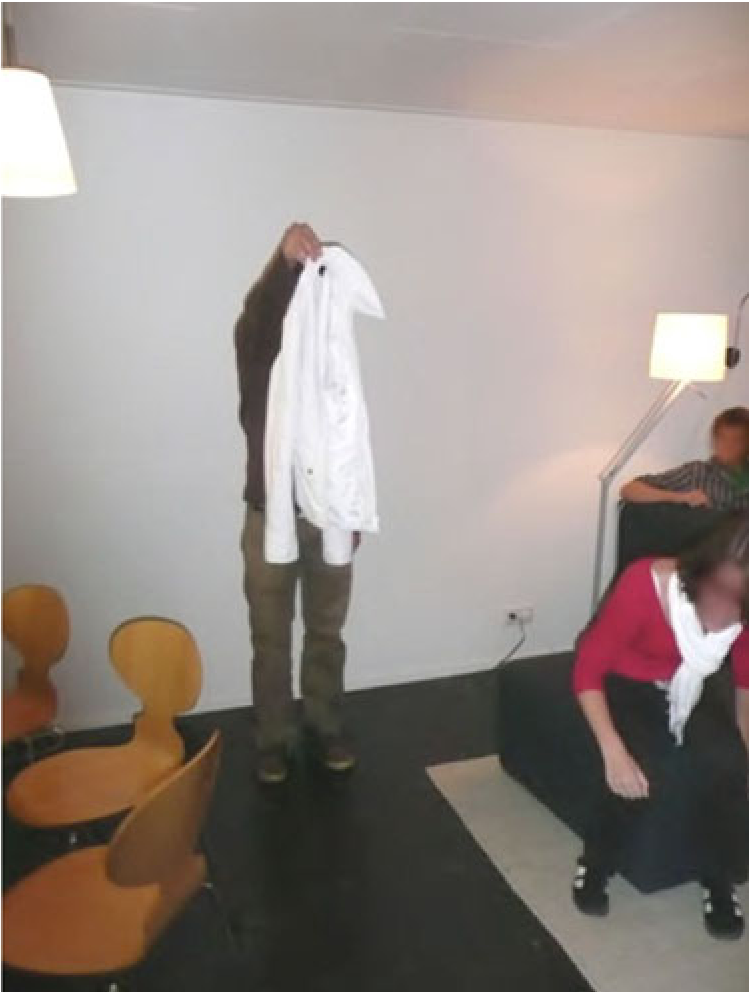 Figure: Designers using bodily movements and role-play to explore interaction possibilities.
Key Insights and Results
The study highlights that the "Material Richness" of a prototyping material (like Bubinga wood or heavy plastic) changes the perception of a design. A "heavy" prototype is perceived as "serious," while a light one is "exploratory."
Key quantitative takeaways:
- Representation Volume: Teams produce 50-100 physical/visual artifacts per cycle.
- Spatial Proximity: Physical distance has a strong negative correlation (r = -0.84) with the probability of interaction.
- Asynchronous Cues: "Artful surfaces" act as silent coordinators, allowing team members to leave traces of their intent for others to see later.
Critical Analysis: The Future of the "Paperless" Studio?
The authors conclude with a warning: Do not replace the material with the digital.
The implication for future technology is not a "paperless office" but an "augmented studio." We should use IoT and RFID to tag physical objects, linking them to digital memories rather than forcing designers behind a monitor. The goal is "Social Flexibility"—technology that allows designers to discuss, move, and "play" anywhere.
Limitations & Outlook
While the study provides a deep ethnographic account, it focuses largely on co-located teams. The "Future Work" in this field must address how to translate this "material richness" to distributed teams without losing the soul of the studio.
Takeaway: If you want to design a tool for creators, don't build a better dashboard; build a bridge between their hands and their data.