
YOLO: Boosting the "Creativity Quotient" Through Robotic Play
Creativity Encounters Between Children and Robots
This paper introduces YOLO (Your Own Living Robot), a social robot designed to stimulate creativity in children during unstructured play and storytelling. By employing "Mirroring" and "Contrasting" behaviors, the study demonstrates that the robot significantly increases the originality of children's creative processes compared to non-interactive tools.
TL;DR
At the age of 7, children often hit a "creativity crisis" where spontaneous imagination begins to decline. This paper presents YOLO (Your Own Living Robot), a social robot designed not to tell stories to children, but to act as a character within their stories. By mirroring or contrasting a child's movements, YOLO successfully boosted the originality and complexity of children's creative processes in a study of 62 participants.
The Problem: The 7-Year-Old Creativity Crisis
In the world of developmental psychology, creativity isn't just a "nice-to-have"—it's a critical survival skill for problem-solving and well-being. However, research identifies a sharp drop in creative elasticity as children enter traditional schooling.
Current interventions often feel like "tests"—boring, structured, and anti-creative. The authors identify a gap: How can we use technology to foster unstructured, messy, and joyful play that naturally stimulates the brain's creative muscles?
Methodology: The "Mirror" and the "Contrast"
The core innovation of YOLO lies in its behavior design, grounded in two fundamental creativity techniques:
- Mirroring: The robot replicates the child's movement. This encourages convergent thinking—elaborating on an existing idea and building a coherent narrative.
- Contrasting: The robot moves in a different or unexpected direction. This sparks divergent thinking—forcing the child to introduce a "plot twist" or a new perspective.
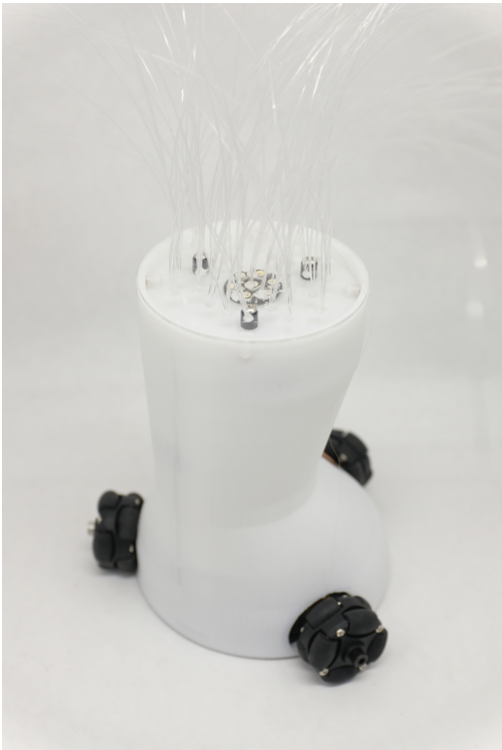 YOLO: A small, lightweight, and abstract robot designed to minimize intimidating "uncanny valley" effects while maximizing creative projection.
The Interaction Loop
Children used YOLO as a "prop" in a story. If a child moved the robot to represent a character going to a forest, YOLO might either "agree" (Mirroring) or "rebel" (Contrasting) based on the stage of the storytelling arc.
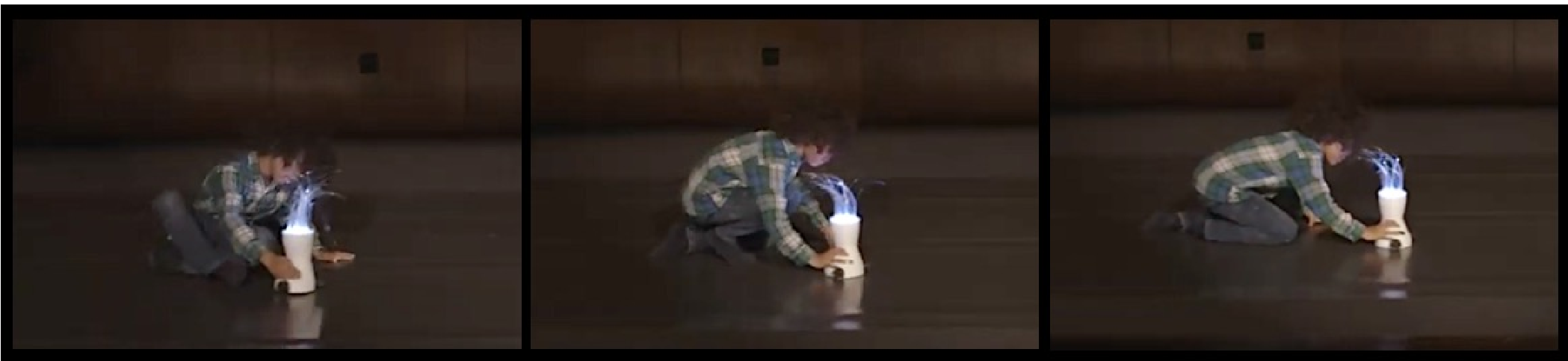 A child interacting with YOLO during an unstructured play session.
Experiments & Results: Measuring the "Messy" Process
Most studies only look at "Pre" and "Post" tests. This research goes deeper by analyzing the Creative Process—coding every verbal interaction for:
- Fluency: Number of ideas.
- Flexibility: Categories of ideas (characters, actions, settings).
- Originality: How unique the ideas are.
Key Findings:
- Originality Spike: Children in the "Simple" (reactive) and "Enhanced" (social) robot conditions produced stories with significantly higher originality than those playing with a deactivated robot.
- Elaboration: Children were most creative when describing actions compared to characters or scenarios, suggesting the robot's physical movement primarily stimulted kinetic and action-oriented imagination.
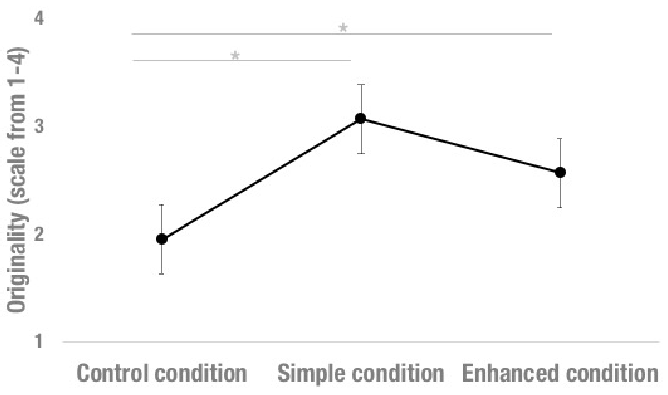 Data shows a clear "Originality" advantage (right) for children interacting with an active YOLO robot.
Critical Insight: Robots as Coworkers, Not Replacements
The paper’s most profound takeaway is that the robot didn't give the children ideas. Instead, by being a slightly unpredictable partner, it facilitated a "state of flow" and collaboration. The robot acts as a catalyst.
Limitations: The study focused on individual play. In the real world, children play in groups. The authors acknowledge that the next frontier is "Group Creativity"—how a robot can facilitate collaborative imagination between multiple children.
Conclusion
YOLO represents a shift in HRI (Human-Robot Interaction) from "Robots as Teachers" to "Robots as Creative Partners." By embracing the chaos of play and using simple behavioral cues like mirroring and contrasting, we can build technology that doesn't just entertain, but actively fights the "creativity crisis."