
Guardian of the Feed: Multi-Stage Credibility Assessment in the Age of Twitter Rumors
A Credibility Analysis System for AssessingInformation on Twitter
The paper introduces a comprehensive Credibility Analysis System for Twitter, integrating a reputation-based model and a machine learning engine to detect misinformation. By combining user behavior, content features, and a novel feature-ranking algorithm (FR_NB), the system achieves over 91% accuracy in identifying non-credible information during critical events.
TL;DR
In an era where a single tweet can trigger market shifts or civil unrest, the ability to judge information credibility is no longer a luxury—it’s a necessity. This paper proposes a robust, four-component system that evaluates both the Source (User) and the Signal (Tweet). By implementing a unique Feature-Ranking Naive Bayes approach, the researchers achieved up to 96% accuracy in distinguishing truth from rumor.
The Core Challenge: The Complexity of "Truth"
The research identifies a fundamental bottleneck in social media analysis: Dynamic Evolution. Malicious actors don't just post fake news; they evolve by purchasing followers and automating engagement to mimic credible accounts. Most prior work treated features (like follower count or hashtag density) with equal weight, failing to recognize that in a crisis, certain signals (like user mentions or URL sources) are far more indicative of truth than others.
Methodology: The Four-Pillar Defense
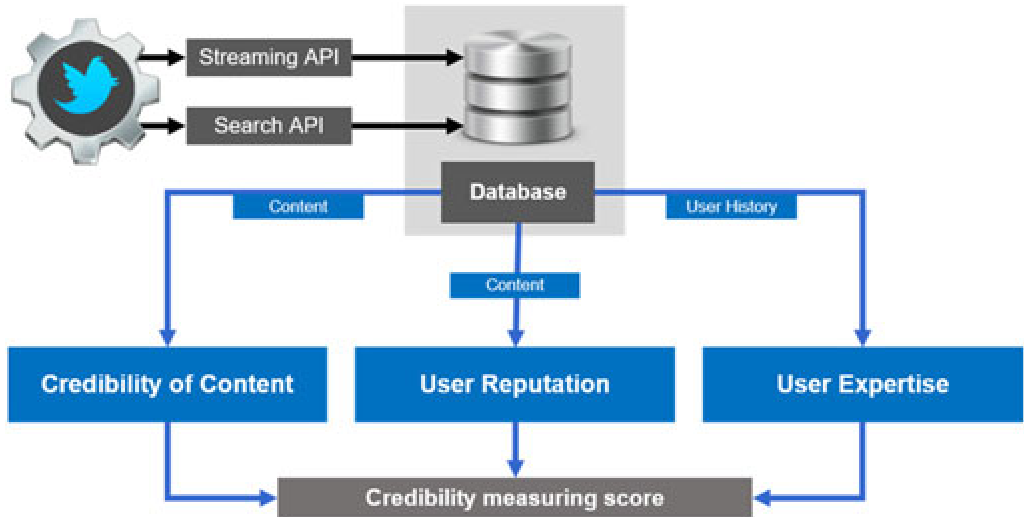
The system doesn't rely on a single "black box" model. Instead, it uses a pipeline:
- Reputation Component: Focuses on "Event Engagement" (retweets, favorites, and mentions specific to the topic) rather than just raw follower counts.
- Credibility Classifier Engine: A supervised learning layer that categorizes content.
- User Experience (UX) Component: Analyzes the long-term history and sentiment orientation of a user.
- Feature-Ranking Algorithm: Perhaps the most innovative piece, it uses human-expert judgment matrices to weight features before they enter the classifier.
Insights from the Data
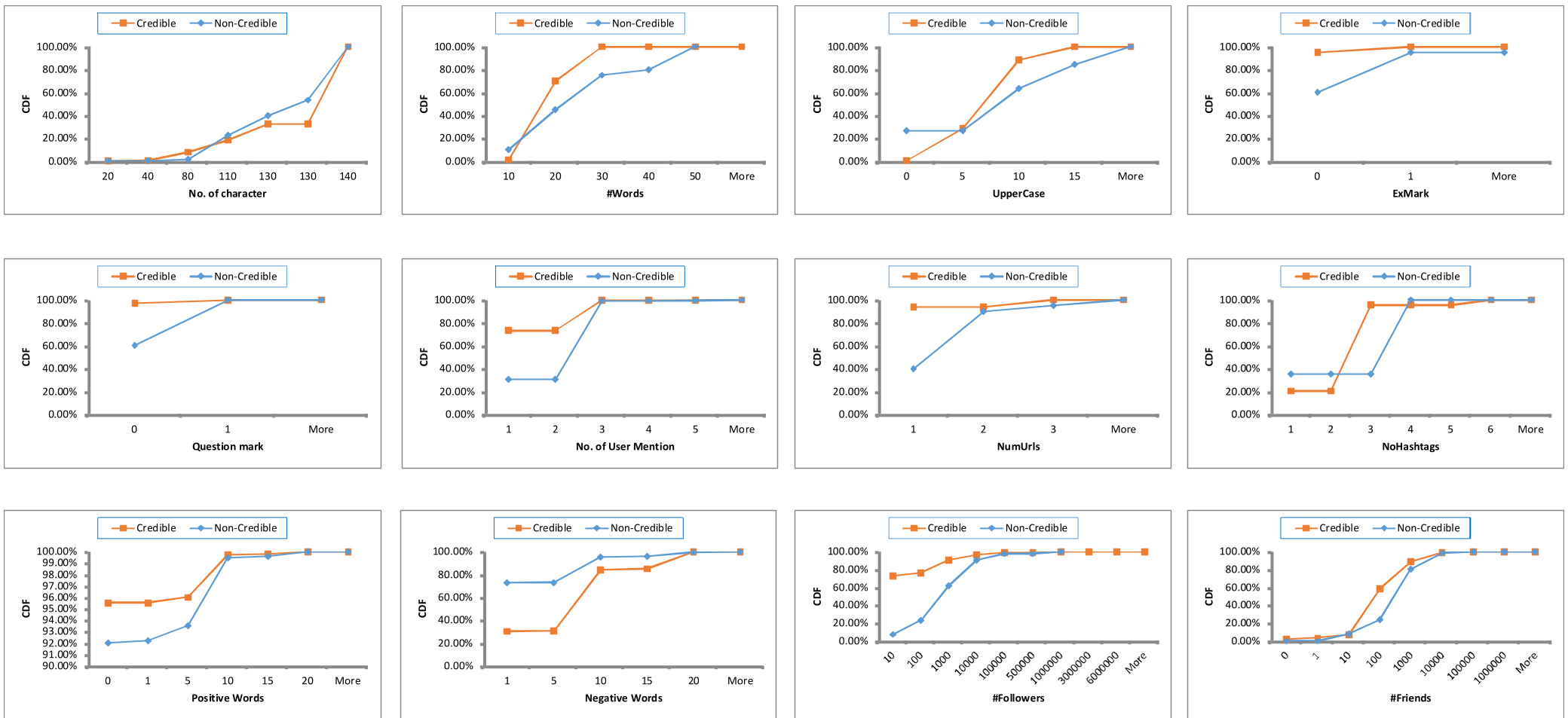
The authors performed a deep dive into the behaviors of credible vs. non-credible actors using Cumulative Distribution Functions (CDF).
- Punctuation as a Signal: Almost 99% of credible tweets avoid excessive exclamation marks, whereas 80% of non-credible ones use them to create artificial urgency.
- The Sentiment Gap: Non-credible tweets are significantly more likely to carry strong negative sentiment, often aimed at inciting emotional responses or social division.
Experiments & SOTA Results
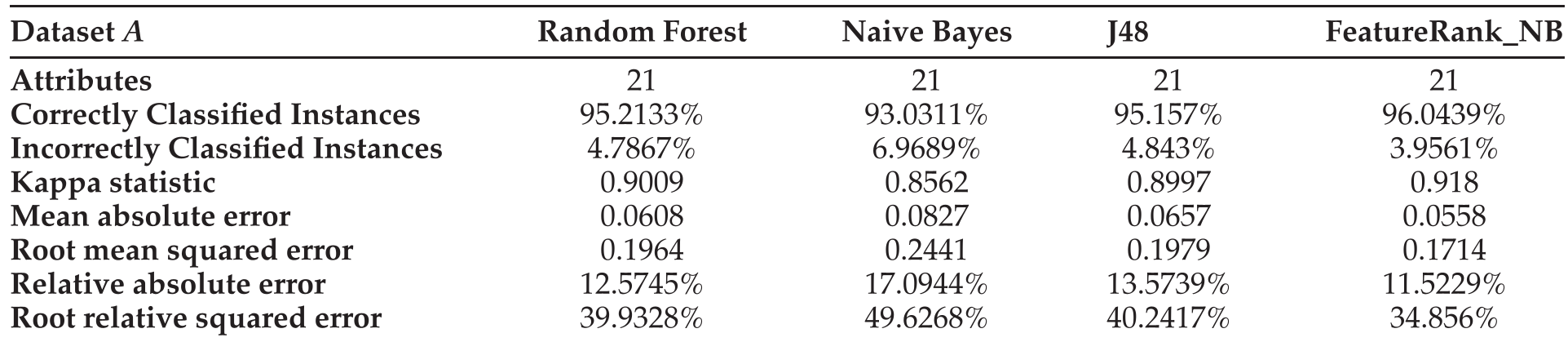
The system was tested against prominent machine learning baselines including Random Forest, standard Naive Bayes, and J48 Decision Trees. The introduction of the Feature-Ranked Naive Bayes (FR_NB) proved decisive.
By weighting features like "Number of Mentions" and "Sentiment Score" using a Priority Vector (PV), the FR_NB model reached 96.04% accuracy on the Aden dataset. More importantly, it achieved a high Recall, which is critical in emergency scenarios—missing a fake rumor (False Negative) is often more dangerous than flagging a true one for further review.
Deep Insight & Conclusion
This work highlights that context is king. A user who is credible in "Politics" might not be an expert in "Healthcare." By integrating user reputation with sentiment history and real-time engagement, the system creates a multi-dimensional "Trustworthiness Value."
Limitations & Future Path: While the system is highly accurate, it currently relies on a human expert to initially set the priority weights for features. Future iterations might look into Self-Supervised Weighting, where the system automatically adjusts feature importance based on the specific type of event (e.g., natural disaster vs. political election).
Ultimately, this study provides a blueprint for building "Entity-Aware" systems that don't just look at what is being said, but who is saying it and how the community is vibrating around it.