
SRPO: Precision Credit Assignment via Self-Localized Resets in LLM Reasoning
Credit Assignment with Resets in Language Model Reasoning
The paper introduces Self-Reset Policy Optimization (SRPO), an RL post-training method for multi-step reasoning that utilizes self-localized resets to improve credit assignment. By backtracking to the first erroneous step in a failed reasoning trace and resampling counterfactual continuations, SRPO achieves state-of-the-art results across 10 reasoning benchmarks and 2-3x faster convergence in coding tasks compared to standard GRPO.
TL;DR
Standard RL for Large Language Models is often "clumsy": it rewards or punishes every token in a reasoning chain equally based on the final answer. Meta AI researchers have proposed Self-Reset Policy Optimization (SRPO), a method that allows models to "find their own mistakes," backtrack to those specific points, and learn from alternative outcomes. This targeted approach yields a 2-3x speedup in learning efficiency and superior reasoning performance.
The Problem: The "Diluted Signal" and the Uniform Credit Trap
In multi-step reasoning, not all steps are created equal. A 20-step math proof might be perfect until a single calculation error in step 5 renders the final result wrong. In current SOTA methods like GRPO, the RL algorithm sees the "Incorrect" label and applies a negative gradient to all 20 steps.
This uniform credit assignment is fundamentally flawed. It penalizes the 4 perfect steps at the beginning and fails to highlight the specific pivot point that caused the failure. This results in high variance and requires massive amounts of data to eventually "average out" the noise.
Methodology: Backtracking with a "Self-Oracle"
The core insight of SRPO is that modern LLMs are surprisingly good at identifying where they tripped up, even if they can't always fix it on the first try.
1. The Thought-MDP
Instead of token-by-token generation, the authors use a "Thought-MDP" where each "action" is a semantically complete reasoning step (delimited by </thought>). This creates clear boundaries for localizing errors.
2. The Reset Mechanism
When a model generates a failing trajectory, SRPO performs a Self-Reset:
- Self-Localization: The model is prompted to look at its own failed chain and identify the first step containing an error.
- Resampling: The model "resets" to the state just before that error (the verified-correct prefix).
- Counterfactual Comparison: It generates multiple new "suffixes" from that reset point.
- Targeted Gradient: The RL update is applied only to the suffix tokens. The correct prefix is masked out, ensuring the model's "learning energy" is focused entirely on the correction.
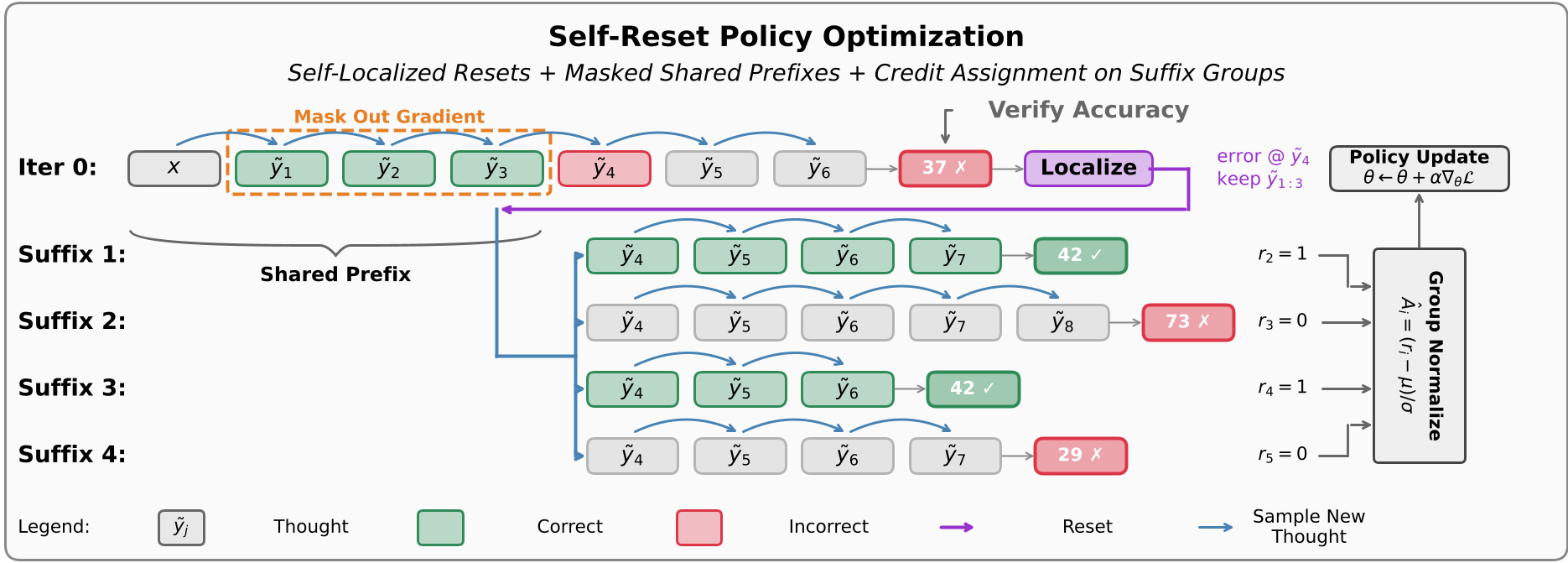 Figure 1: The SRPO workflow showing the seed rollout, self-localization, and the subsequent "shared-prefix" group reinforcement.
Mathematical Intuition: The Power of the Oracle
The authors back their method with an extension of Conservative Policy Iteration (CPI) theory. They prove that using a "Credit-Assignment Reset Oracle" (CARO) reduces sample complexity by a factor of , where is the probability of hitting an "improvable" state.
In plain English: if finding a mistake is like finding a needle in a haystack, SRPO's oracle lets you jump straight to the needle, making the learning signal much stronger than if you sampled the whole haystack randomly.
Experimental Results: Faster, Leaner, Smarter
The researchers tested SRPO on Qwen2.5-14B and OLMo-3-7B across 10 benchmarks.
- Convergence Speed: On the LiveCodeBench (coding), SRPO reached matching pass rates 2-3x faster than GRPO and RRPO (Random-Reset).
- Performance: SRPO consistently outperformed baselines in math, biology, and chemistry, proving that the localized signal generalizes across domains.
- Localization Quality: Interestingly, "clean" prefixes (where the model correctly identified the error point) corrected the final answer nearly 2x as often as erroneous localizations.
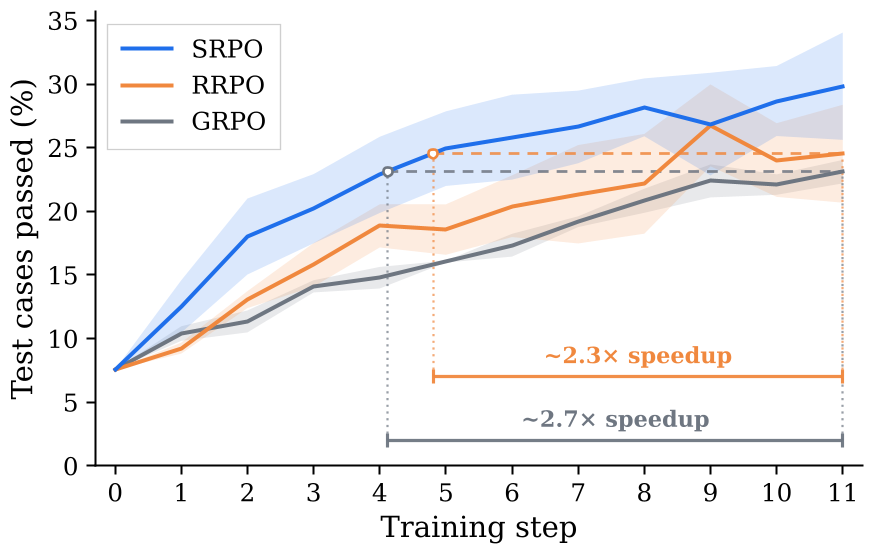 Figure 2: Validation curves comparing SRPO against GRPO and RRPO. Note the significantly steeper learning curve for SRPO.
Critical Analysis & Conclusion
SRPO marks a shift from "brute-force" RL to "intelligent" RL. By leveraging the model's internal world-model to guide its own training, we reduce the reliance on expensive human-annotated step-by-step rewards (PRMs).
Limitations:
- The method relies on verifiable rewards (e.g., math/code results). Extending this to creative writing or subjective "alignment" is still an open challenge.
- Localization Bottleneck: The performance is bounded by the model's ability to recognize its own errors. If the model is too small to spot its mistakes, SRPO reverts to a more random behavior.
Future Outlook: The success of SRPO suggests that the next generation of LLM post-training will involve tighter loops of self-critique, backtracking, and internal simulation—moving the "Reasoning" capability of models like o1 into the actual training process itself.