
Strategizing Credit: Leveraging Data Mining for Precision Marketing in Banking
Credit Card Customer Segmentation and Target Marketing Based on Data Mining
This paper presents a data-driven framework for credit card customer segmentation and predictive modeling using real data from a Chinese commercial bank. The researchers utilize K-means clustering to segment customers into four distinct value tiers and evaluate four mining algorithms (C5.0, Neural Network, CHAID, and C&R Tree) to predict customer types and generate actionable marketing rules.
TL;DR
In the competitive landscape of Chinese retail banking, blindly issuing credit cards leads to "sleeping accounts" and wasted resources. This research utilizes K-means clustering and the C5.0 decision tree algorithm to segment over 65,000 customers into value tiers. By extracting clear "if-then" rules, the study provides a roadmap for banks to identify high-value targets and mitigate risks with surgical precision.
Background & Motivation: Moving Beyond "Quantity Over Quality"
The Chinese credit card market has historically prioritized the volume of cards issued. However, this "blind issuance" has led to a stagnant ratio of active cards and poor risk management. The authors argue that bank resources are limited; therefore, the core challenge is to identify which customers drive profit (High Income/High Consumption) and which pose a threat to the bottom line (Bad Credit/Low Income).
Methodology: The Two-Stage Mining Architecture
1. Customer Segmentation (Clustering)
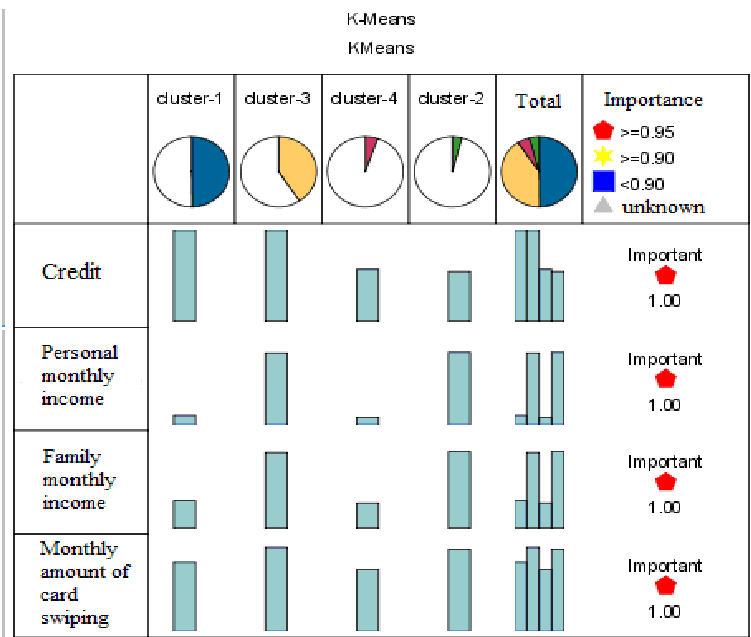
The researchers defined three critical dimensions for clustering:
- Income Tier: Monthly personal and family income.
- Consumption Power: Average monthly card swiping amount.
- Credit Score: A synthesized metric derived from seven variables (e.g., overdue records, frozen accounts, bad debt).
Using K-means, they categorized the population into four clusters, as visualized in the model output.
2. Predictive Modeling (Classification)
To predict which segment a new applicant belongs to, the authors compared four algorithms:
- C5.0: A decision tree algorithm known for high efficiency and rule generation.
- Neural Network: High performance but lacks "explainability."
- CHAID & C&R Tree: Alternative tree-based methods.
Crucially, they implemented a Balance Node to handle the data imbalance (as Cluster 2 and 4 were much smaller than 1 and 3), ensuring the model didn't become biased toward the majority classes.
Experimental Results: Accuracy vs. Interpretability
The performance comparison across the four models revealed a classic trade-off in machine learning:
| Algorithm | Training Set Accuracy | Testing Set Accuracy |
|---|---|---|
| Neural Network | 92.22% | 91.93% |
| C5.0 | 88.64% | 88.11% |
| CHAID | 81.38% | 81.24% |
| C&R Tree | 79.62% | 79.51% |
While Neural Networks were the most accurate, the authors chose C5.0. Why? Because in banking, a "Blackbox" result is less useful than a set of logical rules. C5.0 allowed the extraction of 52 "if-then" regulations that marketing teams can actually read and use.
High-Value Insights: The "If-Then" Rules
The study concludes with actionable archetypes:
- High-Quality Rule:
IF (Income > 6000) AND (Family Size < 7) AND (Age 45-59) THEN "High Quality". (Confidence: 99.5%) - Potential High-Quality Rule: This group features high income but low usage—often influenced by lifestyle factors (e.g., the study interestingly notes the "Aquarius" constellation as a variable in one particular rule, though this may be a correlation specific to this dataset).
- Unfavorable Rule:
IF (Income < 2000) AND (Age < 35) AND (Lives with Parents) THEN "Unfavorable".
Critical Analysis & Conclusion
Takeaway
The real strength of this paper is the transition from unsupervised learning (clustering) to supervised learning (classification) to generate practical business logic. It proves that for target marketing, interpretability is just as important as accuracy.
Limitations
The inclusion of "Constellation" and "Religious Belief" as variables might introduce noise or ethical concerns in a modern deployment. Furthermore, while the model solves for static segmentation, it does not yet address dynamic behavioral changes over time (e.g., a "Common" customer becoming "High Quality" due to a career change).
Future Outlook
Future iterations could benefit from Ensemble methods (like Random Forests) to boost accuracy while maintaining some level of feature importance transparency, or Time-Series analysis to predict customer value evolution.