
Credulous Users: The Hidden Engine of Fake News on Twitter
Credulous Users and Fake News: a Real Case Study on the Propagation in Twitter
This study characterizes "credulous users" on Twitter—human accounts following a disproportionately high number of bots—and investigates their role in fake news propagation. By analyzing the FakeNewsNet dataset, the authors demonstrate that these users are significantly more involved in spreading misinformation than non-credulous human users across both political and gossip topics.
TL;DR
While bots are often blamed for misinformation, this study reveals that a specific subgroup of humans—Credulous Users—are the primary vehicles for fake news propagation. By identifying users who follow a high percentage of bots, researchers found they are responsible for the vast majority of human-led fake news sharing, suggesting that monitoring these "vulnerable" accounts is the key to stopping viral disinformation.
The Missing Link in Misinformation
The academic "arms race" against fake news has traditionally focused on two fronts: 1) Bot Detection (killing the source) and 2) NLP Content Analysis (identifying the lie). However, these methods often ignore the medium: the human users who believe and retweet.
The authors argue that certain users are "credulous"—they have a high exposure to bots (high percentage of bot-followees) and thus act as amplifiers. Why does this matter? Because a fake news story shared by a human often carries more social weight and is harder for platforms to censor than one shared by a bot.
Methodology: Identifying the "Credulous"
The researchers utilized a three-task pipeline to isolate these users within the FakeNewsNet dataset, covering Politics (PolitiFact) and Gossip (GossipCop).
- Author Identification: Extracting profiles of 536,513 Twitter accounts.
- Bot vs. Human: Using a Random Forest classifier with 98.41% accuracy to filter out automated accounts.
- Credulous Classification: Human users were categorized as credulous based on their social graph (ratio of bots they follow). The study employed an ensemble of 8 specialized classifiers to handle data imbalance.
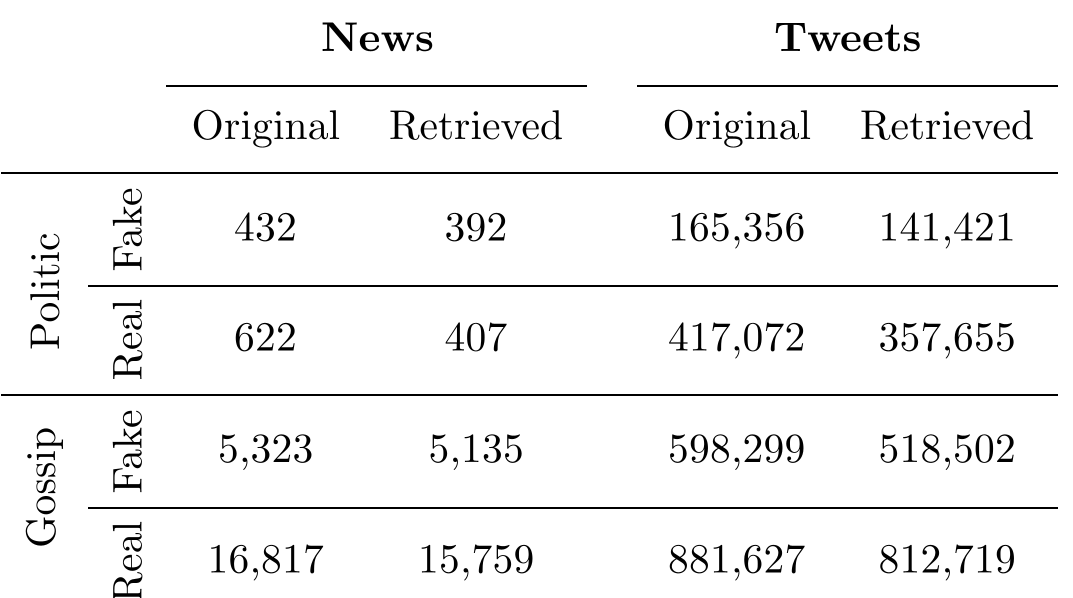 Table 1: The structure of the FakeNewsNet data used, highlighting the massive scale of Gossip vs. Political news.
Key Insights: How Credulous Users Behave
The results provide concrete evidence that credulous users are not just "unlucky," but are fundamentally more active in the misinformation ecosystem.
1. Topic Matters
In Politics, credulous users covered 95% of all retrieved fake news. In Gossip, the sheer volume of misinformation shared by credulous users was nearly double that of non-credulous users. This suggests that certain "low-stakes" topics (gossip) might be used to prime users for susceptibility in "high-stakes" areas (politics).
2. High Intensity Sharing
It isn't just that there are more credulous users; they tweet more frequently. In the gossip category, the average number of fake tweets per credulous user was significantly higher than for real news, indicating a "pull" toward sensationalist, false content.
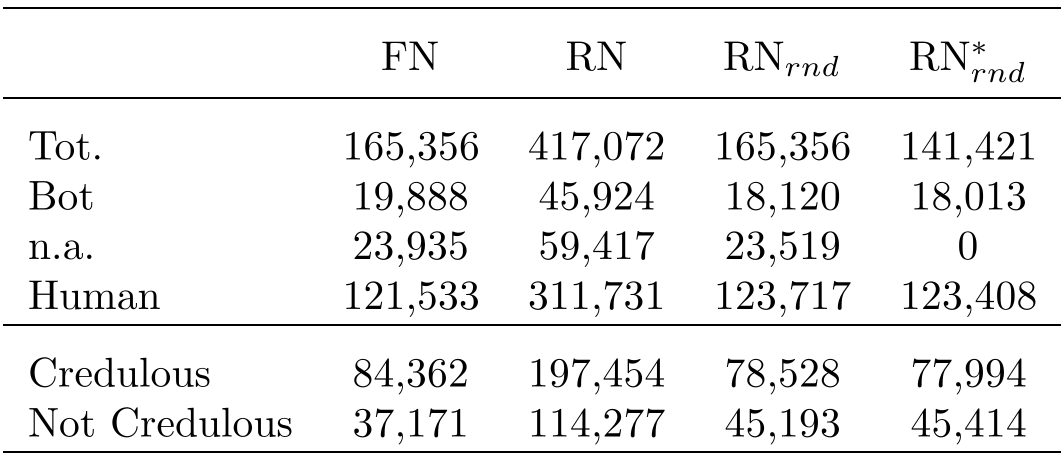 Table 5: User participation in Political news. Note how Credulous users dominate the 'FN' (Fake News) column compared to Not-Credulous humans.
A New Shield: Monitoring the Vulnerable
The study concludes with a radical recommendation for Social Media (OSM) administrators: Targeted Fact-Checking.
Instead of trying to scan every tweet on the platform—an impossible task—systems should "listen" specifically to the data streams of identified credulous users.
- Efficiency: Reducing the pool of human accounts to audit.
- Slowing Propagation: By delaying retweets from highly credulous accounts during breaking news events, platforms can "quarantine" potential fake news before it reaches a critical mass.
Critical Analysis & Future Outlook
While the study is robust, it relies on bot detection (Botometer) as its ground truth for "credulousness." If bot detection fails, the credulous classification fails. Furthermore, the study doesn't dive deep into why these users follow bots—is it a lack of digital literacy, or a shared political bias?
Takeaway: The "Credulous User" metric is a powerful new coordinate in the misinformation landscape. Future research must now look at how to educate these users, rather than just monitoring them, to break the bot-human-misinfo loop.