
Critical Mass: The Physics of Social Network Valuation
Critical mass and willingness to pay for social networks
This paper introduces a formal mathematical framework for "critical mass" in social networks using percolation theory on a Bethe lattice. It defines the point of self-sustaining growth as a physical phase transition and establishes that a network's willingness to pay (WTP) follows a logarithmic scaling, effectively refuting Metcalfe’s and Reed’s Laws in favor of the Odlyzko-Tilly estimation.
TL;DR
Why do some social networks explode into global phenomena while others wither in obscurity? This paper moves beyond vague business metaphors to define Critical Mass as a literal physical phase change. By applying Percolation Theory, the research demonstrates that a network's value doesn't just grow with users (Metcalfe); it transforms fundamentally once it hits a specific mathematical threshold, shifting from isolated clusters to a "Giant Cluster."
The Valuation Crisis: Sarnoff vs. Metcalfe vs. Reed
For decades, we’ve used "Laws" to guess what a network is worth:
- Sarnoff’s Law: Value (Broadcast logic).
- Metcalfe’s Law: Value (The Dot-com era's favorite).
- Reed’s Law: Value (The "power of coalitions").
The problem? These models often lead to massive overvaluation or fail to account for the "tipping point." This paper argues that below a certain probability of connection, the network is worth effectively zero because users are trapped in isolated "islands" of interest.
Methodology: The Bethe Lattice and Percolation
The author uses a Bethe Lattice—a connected acyclic graph where every node has a maximum number of contacts ().
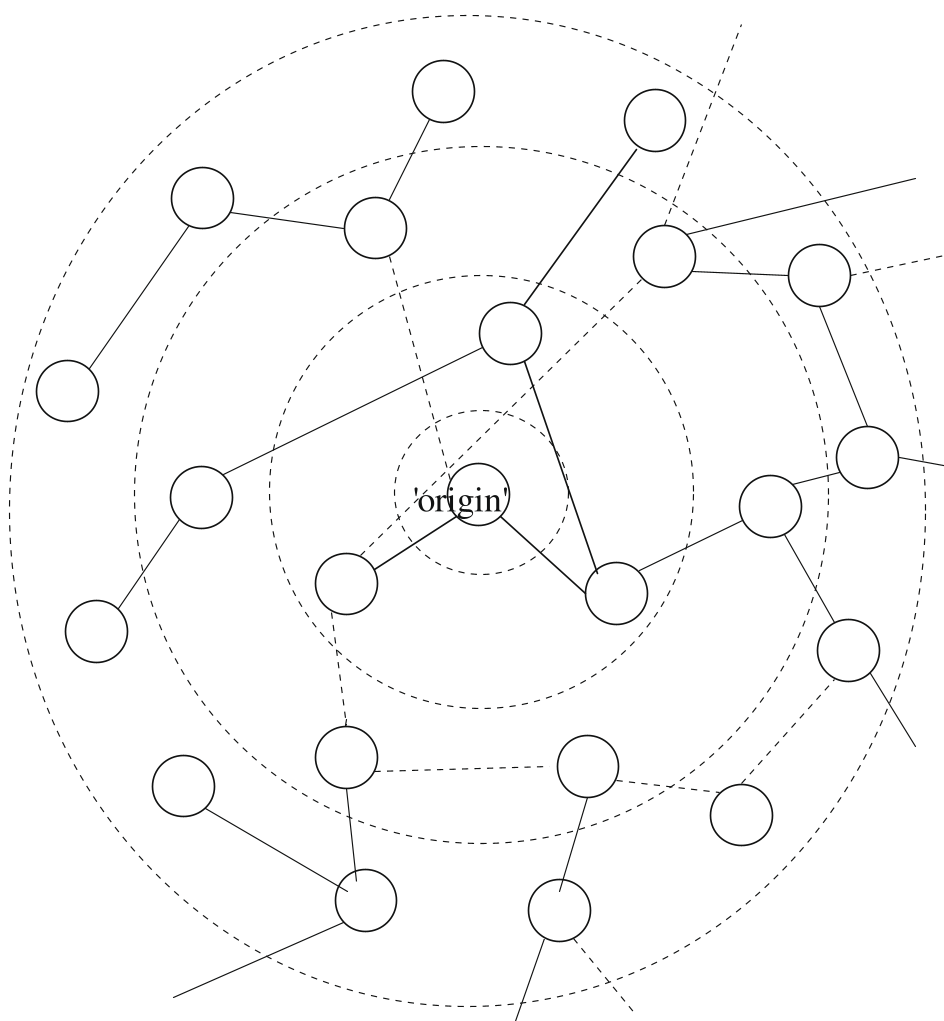 Fig 1: A visualization of network generations centered around an 'origin' node. Solid lines represent accepted invitations.
The core insight is the Phase Change:
- Pre-Critical Mass (): Connections are sparse. The network consists of "open islands in a closed sea." The probability of an arbitrary member reaching the rest of the network is zero.
- At Critical Mass (): A "Giant Cluster" suddenly forms. This is the "Critical Mass."
- Post-Critical Mass (): The network becomes self-sustaining. The value is driven by Germanity ()—the likelihood that any new member will instantly connect to the main conversation.
Experimental Proof: The Facebook Evidence
To test the theory, the author analyzed real-world Facebook ego-networks. As individuals gain more friends, the distribution of their "friend-clusters" changes.
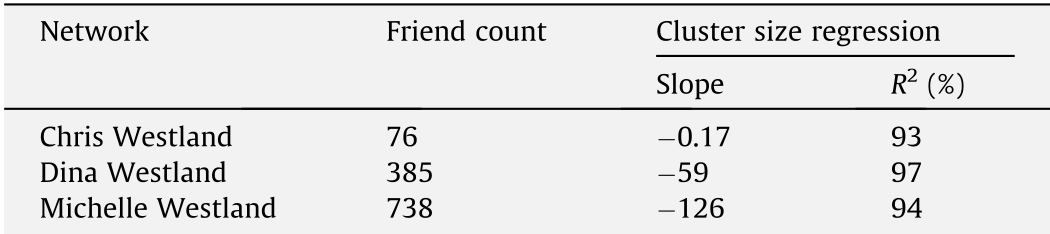 Table 1: As friend counts increase from 76 to 738, the regression slope steepens, showing the emergence of a dominant cluster.
The data supports a Power Law transition. Just before a network hits critical mass, the number of special interest groups follow the Fisher Exponent (). Once the "Giant Cluster" appears, it defines the culture and topical standards of the entire platform.
Strategic Insights for Managers
- Quality over Quantity: Targeted invitations (maximizing the probability of acceptance ) are vastly superior to "spamming" (maximizing ). Because humans have a cognitive limit (Dunbar’s Number ), you cannot simply grow infinitely.
- Adaptive Identity: Management should not "lock in" the network’s topic too early. The network’s true identity isn't settled until the Giant Cluster forms.
- Willingness to Pay (WTP): The study confirms the Odlyzko and Tilly estimate: value scales roughly as . It’s more than Sarnoff, but significantly less than the "irrational exuberance" of Metcalfe's .
Critical Insight & Future Outlook
This work provides a "stress test" for social platform investments. By calculating the Germanity of a network, investors can distinguish between a collection of fragmented users and a truly unified social force.
Limitations: The model assumes an acyclic graph (no "friend-of-a-friend" loops). In reality, social networks are full of cycles, which likely makes clustering even more intense and path lengths even shorter than this model predicts. Future research into "Small World" phenomena will be the next step in refining these physical laws of the social web.