
Critical Race Theory for HCI: Dismantling the Myth of Neutral Design
Critical Race Theory for HCI
This seminal paper introduces and adapts Critical Race Theory (CRT) for the Human-Computer Interaction (HCI) community, providing a theoretical framework to analyze race-conscious efforts in research and institutional practice. It challenges the field's meager progress in racial diversity and identifies how socio-technical systems and neoliberal technology industry structures propagate systemic racism.
TL;DR
"Critical Race Theory for HCI" is a call to action that challenges the Human-Computer Interaction community to stop viewing racism as a peripheral "diversity issue" and start seeing it as a fundamental feature of socio-technical systems. By adapting the tenets of Critical Race Theory (CRT), the authors argue that racism is ordinary, structural, and often reinforced by the very technologies we design to be "inclusive."
The "Color-Blind" Fallacy in Tech
Innovation is rarely neutral. In the academic and corporate tech spheres, the dominant philosophy is often a form of "liberal universalism"—the idea that if we design for the "average" user and ignore race, we achieve equality.
The authors argue that this perspective is not only flawed but dangerous. When we claim "not to see color," we ignore the historical and material realities that shape how different people interact with technology. From Nikon cameras failing to recognize Asian eyes to search algorithms returning mugshots for Black teenagers, the "ordinariness" of racism is baked into our digital world.
Methodology: The Power of Counter-Storytelling
One of the most striking aspects of this paper is its departure from traditional, detached academic writing. The authors use Storytelling as a core methodology, presenting nine personal narratives that expose the friction points where race and HCI collide.
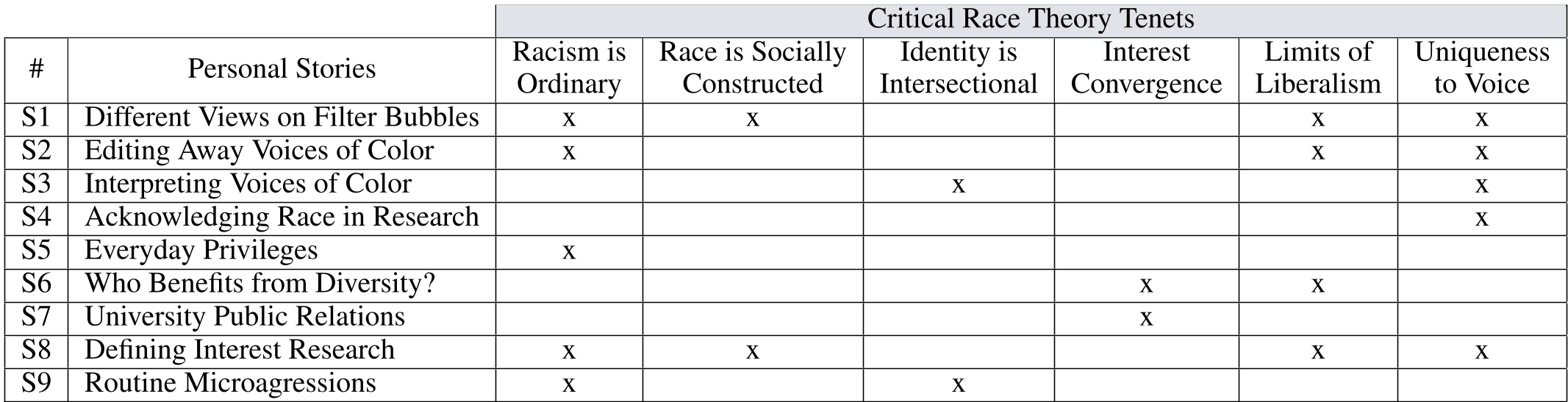
These stories reveal a "backstage racism" in the academy:
- Gatekeeping Reality: Reviewers asking researchers to "clean up" vernacular English in quotes, effectively erasing the authentic voices of participants of color.
- Interest Convergence: Organizations promoting diversity only when it generates positive PR or serves a market interest, while the actual material metrics (leadership diversity) remain stagnant.
Adapting CRT Tenets to Computing
The paper masterfully translates legal theory into design provocations:
- Racism is Ordinary (Not Aberrational): It is a systemic feature of our society. Therefore, any technology built on top of this society without active anti-racist intervention will inevitably be racist.
- Interest Convergence: Real progress toward racial justice in tech is often halted as soon as it competes with the bottom line or the status quo of those in power.
- Uniqueness of Voice: Researchers of color bring "double consciousness" to HCI, identifying issues that White researchers—blinded by their own privilege—frequently miss.
 (Image: The researchers advocate for a radical shift in how we position the researcher's identity in the design process.)
Experimental Results: The Diversity Gap
The paper doesn't just theorize; it presents uncomfortable data regarding the HCI community's leadership.
- CHI Academy Statistics: Out of 133 recognized leaders, 93% are White.
- Representation: There remains a 0% representation of Black or African descent individuals in the Academy, highlighting a massive disconnect between the community's "progressive" self-image and its actual demographics.
Deep Insight: A Call to Action
The authors provide clear implications for the future of the field:
- Reject Deficit Narratives: Stop designing for communities of color as if they are "lacking" and instead recognize their creative agency.
- Institutional Accountability: SIGCHI and major tech conferences must track material metrics (who is getting funded, who is getting published, who is on stage) and not just settle for "Diversity & Inclusion lunches."
- Other-Consciousness: When writing papers, authors should imagine how a reader from a marginalized community would perceive their work, rather than only optimizing for the "mainstream" reviewer.
Conclusion: Beyond Performative Inclusion
"Critical Race Theory for HCI" reminds us that we are complicit in the systems we build. If we continue to treat race as a discrete variable to be "solved" by better training data or a more diverse recruitment team, we fail to address the underlying power structures. To be truly human-centered, HCI must first be race-conscious.
Limitations: The paper focuses primarily on the U.S. context, which the authors acknowledge. Future work must bridge these CRT tenets with global perspectives on ethnicity and post-colonialism.