
Beyond Static Diagnosis: The Quest for Dynamic Predictive Models in Medicine
A Critical Review for Developing Accurate and Dynamic Predictive Models Using Machine Learning Methods in Medicine and Health Care
This paper provides a critical review of machine learning (ML) applications in medical predictive modeling, specifically focusing on patient outcomes in healthcare. It categorizes core ML methodologies—such as ANN, SVM, and DT—and highlights the inconsistency in predictive accuracy across different models even when trained on identical clinical datasets.
TL;DR
The medical field is at a crossroads where Artificial Intelligence (AI) promises to revolutionize patient prognosis. This critical review by Alanazi et al. evaluates the current state of Machine Learning (ML) in healthcare, revealing a significant problem: different models produce wildly inconsistent results on the same datasets. The authors argue that while ML outperforms traditional statistics, the industry lacks a "dynamic" gold standard for real-time clinical decision-making.
The "Precision" Gap in Medical AI
In medicine, timing is everything. A physician's ability to predict a patient's outcome—be it brain death, recovery from trauma, or disease progression—determines the course of treatment. However, existing prior work often relies on static models that fail to adapt to the fluid nature of patient health.
The core insight of this review is that the "subjectivity" of human diagnosis can be reduced through ML, but only if we overcome the current landscape of conflicting model performances.
Methodology: The ML Toolbox for Doctors
The paper meticulously breaks down the architectures currently dominating medical research. Each method serves a specific "inductive bias" in clinical settings:
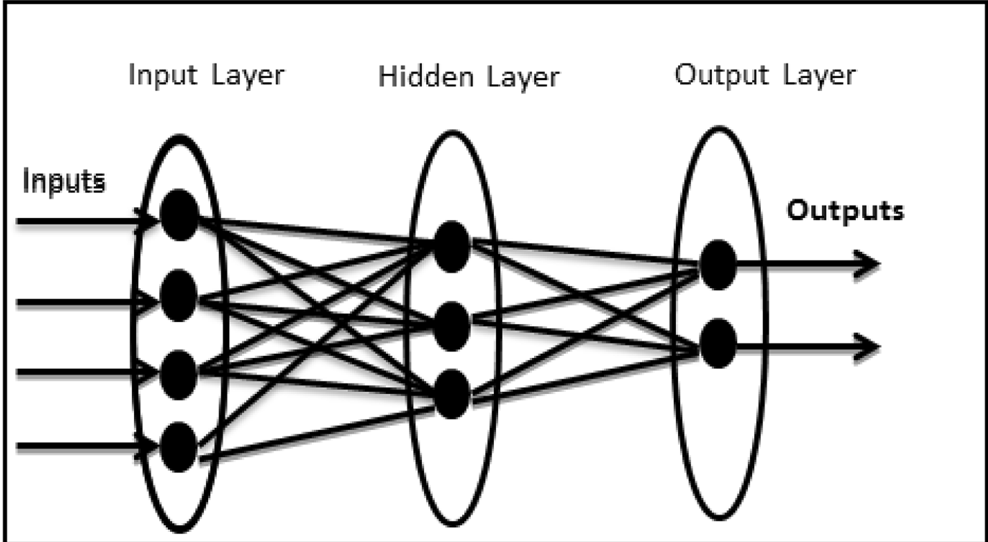
- Artificial Neural Networks (ANN): Pattern recognition powerhouses. As shown in the study, they excel at mapping non-linear relationships in complex data like ECGs or brain scans.
- Support Vector Machines (SVM): The kings of binary classification (e.g., "Cancer" vs. "Healthy"), utilizing the "kernel trick" to handle high-dimensional patient data.
- Decision Trees (DT) & Logistic Regression (LR): Favored for their "interpretability"—doctors can actually follow the logic path to a conclusion.
Architectural Overview
The following diagram illustrates the standard ANN structure frequently employed in the reviewed studies to process inputs like GCS scores and age to predict patient mortality.
The Performance Paradox: A Critical Look at Results
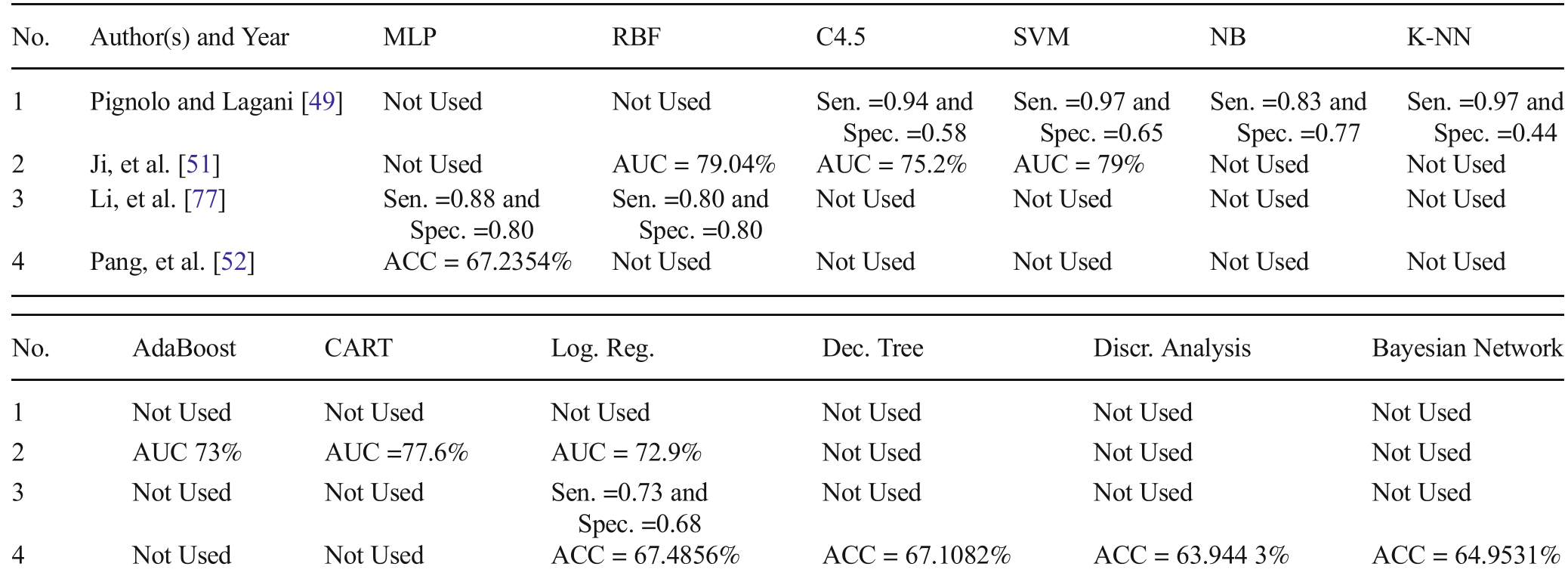
The most striking finding of this review is the lack of consensus. For example:
- Ji et al. claimed ANNs were the most accurate (79.04%).
- Pignolo and Lagani found that only SVMs were appropriate for clinical use in vegetative state prognosis.
- Zhao et al. conversely found that ANNs and DTs outperformed SVMs in T-cell prediction.
The authors provide a comparative table (Table 1) highlighting these discrepancies:
Intellectual Insight: Why Methods Clash
The review concludes that ML accuracy is highly sensitive to the quality and type of dataset. A model that achieves 91% accuracy in one hospital (e.g., Güler et al.) may fail in another due to variations in demographic data or "missing values," to which algorithms like DT and LR are particularly sensitive.
The authors distinguish ML from statistics by noting that while statistics tests a hypothesis, ML builds and stores knowledge. The future of medicine lies in making this knowledge "dynamic"—able to update as new patient data flows in.
Final Takeaway & Future Outlook
The healthcare sector is no longer questioning if AI should be used, but which AI is most reliable. This review serves as a call to action for researchers to move toward hybrid models that combine the strengths of different architectures.
Limitations: The paper identifies that current models often lack "external validation" (testing on datasets from different geographical regions), which remains a hurdle for global medical AI adoption.
Future Work: The next step is the development of a "unified dynamic model" that provides real-time updates to prognosis as a patient's vital signs change in the ICU.