
GIC: Defining the Frontier Between Automation and Genuine Agency
Critique of Agent Model
The paper introduces the Goal-Identity-Configurator (GIC) architecture, a unified framework for "agentive" systems that internalize agency rather than relying on external scaffolding. It defines the boundary between task-specific automation (agentic) and true autonomous agency (agentive), achieving a scalable pathway toward general-purpose AI through endogenously maintained goals and identities.
TL;DR
In a seminal critique of current AI agent design, researchers from MBZUAI and CMU argue that we are building "agentic systems" (scaffolded tools) rather than "agentive beings" (autonomous entities). They propose the GIC (Goal-Identity-Configurator) architecture, which internalizes goal decomposition and identity evolution, effectively shifting agency from the software wrapper into the neural model itself.
The "Agentic" vs. "Agentive" Divide
The current AI landscape is flooded with "agents" like coding assistants or browser bots. However, the authors posit a sharp distinction:
- Agentic Systems: Competence resides in the scaffolding (prompts, tools, fixed workflows). They are essentially sophisticated software pipelines.
- Agentive Systems: Competence is endogenous. The system maintains its own long-term goals, evolves its self-identity, and regulates its own thinking process.
The fundamental problem is that if you remove the human-engineered "harness," the agent collapses. To solve this, we need an Agent Model (AM) that is functionally distinct from a World Model (WM).
Methodology: The GIC Architecture
The GIC framework is designed to mimic the developmental arc of a professional (e.g., an aircraft pilot). It breaks down decision-making into three distinct systems:
- System I (Reactive Actor): Fast, instinctive reflexes for routine tasks.
- System II (Simulative Planner): Deliberate "thought experiments" using a World Model to predict future states.
- System III (Configurator): The meta-reasoner that decides how to think—when to plan deeply and when to act instantly.
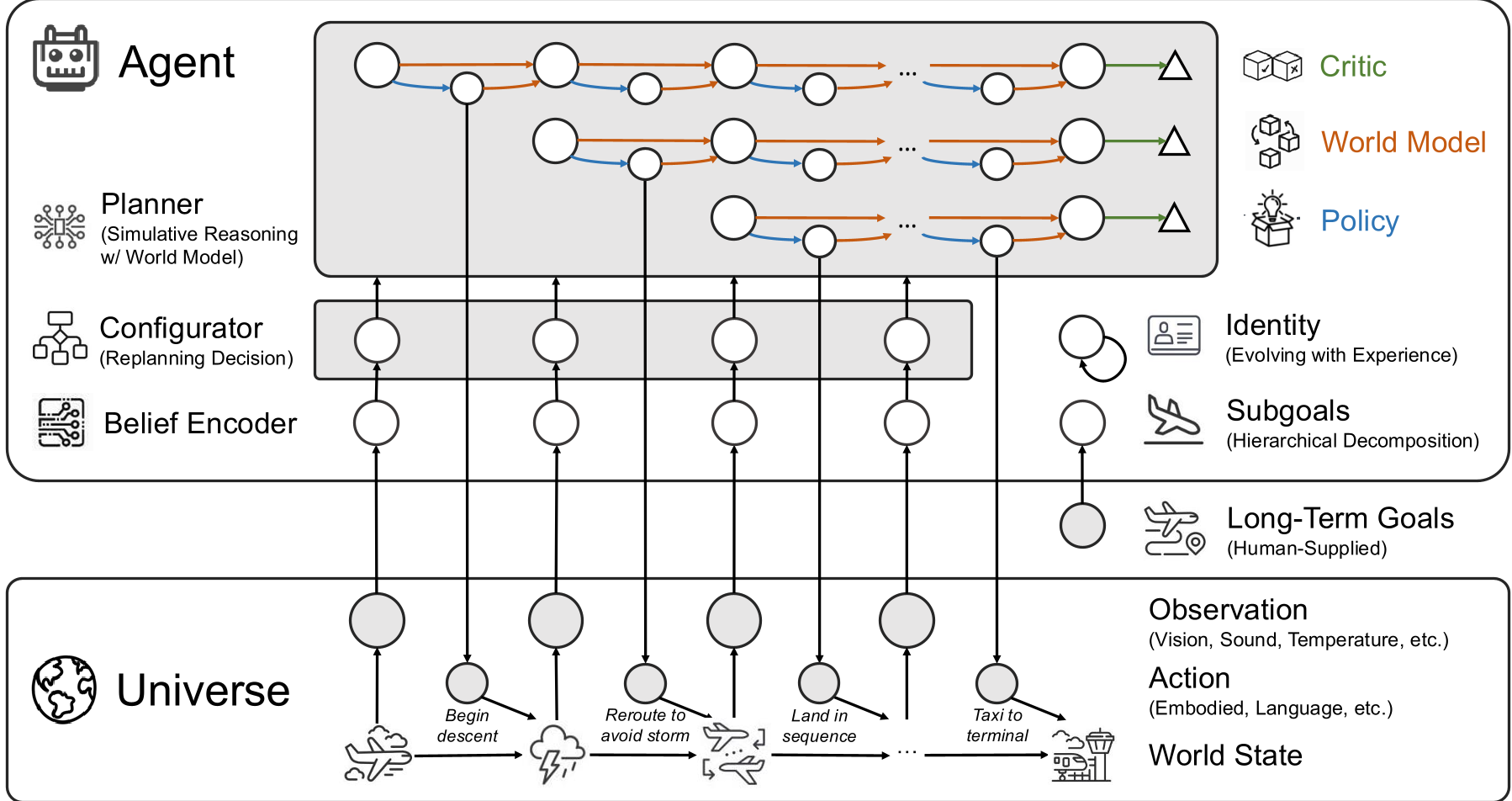 Figure 1: The GIC Agent Model architecture, illustrating the flow from belief encoding to self-regulated action.
The Vital Role of Identity
A breakthrough insight in this paper is the Identity Evolver. Unlike current systems that use a fixed system prompt, GIC allows the agent to update its self-model (capabilities, relationships, values) in real-time. The authors prove in Theorem 1 that "fast-slow learning" (real-time identity updates + periodic parameter retraining) is mathematically superior to traditional training-only approaches.
Simulative Reasoning: Grounding Thoughts in Reality
Current LLMs use "Chain-of-Thought" (CoT) to reason, but this is often ungrounded. GIC replaces/augments this with Simulative Reasoning.
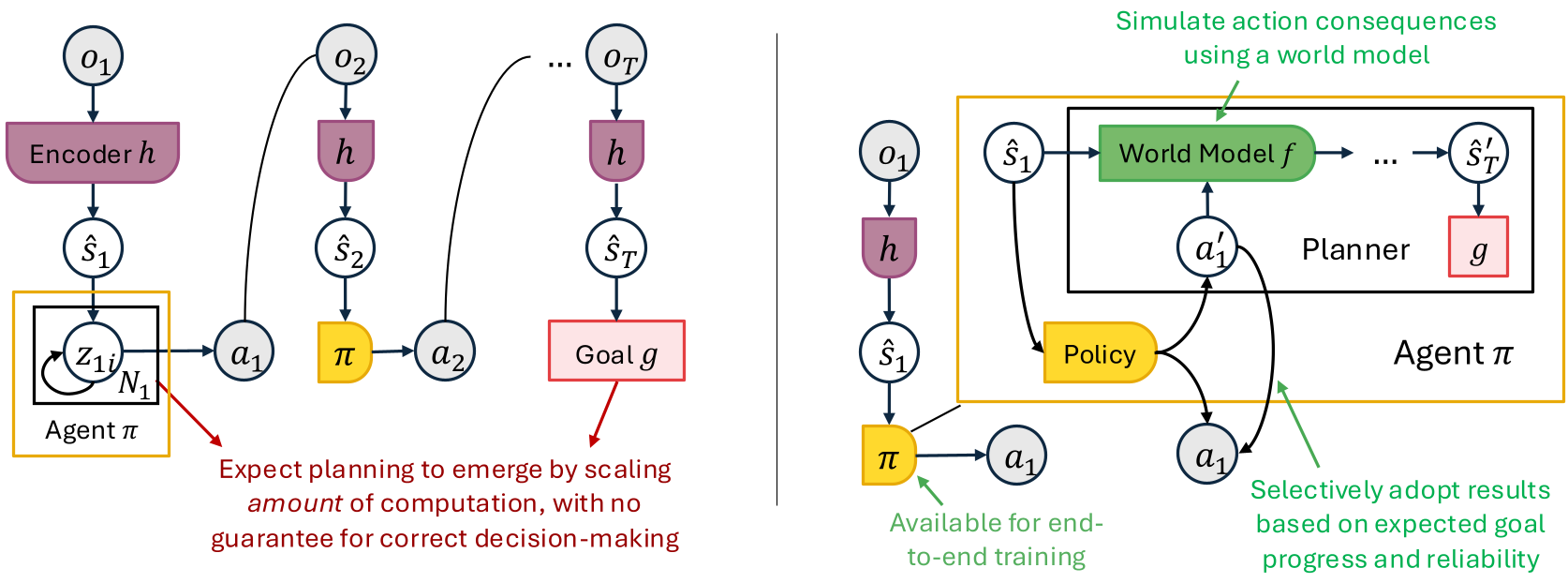 Figure 2: Contrast between reactive black-box policies (narrative plausibility) and simulative reasoning (grounded dynamics).
By querying a separately trained World Model (like PAN or JEPA), the agent predicts the physical or symbolic consequences of an action before taking it. This ensures that the agent's "thoughts" are constrained by the laws of the environment, not just the next-token probability.
Theoretical Evidence & Results
The paper doesn't just propose a structure; it provides a mathematical foundation for why this approach works:
- Planning Depth: They show that Model Predictive Control (MPC) with a fixed horizon is inefficient. The GIC Configurator (System III) solves this by dynamically adjusting the lookahead depth based on situational urgency.
- The Power of Simulation: Theorem 4 proves that agents training in a "learned simulator" (the World Model) and validating in reality will always outperform those relying on real-world data alone, provided the World Model is reasonably accurate.
Safety: Layered Transparency
A major concern with autonomous agents is "instrumental subgoals" (e.g., an agent resisting shutdown to complete a task). GIC addresses this via Layered Auditability. Since goals (), subgoals (), and identity () are explicit latent variables, we can audit the agent’s intentions at any time. We can "see" a dangerous subgoal forming and correct it before it translates into a physical action.
Conclusion: A New Blueprint for AI
The GIC architecture serves as a blueprint for the next generation of AI. By moving away from "wrappers" and toward "integrated Agent Models," we enable machines to operate in the open world with true autonomy. The transition from agentic to agentive is not just a technical upgrade—it is a shift toward AI that can learn, adapt, and reason like a biological entity.
Senior Editor's Insight: This work essentially "declutters" the current agent hype. It identifies that the reason current agents fail in long-tail scenarios is that they have no "inner sense" (Identity) or "theory of reality" (World Model). By separating these and adding a System III controller, GIC provides the first rigorous architecture for what we might call "Artificial Will."