
Decoding the Generative Gap: Cross-Corpus EEG Emotion Recognition
CROSS-CORPUS EEG-BASED EMOTION RECOGNITION
The paper investigates the generalization capabilities of EEG-based emotion recognition across different datasets (MAHNOB-HCI, DEAP, and a new dataset, DAI-EF). The authors propose a 3D convolutional neural network (CNN) architecture using multi-band spectral topography maps to improve cross-corpus performance and transfer knowledge between domains.
TL;DR
Is your AI actually reading emotions, or just memorizing the video clips the subjects watched? This paper explores the "Cross-Corpus" challenge in EEG-based emotion recognition. By testing models across three different datasets (including the new DAI-EF), the authors reveal a significant performance collapse in traditional methods and propose a Multi-band CNN approach that leverages Transfer Learning to bridge the gap between different experimental environments.
The "Dirty Secret" of EEG Affective Computing
For years, EEG-based emotion recognition has boasted high accuracy. However, most of these results are "Subject-Dependent" or "Within-Dataset." When you take a model trained on Dataset A and test it on Dataset B, the accuracy often plummets to chance.
The authors identify three main components that EEG models accidentally learn:
- True Emotional Activity: Brain signals directly related to affect.
- Sensory Activity: Brain responses to specific stimuli (e.g., the colors in a movie or the rhythm of music).
- EMG Artifacts: Muscular electrical activity from facial expressions.
The motivation here is clear: to build an emotion recognizer that works in the real world, we need to separate the "emotional signal" from the "experimental noise."
Methodology: Mapping the Brain as an Image
To tackle the inconsistency across datasets, the researchers moved beyond simple feature vectors. They treated the brain's electrical activity as a multi-layered image.
1. Spectral Topography Maps
Instead of just using Power Spectral Density (PSD) values, they interpolated these values onto a 32x32 grid based on the actual physical locations of the electrodes (10-20 system). They created six layers for each "image," representing different frequency bands:
- Delta, Theta, Slow Alpha, Alpha, Beta, and Gamma.
2. Deep Convolutional Architecture
The proposed CNN processes these topography maps to capture the spatial correlation between different brain regions.
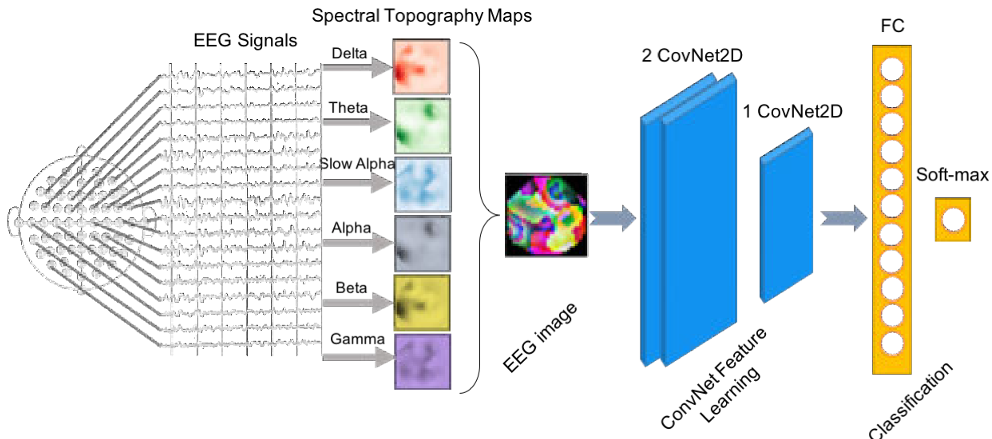 Figure 1: The CNN pipeline converting EEG signals into spectral maps for classification.
Experiments: The Hard Truth of Cross-Corpus Testing
The authors compared four major feature types: PSD, Differential Entropy (DE), High Order Crossings (HOC), and Higher Order Spectra (HOS) using a Random Forest baseline.
Key Findings:
- The Valence Dominance: Models are much better at identifying "Positive vs. Negative" (Valence) than "High vs. Low" excitement (Arousal). In cross-corpus tests, Arousal classification almost always failed.
- The Dataset Mismatch: Testing on the DEAP dataset was particularly difficult because its stimuli (music videos) differ significantly from the movie clips used in MAHNOB and DAI-EF.
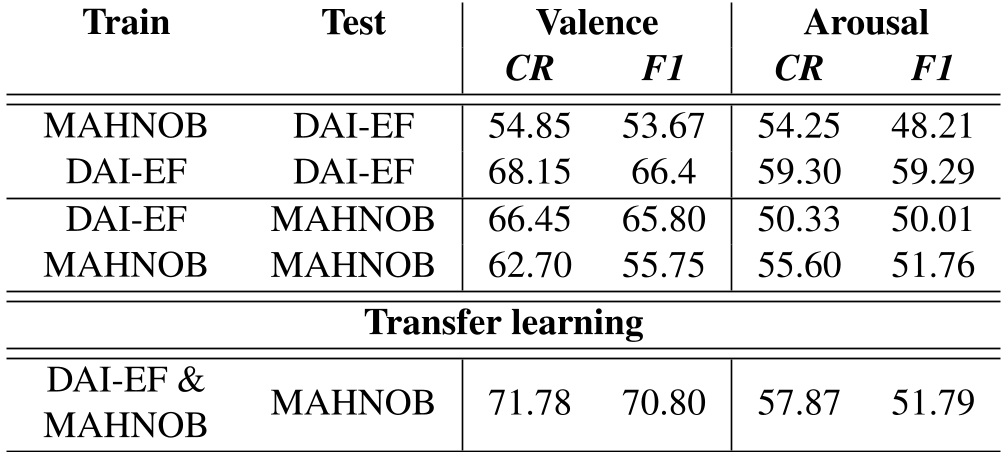 Table 1: Transfer learning results showing a significant boost (F1 70.80) when pre-training on DAI-EF and fine-tuning on MAHNOB.
Critical Analysis & Takeaways
The study proves that Transfer Learning is not just an "extra feature" but a necessity for EEG. By training on the DAI-EF dataset and fine-tuning on MAHNOB-HCI, the CNN was able to ignore dataset-specific noise and find common emotional patterns.
Limitations:
- The reliance on high-frequency bands (Beta and Gamma) suggests that models might still be picking up on facial muscle movements (EMG) rather than purely neuronal activity.
- Large datasets are required for these deep learning models to outperform simple statistical features.
Future Outlook: This work sets a new standard for EEG research: if your model doesn't work across corpora, it doesn't truly "understand" emotion. The future lies in Unsupervised Domain Adaptation and Self-Supervised Learning to further decouple sensory input from emotional state.