
The Gender Nudge: How Voice and Culture Shape Robot Persuasion
Exploring Cross-cultural Differences in Persuasive Robotics
This study investigates cultural and gender-based influences on human-robot persuasion using the NAO humanoid robot. Through a controlled experiment involving donation appeals, researchers evaluated how a robot's assigned gender (via voice and name) affects the compliance and generosity of both local Kazakhstani and international participants.
TL;DR
Can a robot's voice convince you to reach into your pocket? This study reveals that both robot gender and the cultural background of the user play pivotal roles in how persuasive a machine can be. By testing the NAO robot in a donation scenario, researchers found that female robots consistently outperform male ones in soliciting money, while international participants show a higher tendency to donate than locals.
Context: Robots as Social Influencers
Persuasion isn't just a human trait; it is a critical requirement for social robots working in therapy, education, and public service. While we might think of robots as "genderless" machines, humans are hardwired to project social categories onto them. This paper builds on the foundational work of Siegel et al. (2009) to ask: Does gender matter in persuasion, and do these psychological "nudges" work the same way in a Central Asian context as they do in the West?
The Experiment: Voice, Names, and Hard Cash
The researchers set up a "Donation Box" challenge at Nazarbayev University. Participants—ranging from local Kazakhstani citizens to foreigners from Asia, Europe, and North America—met a NAO robot that introduced itself with either a male or female voice and a corresponding name (e.g., "Ruslan" vs. "Roza").
Methodological Highlights:
- Physical Setup: An interview suite where the participant is left alone with the robot to ensure social pressure comes solely from the agent.
- The Hook: Participants are given 600 tenge (3 banknotes) to participate, which they can either keep or donate back to "the project."
- Measurement: Beyond the amount donated, the team measured Trust, Credibility, and Engagement using Likert scales.
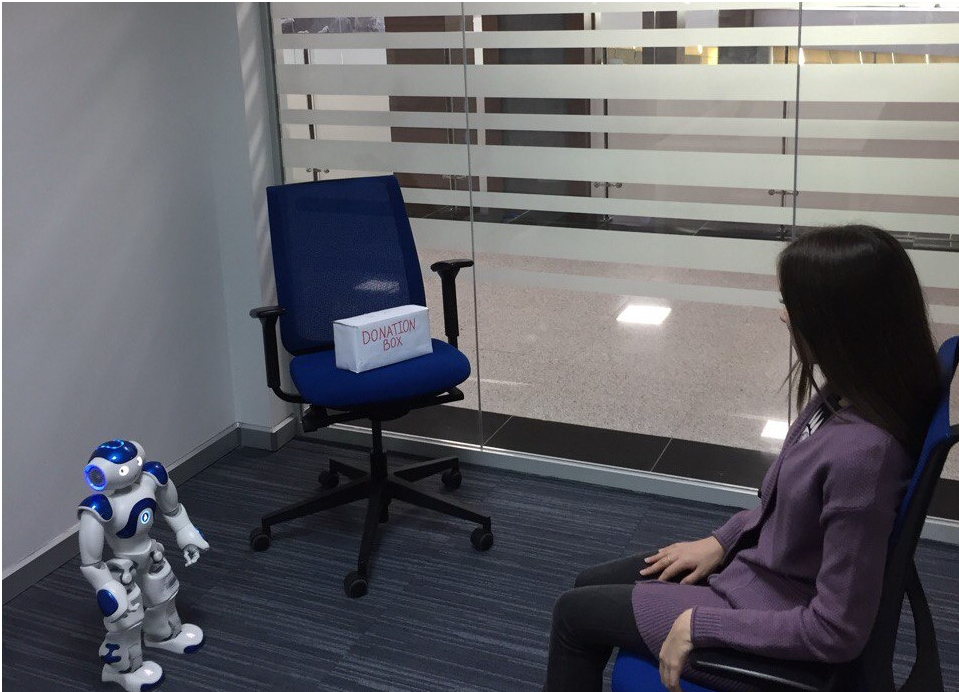 Figure 1: The experimental setup showing the NAO robot and the donation box.
Key Findings: The "Female Robot" Advantage
The data revealed a clear winner in the persuasion game.
1. The Gender Effect
The female-voiced robot was statistically more successful at soliciting funds.
- Female Robot Total: 5200 tenge (Mean: 400)
- Male Robot Total: 3200 tenge (Mean: 188) Interestingly, when participants were unsure of the robot's gender, they actually donated the most. This suggests that ambiguity might trigger a different kind of curiosity or social caution.
2. The Cultural Gap
Culture proved to be a significant variable in compliance. Foreign participants donated roughly 43% more money than local Kazakhstani participants. This "generosity gap" suggests that cultural norms regarding charity, interaction with technology, or even the perceived "novelty" of the robot might vary significantly across borders.
3. Subjective Perception
Despite the differences in donation amounts, the subjective scores for Trust and Credibility did not show a statistically significant difference (p = .071). This implies that a robot can be persuasive (getting the money) without necessarily being perceived as more "trustworthy" in a self-reported survey—a fascinating disconnect between behavior and attitude.
Critical Insight: Why Does This Work?
The study highlights that Inductive Bias is at play. Humans apply social stereotypes to robots the moment they hear a gendered voice. The preference for female robots in persuasive tasks often aligns with human-human studies where female voices are perceived as more helpful or less threatening in "ask" scenarios.
Limitations and Future Work
The study had a few "ghosts in the machine":
- The Color Factor: The NAO used was blue, a color culturally associated with masculinity in some regions, which confused 6 participants regarding its gender.
- Voice Tech: The Russian text-to-speech for locals and the English version for foreigners might have had different "warmth" qualities.
Conclusion
If you are designing a robot to collect for charity or encourage a patient to follow a medical regimen, gender matters. This research proves that while human-robot interaction is universal, our responses are filtered through both the robot's "identity" and our own cultural upbringing. For HRI designers, the takeaway is clear: don't treat gender as a cosmetic choice—it's a functional one.