
Flow Dialects: How Culture Shapes Optimal Experience in Digital Worlds
A Cross-Cultural Study of Flow Experience in the IT Environment: The Beginning
This paper presents a pioneering cross-cultural study of "Flow" (optimal experience) within IT environments, specifically focusing on MUD (Multi-User Dungeon) gamers. By comparing Russian and French player samples, the author identifies "flow dialects"—culture-specific variations in how optimal experience is structured and perceived during digital interaction.
TL;DR
Is "being in the zone" the same for everyone? This paper explores the "Flow" experience—that state of total absorption—among Russian and French online gamers. It reveals that while Flow is universal, its internal structure is culture-dependent. For Russians, Flow is a distinct, primary driver; for the French, Flow is deeply entwined with the desire for achievement.
Background: The Universal vs. The Specific
"Flow," a concept introduced by Mihaly Csikszentmihalyi, describes the holistic sensation people feel when they act with total involvement. In the IT world, this is the "holy grail" of UX design—keeping users engaged, whether they are coding, shopping, or gaming. However, Alexander E. Voiskounsky argues that we cannot assume a "one-size-fits-all" model. As the Internet is global, we must understand how different cultures experience this optimal state.
Problem & Motivation: Beyond the English-Centric View
Most IT-related Flow research has been conducted on English-speaking or Taiwanese populations. This leaves a massive gap:
- Does a Russian gamer experience the merger of "action and awareness" the same way a French gamer does?
- How do cultural histories (like the French Minitel system vs. the post-Soviet Internet expansion) influence digital behavior?
- The author suggests that "flow dialects" exist—different sets of dimensions that characterize optimal experience depending on task, competence, and cultural background.
Methodology: Comparing Russians and Francophones
The study focused on MUDs (Multi-User Dungeons), the text-based ancestors of modern MMORPGs. These games are perfect for studying Flow because they require high cognitive skills and imagination, leading to deep immersion despite lacking modern graphics.
The Factor Models
The researchers used factor analysis to map out the psychological landscape of players:
- Russian Sample (N=347): A complex 6-factor structure.
- French Sample (N=203): A simplified 3-factor structure.
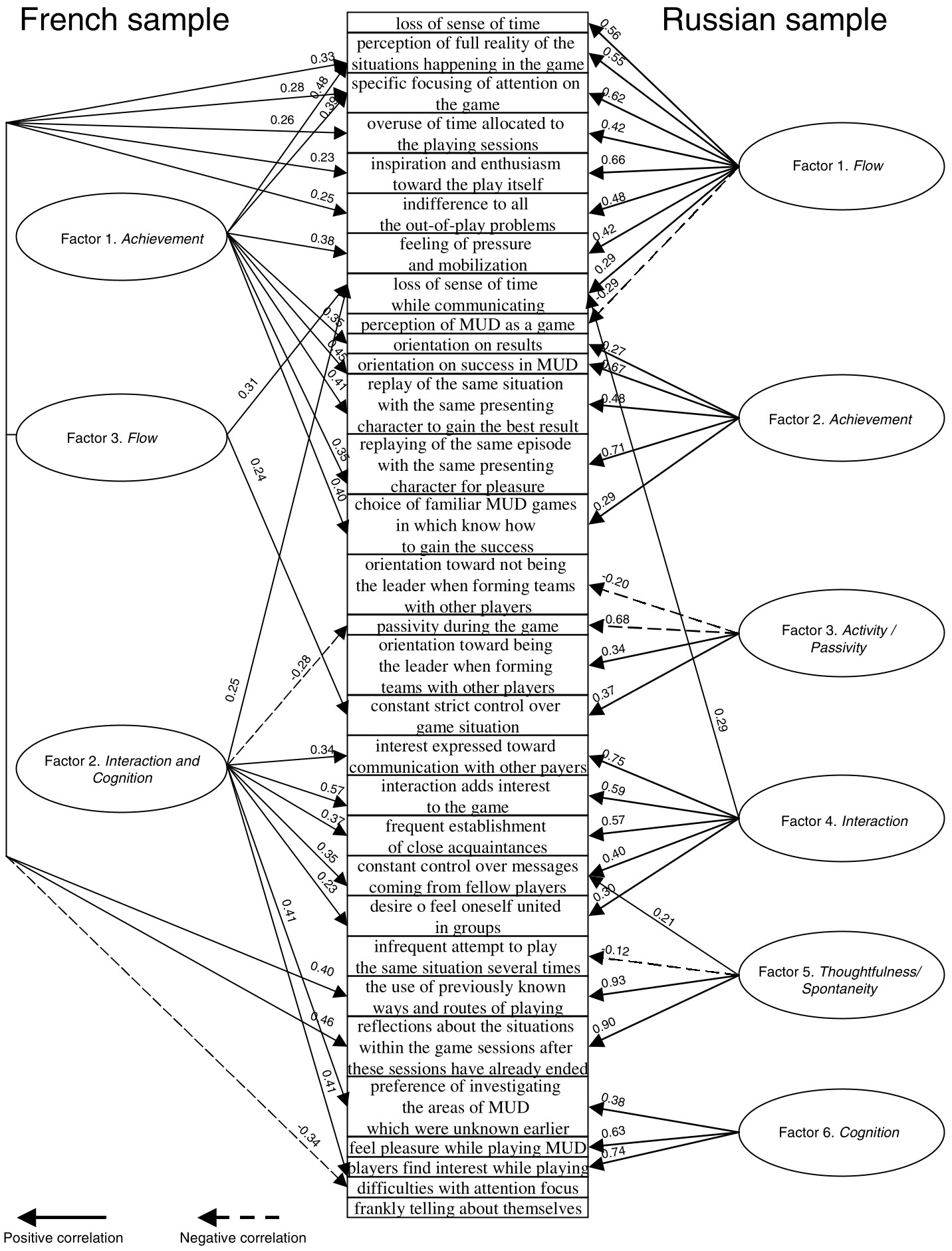
Deep Insight: Achievement vs. Flow
The most striking finding was the relationship between Achievement and Flow:
- For the French: "Achievement" was the dominant factor. Interestingly, it swallowed up several Flow characteristics like "focused attention" and "mobilization." To a French player, the feeling of Flow is part of the feeling of succeeding.
- For the Russians: "Flow" stood as its own independent, major factor. Furthermore, Russians maintained a clear distinction between "Cognition" (learning the game) and "Interaction" (socializing), whereas these two merged for the French.
Experiments & Results: The Longevity of Text
The study explains why players remain attached to "old-fashioned" text-only games for decades: MUDs are Flow engines.
- In both cultures, Flow was a significant component of the experience.
- The structural differences (the "dialects") suggest that the motivation for playing differs culturally, even if the intensity of the experience is similar.
Critical Analysis & Conclusion
Takeaway
The research successfully moves Flow theory from a universal abstraction to a culturally nuanced tool. It proves that the "optimal experience" in IT is sensitive to the user's cultural "operating system."
Limitations
The study relies on MUDs, which are text-heavy. Modern graphical MMORPGs (like World of Warcraft) might trigger different "dialects" of Flow where visual presence outweighs cognitive construction. Additionally, the sample sizes, while adequate for the time (2003-2004), would need expansion in the era of billion-player mobile gaming.
Future Outlook
As we move toward a global Metaverse, developers must realize that "engagement" is not a monolithic metric. Designing for "Flow" requires an understanding of the cultural "dialects" of the target audience. Are they playing to achieve (merging flow with success) or playing to experience the flow state as an end in itself?