
Unmasking the Vocal Liar: How Culture and Personality Shape Deception in Speech
Cross-Cultural Production and Detection of Deception from Speech
This paper presents a large-scale multimodal study on automatic deception detection in speech, introducing a new corpus of 100.5 hours of audio from native English and Mandarin speakers. By utilizing a "fake resume" paradigm, the authors developed a classification system that integrates acoustic-prosodic features with personality traits (NEO-FFI), achieving 65.86% accuracy.
TL;DR
Researchers from Columbia University and CUNY have addressed the "Pinocchio Problem" by creating the largest corpus of deceptive speech to date. By training machine learning models on not just how someone speaks (acoustics) but who they are (personality and culture), they achieved a significant 10% boost in detection accuracy, proving that a liar's profile is as important as their pitch.
Contextual Positioning
In the landscape of forensic linguistics, this work is a foundational SOTA benchmark. While previous studies focused on small, homogeneous groups, this paper introduces a cross-cultural dimension (Standard American English vs. Mandarin Chinese) and leverages the NEO-FFI Five-Factor Model to personalize the detection algorithm.
The Problem: Why Lie Detection is "Broken"
Most existing methods for lie detection are either too invasive (fMRI), too unreliable (polygraphs), or too manual (micro-expression coding). The researchers identified two major hurdles:
- Lack of Ground Truth: Most datasets use "staged" lies with no stakes. This study uses a monetary incentive system where participants earn or lose money based on their performance.
- The "Individual Difference" Bias: There is no universal "tell." Some people raise their pitch when lying; others lower it. Without accounting for personality and culture, these cues cancel each other out in the data.
Methodology: The Core Architecture
The researchers segmented speech into Inter-Pausal Units (IPUs)—pause-free segments—to analyze "local" lies.
1. Feature Extraction
The model looks at several layers of data:
- Prosodic: Pitch (F0) and Loudness (Intensity).
- Voice Quality: Jitter, Shimmer, and Noise-to-Harmonics ratio (identifying "breathiness" or "tension").
- Personality: Scores across Openness, Conscientiousness, Extraversion, Agreeableness, and Neuroticism.
- Demographics: Gender and native language of both the speaker and the listener.
2. Normalization Strategy
This is the "secret sauce." Instead of looking at raw values, the authors used Session Normalization and Baseline Normalization (comparing a speaker's "lying" voice to their "natural" base voice).
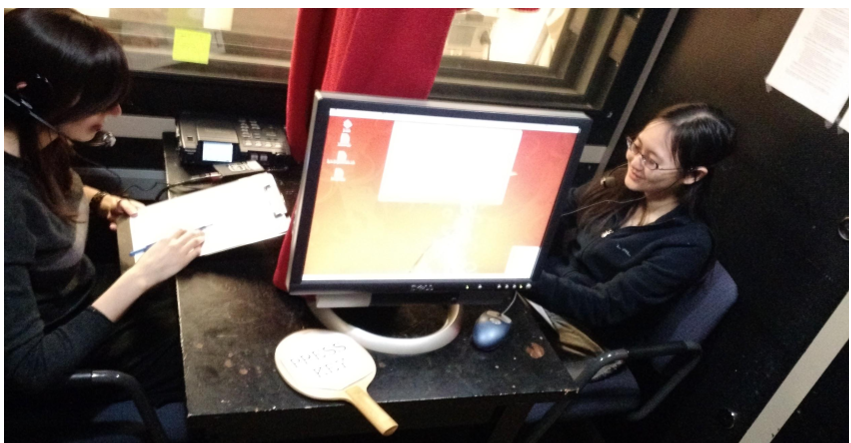 Figure 1: The dual-channel recording setup. Note the curtain used to eliminate visual cues, forcing a pure focus on acoustic data.
Experimental Results: Machines vs. Instinct
The experiment utilized a Random Forest classifier, which thrived on the high-dimensional data provided by the personality scores.
| Model Type | Accuracy (Acoustic Only) | Accuracy (+ Personality & Culture) |
|---|---|---|
| Majority Baseline | 59.9% | 59.9% |
| Random Forest | 63.03% | 65.86% |
Key Insights:
- The Gender/Culture Link: SAE males with high Extraversion were actually worse at deceiving.
- Confidence Paradox: People who were more confident in their ability to catch a liar were generally worse at it.
- The Power of Personality: Adding NEO-FFI scores and demographic data improved the model by nearly 5% absolute over purely acoustic features.
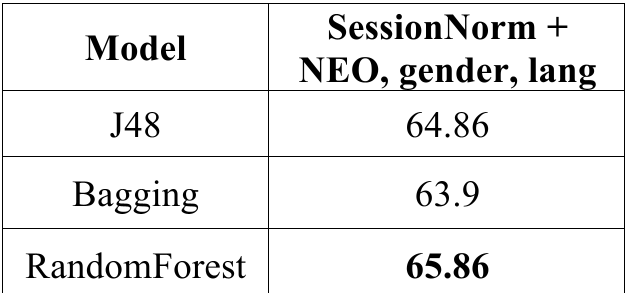 Figure 2: Performance gains achieved by integrating metadata (NEO, gender, language).
Critical Analysis & Future Outlook
Takeaway: This paper successfully argues that deception is a relational and individual phenomenon. You cannot detect a lie in a vacuum; you must know who is talking to whom.
Limitations:
- The classification was done at the IPU level. As the authors note, a single phrase might be too short to carry a definitive "lie signal."
- The study is limited to English-speaking sessions, even for native Mandarin speakers.
Future Work: The logical next step is the inclusion of Lexical Features (NLP). Analyzing what words are chosen (e.g., distancing language, lack of first-person pronouns) in combination with the acoustic "personality-aware" model could likely push accuracy beyond the 70% threshold.