
Decoding the Cultural DNA of Travel: A Cross-Cultural Study of Tourist Mobility
Cross-cultural study of tourists mobility using social media
This paper presents a cross-cultural study of tourist and resident mobility using Location-Based Social Network (LBSN) data from Foursquare-Swarm and TripAdvisor. By modeling mobility as semantic transition graphs between venue categories, the authors identify distinct behavior patterns and cultural clusters across major global cities.
TL;DR
Digital footprints on social media are more than just check-ins; they are cultural signatures. This research analyzes Foursquare and TripAdvisor data to prove that where you come from fundamentally shapes how you move through a city. By comparing residents and tourists across global hubs like NYC, Paris, and Tokyo, the study identifies clear cultural clusters that could revolutionize personalized travel recommendations.
Problem & Motivation: Beyond Geographical Coordinates
Why do two people in the same city—one a local and one a visitor—move so differently? Traditional urban studies used surveys to answer this, but they couldn't scale. Modern LBSN (Location-Based Social Network) studies have the scale but often treat "tourists" as a monolithic group.
The authors argue that mobility isn't just about Latitude and Longitude; it's about semantics. Moving from a "Work" category to a "Nightlife" category tells a story of culture and routine. The core problem this paper addresses is whether cultural background creates predictable, shared patterns of movement that differ from the "routine-driven" mobility of permanent residents.
Methodology: The Semantic Transition Graph
The researchers didn't just look at where people went; they looked at the sequences of venue types.
- Data Sources: They utilized two massive datasets from Foursquare-Swarm (2010–2019) and TripAdvisor to identify Points of Interest (POIs).
- Graph Modeling: They built bidirectional graphs where vertices represent Foursquare venue categories (e.g., Professional, Food, Arts).
- Temporal Windows: Mobility was divided into five periods (Morning, Midday, Afternoon, Night, Dawn) to capture the rhythm of city life.
- Clustering: Using the Canberra distance and Ward’s method, they transformed these 10x10 transition matrices into vectors to find "cultural neighbors."
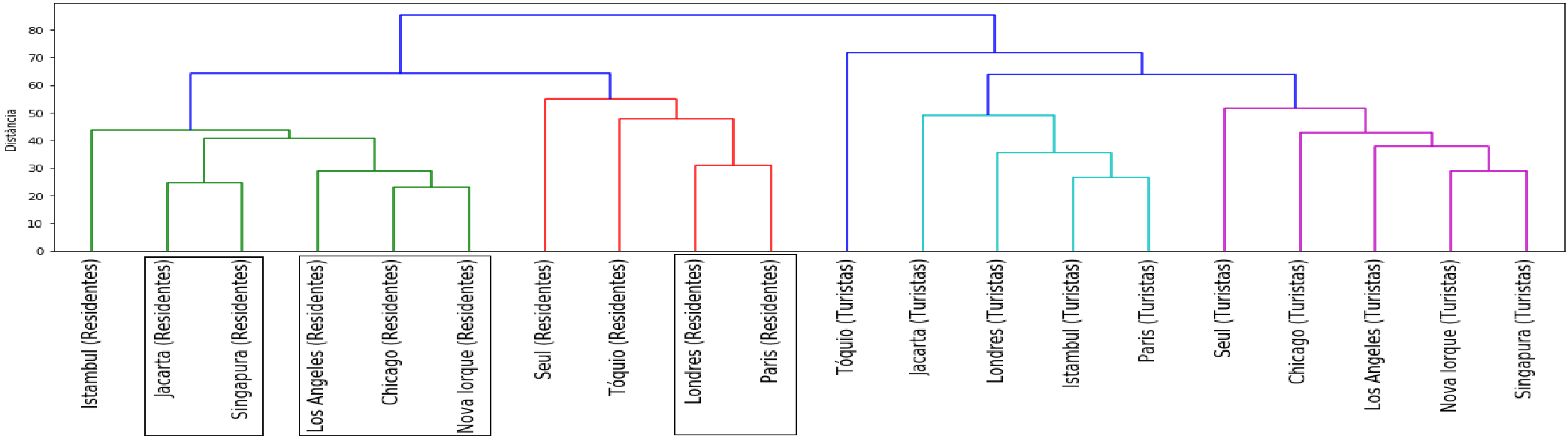 The figure above shows how residents in cities like LA, NY, and Chicago cluster together, while European cities like London and Paris form a separate cultural block.
Key Insights from Experiments
The results confirm that culture overrides geography in surprising ways:
- The Resident-Tourist Divide: Residents are almost always grouped away from tourists. Residents' movements are dominated by local routines (Work -> Food -> Home), whereas tourists focus on the "semantic triad" of Travel -> Arts -> Food.
- Regional Dominance: Residents in the US, Europe, and Southeast Asia form distinct "islands" of similarity.
- Religious and Cultural Echoes: An interesting finding was the similarity between mobility patterns in Istanbul (Turkey) and Jakarta (Indonesia), likely reflecting shared religious routines and lifestyle habits despite the geographical distance.
- The Korean/Japanese Exception: South Korean residents showed mobility more similar to Western tourists than to other Asian residents, possibly due to high levels of Western-influenced consumption or specific local check-in habits.
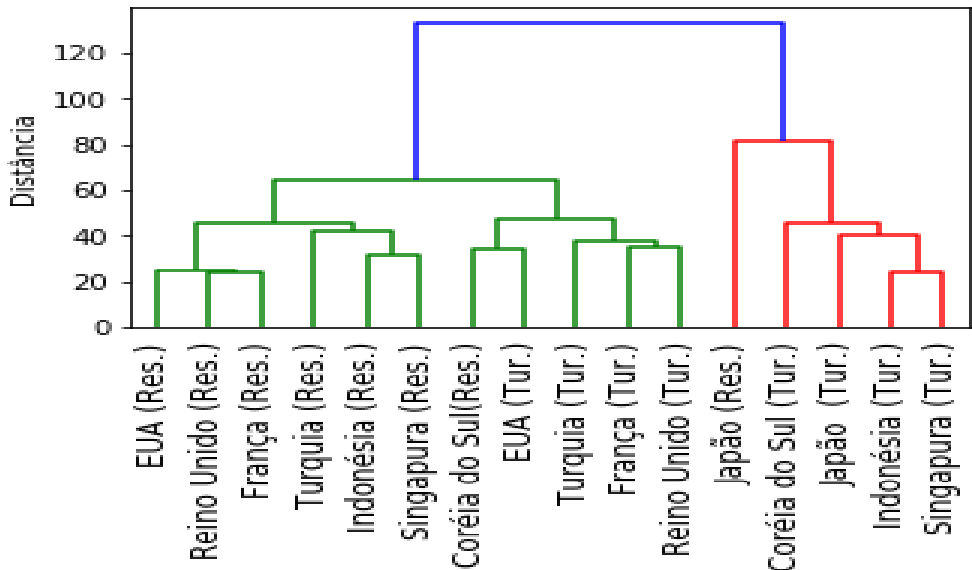 The country-level analysis validates that large cities are often representative of their national cultural "mobility signature."
Critical Analysis & Future Outlook
While the study is robust in its use of multi-year datasets, it acknowledges a few limitations:
- The "Invisible" Tourist: Some tourists act like residents (avoiding POIs). Currently, they are classified as residents, which might slightly blur the results.
- Infrastructure Bias: A tourist's behavior is limited by the destination's infrastructure. If a city lacks "Nightlife" venues, even the most night-owl culture will look "Early Bird" in the data.
The Takeaway for Developers: If you are building a recommendation engine, don't just recommend "the best pizza in Rome" to everyone. Use the user's origin. A tourist from Tokyo might be looking for a very different "semantic flow" through the city compared to a tourist from New York.
Future Work: The authors plan to integrate seasonality and specific times of day to see if "Culture" shines brighter during Summer vacations or Winter retreats.