
SocialTransfer: Capturing the Lightning of Bursty Video Popularity via Social Streams
12987_Towards Cross-Domain Learning for Social Video Popularity Prediction.
The paper introduces SocialTransfer, a cross-domain transfer learning framework designed to predict online video popularity bursts. It leverages real-time social streams (Twitter) to model the "social prominence" of video topics, achieving state-of-the-art results in detecting sudden spikes in view counts that traditional logarithmic models fail to capture.
TL;DR
Why do some videos explode overnight while others sit in obscurity? This paper argues that Social Streams (Twitter) are the lead indicators of "bursty" popularity in the Video Domain (YouTube). By introducing SocialTransfer, the authors bridge these disparate domains using a scalable spectral learning framework, improving burst prediction accuracy by over 40%.
1. The Death of the Logarithmic Curve
For years, academic consensus held that video popularity followed a predictable, logarithmic growth path. However, in the age of viral social media, this model is broken. Many videos exhibit "bursty" behavior—sharp spikes triggered by real-world events.
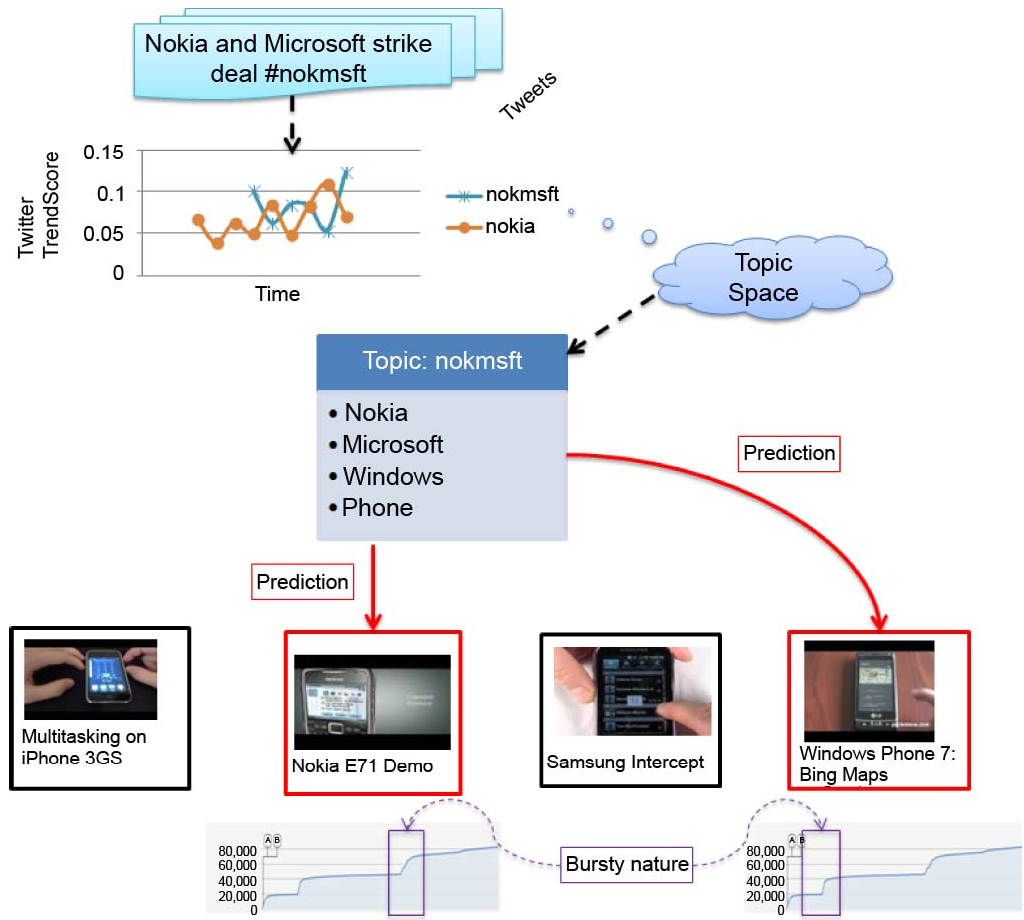
The problem? You can't predict a burst by looking at video tags alone. The trigger often happens outside the video portal. As the "Chain of Digitization" suggests, an event usually hits Twitter first, moves to search queries, and finally results in a YouTube view explosion.
2. Bridging Domains: The SocialTransfer Architecture
The core innovation is a transfer learning framework that doesn't just look at what a video is, but how prominent its topic is in the social sphere.
The Methodology Breakdown:
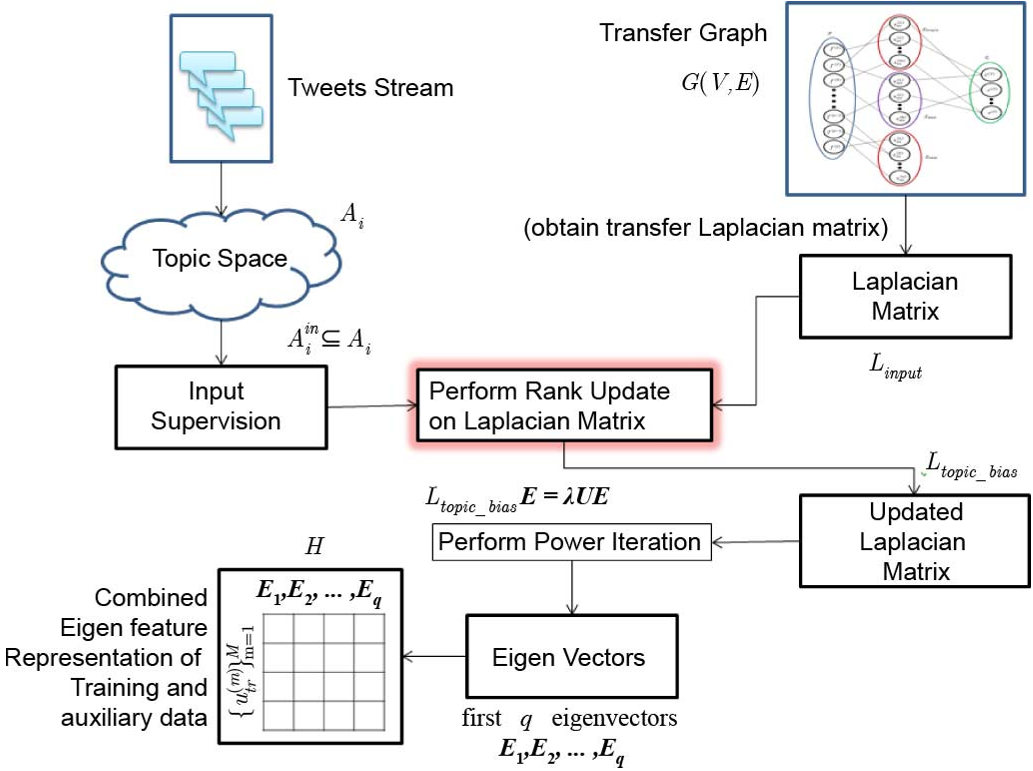
- Online Topic Modeling (OSLDA): Extracts real-time topics from a never-ending stream of tweets.
- The Transfer Graph: A unified structure where nodes represent videos, tweets, feature words, and category labels.
- Scalable Spectral Learning: Instead of heavy matrix decomposition (like Ncut), the authors use Power Iteration. To make it "socially aware," they perform a Rank-1 update on the Laplacian matrix, essentially "nudging" the graph structure to favor features currently trending on Twitter.
3. Quantifying "Social Prominence"
The authors define Trend-Aware Popularity (TAP). It isn't just view counts; it's a weighted fusion of:
- TScore: How much a topic is currently "trending," adjusted by a time-decay factor.
- Adjusted View Count: A traditional metric normalized by upload age and the onset time of the trend.
If a video's TAP/ViewCount ratio hits the lower 10th percentile, it is flagged as a high-probability burst candidate.
4. Does it actually work?
In a massive test involving over 3.5 million videos, SocialTransfer crushed traditional non-transfer SVMs across every major category.
- Overall Error Rate: Dropped from 0.52 to 0.31.
- Specific Categories: The gain was most pronounced in Music (Error: 0.57 0.23) and Sports (Error: 0.45 0.22).
- Scalability: Unlike traditional spectral methods (Ncut), SocialTransfer's runtime stays consistently below the tweet inflow rate, making it viable for production deployment.

5. Critical Insights & Takeaways
The brilliance of this paper lies in its Inductive Bias. It acknowledges that "multimedia" is no longer an isolated field. By treating Twitter as a "social sensor" for YouTube, the researchers solved a problem that visual analysis alone could never crack.
Limitations: The model assumes a strong linguistic overlap (tags and tweet words). In a world of "blind" video uploads with no tags, the system would need to be paired with visual object detection to generate features.
Future Outlook: This framework sets a blueprint for cross-domain intelligence. Whether it's predicting stock market moves from Reddit or supply chain disruptions from news feeds, the SocialTransfer logic—transferring "prominence" from a high-frequency domain to a low-frequency one—is a powerful paradigm shift.
Senior Editor's Note: This paper is a milestone for Real-Time Social Analytics.