
SocialTransfer: Leveraging Twitter Streams to Predict the Next YouTube Burst
18334_Towards Cross-Domain Learning for Social Video Popularity Prediction.
This paper introduces SocialTransfer, a cross-domain transfer learning framework that predicts sudden "bursty" popularity in online videos by leveraging real-time social streams from Twitter. By modeling the social prominence of video topics through an Online Stream LDA (OSLDA) and spectral graph learning, it achieves state-of-the-art performance in identifying high-impact video content before it peaks.
TL;DR
Why do some videos suddenly explode in views while others follow a predictable, slow growth? This paper argues that the secret lies outside the video platform itself. By introducing SocialTransfer, the authors use real-time Twitter trends as a "lead indicator" to predict YouTube "bursty" videos, achieving a 40% improvement in accuracy over traditional models.
Background: The Myth of Logarithmic Growth
For years, academic research suggested that video popularity followed a neat logarithmic curve—a gradual rise and a steady plateau. However, the reality of the social web is much more chaotic. Events like the "Aurora Shootings" or viral memes create sharp, sudden spikes (bursts) that traditional algorithms, looking only at video tags or past view counts, completely miss.
The authors' core insight is the "Chain of Digitization":
- A physical event happens.
- It is first detected as a Twitter trend.
- Users then search for it.
- They finally watch related videos on YouTube.
By the time the view count starts rising on YouTube, the signal has already been alive on Twitter for hours or days.
Methodology: Bridging Disparate Domains
The challenge is technical: how do you map a 140-character tweet to a high-definition video? The authors suggest a three-step pipeline:
1. Topic Discovery (OSLDA)
Using Online Stream LDA, the system extracts "Topical Words" from a continuous stream of tweets. This creates an intermediate "Topic Space" where a tweet about "Gaga" and a video tagged with "Music" can finally meet.
2. The Transfer Graph
To align these domains, the authors construct a Transfer Graph. This graph acts as a bridge, where vertices represent videos, tweets, feature words, and category labels.
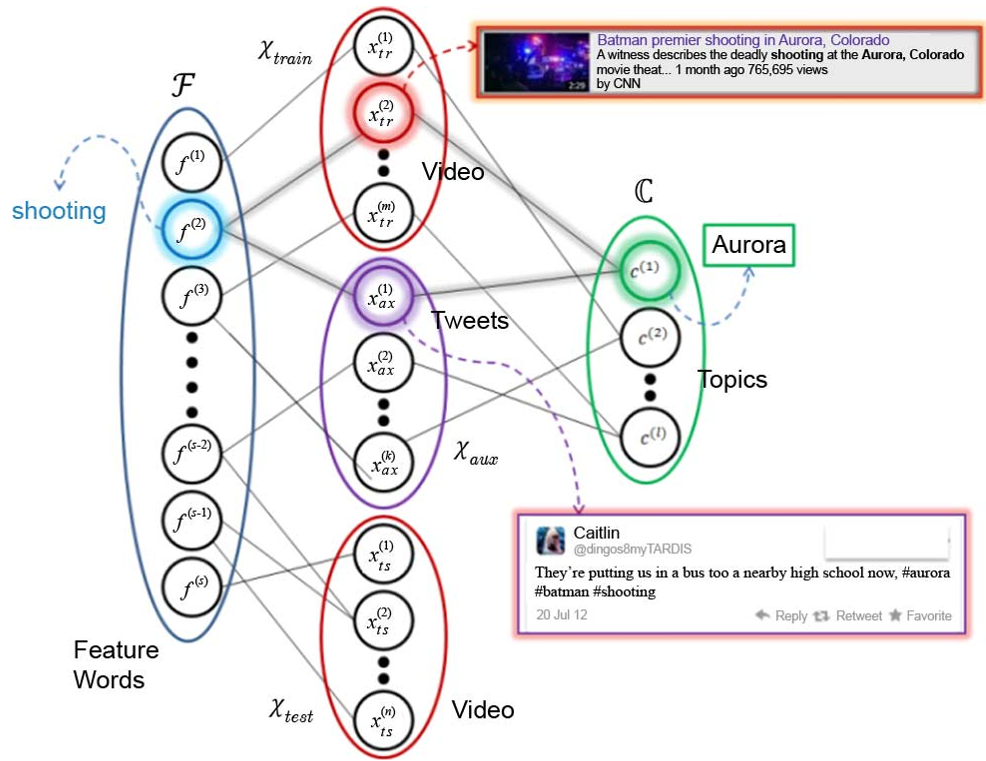 Fig 1: The Transfer Graph structures the relationship between social and video features.
3. Scalable Spectral Learning
Traditional matrix decomposition is too slow for the "firehose" of Twitter data. SocialTransfer uses Power Iteration to extract eigenvectors from the graph's Laplacian matrix. Crucially, they use a Rank-1 update to inject new social topics into the model without recalculating everything from scratch, allowing the model to "evolve" alongside the news cycle.
Experimental Proof: The "Social Prominence" Factor
The researchers tested their model on a massive dataset of 10.2 million tweets and 3.5 million videos. They defined a new metric: Trend-Aware Popularity (TAP).
Key Findings:
- Accuracy Boost: SocialTransfer significantly outperformed standard SVMs. In categories like "People & Blogs" and "Music," the error rate was slashed by nearly half.
- Real-Time Scaling: While standard methods (like Normalized Cut) failed under high tweet volumes, SocialTransfer's Power Iteration remained faster than the speed of incoming data.
 Table 1: Error rate comparison between Non-Transfer and SocialTransfer across different categories.
Deep Insights & Future Outlook
The most profound takeaway is that media is no longer an island. To understand what is happening in one domain (Video), you must measure the "Social Prominence" in another (Micro-blogs).
Limitations: While powerful, the model relies heavily on text metadata (tags/titles). As the authors note, the "Semantic Gap" remains—incorporating visual object detection (knowing there is a specific car or celebrity in the video without a tag) would make this even more potent.
Conclusion: SocialTransfer represents a shift toward "Socialized" media analytics. For advertisers looking to catch a viral wave and network providers trying to cache high-traffic content, this cross-domain approach is the new gold standard.