
Bridging History and Media: A Semantic Dive into Personalized Cultural Recommendations
Cross-Domain Recommendation for Enhancing Cultural Heritage Experience
This paper introduces a cross-domain recommender system designed to enhance cultural heritage experiences by recommending personalized points of interest (POIs) and associated multimedia content (books, movies, music). The methodology integrates Linked Open Data (LOD) for semantic discovery with social media signals (Facebook) for reranking, achieving a highly personalized and context-aware suggestion engine.
TL;DR
Researchers from Roma Tre University have developed a recommender system that doesn't just tell you to visit the Colosseum—it suggests a Fellini movie or a Bon Jovi song specifically chosen for you based on your social media activity and semantic proximity. By combining Linked Open Data (LOD) with Doc2Vec embeddings, the system transforms a simple GPS-based tool into a rich, cross-domain cultural companion.
Background: Beyond the Coordinate
Most location-based services (LBS) suffer from "contextual shallowness." They understand where you are but not who you are or the cultural fabric of your surroundings. This paper addresses the gap between physical tourism and personal interests by treating cultural heritage as a multi-dimensional graph rather than a list of coordinates.
The Problem: The Personalization Gap in Multimedia
While the authors previously succeeded in recommending itineraries, the multimedia content (the "background stories") remained generic. If two different users visited the same monument, they received the same movie suggestions. The challenge was: how do we leverage disparate data sources (Facebook likes + DBpedia entries) to rank these cross-domain items effectively?
Methodology: The Semantic Engine
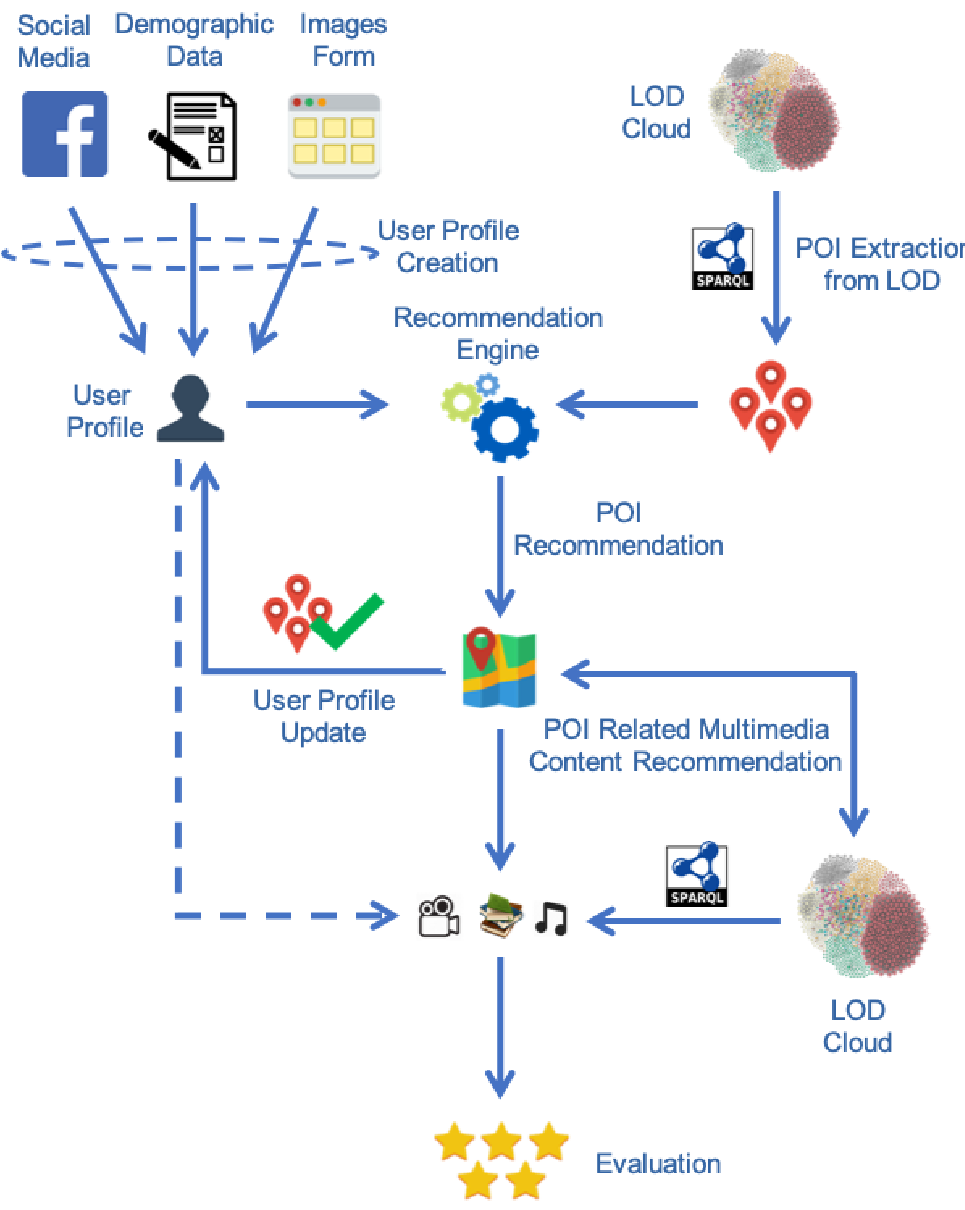
The architecture is a sophisticated pipeline that turns raw data into cultural insights.
1. Architectural Blueprint
The system follows a five-step modular flow:
- Profile Construction: Merges demographic data, social media "footprints," and an ingenious image-selection task (using Flickr tags) to solve the initial cold-start problem.
- LOD Extraction: Uses SPARQL to pull POIs from the LOD cloud based on the user's geofence.
- The Doc2Vec Bridge: The core innovation involves taking the
dbo:abstract(textual description) from DBpedia and converting it into a vector.
2. Semantic Personalization
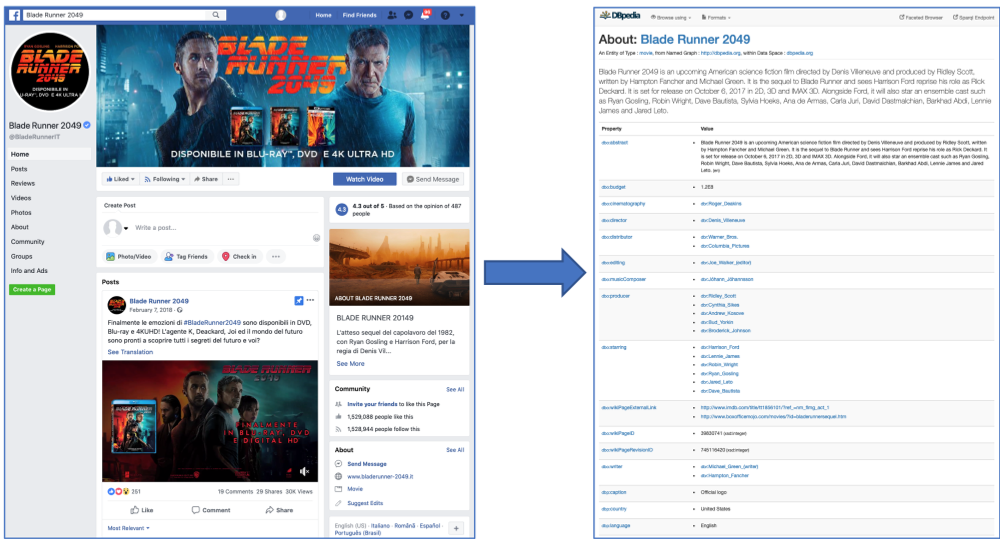
The "magic" happens in the reranking process. The system identifies semantic links (e.g., "The Colosseum" is linked to the movie "Roman Holiday"). It then calculates the similarity between the user's interest vector and the multimedia item's vector.
Experiments and Results: The Subjective Metric
The authors propose a rigorous evaluation framework utilizing five-point Likert scales and volunteer testers. Unlike purely algorithmic papers, this work prioritizes subjective experience. Preliminary studies of their base framework showed that incorporating social and semantic data doesn't just improve accuracy—it boosts Novelty and Serendipity (finding things you didn't know you would love).
Critical Insight: Why This Matters
This work sits at the intersection of the Semantic Web and Machine Learning. By using Doc2Vec on DBpedia abstracts, the authors bypass the need for manually labeled datasets. They treat the entirety of human-curated knowledge (via Wikipedia/DBpedia) as an embedding space for recommendation.
Future Outlook
The next frontier for this research involves Affective Computing—adjusting recommendations based on the user's current mood—and Temporal Dynamics—recognizing that a user's interest in "History" might peak in the morning but shift to "Music" by nightfall.
Conclusion
Sansonetti et al. remind us that recommendation isn't just about labels; it's about connections. By linking a monument in Rome to a song on a user's Facebook profile, they provide a roadmap for truly "intelligent" tourism.