
CCC: Decoding Node Influence in the Era of Multiplex Social Networks
Cross-Layer Closeness Centrality in Multiplex Social Networks
The paper introduces Cross-Layer Closeness Centrality (CCC), a novel metric designed to measure the influential power of nodes in multiplex social networks. By integrating intra-layer and inter-layer distances with a tunable balancing parameter, the method achieves a more nuanced ranking of node importance than traditional aggregated network approaches.
TL;DR
In our hyper-connected world, a single relationship (simplex) rarely tells the whole story. Cross-Layer Closeness Centrality (CCC) is a new mathematical framework that identifies influential nodes by analyzing how "close" they are to others across multiple layers of interaction—such as business ties, family alliances, and digital communications—simultaneously. It moves beyond simple network aggregation to provide a high-fidelity map of social power.
Background: The Limits of Flattening Reality
Historically, social network analysis (SNA) has relied on "flattening" interactions. If two people are friends on Facebook and colleagues at work, traditional models often merge these into a single link.
The Insight: This "aggregation" destroys vital information. A node might be moderately connected in three different layers but, through the synergy of those layers, occupy a globally strategic position. The author argues that we need a metric that perceives these layers as a unified, complex system rather than a flattened sum.
Methodology: The CCC Framework
The core contribution is the Cross-Layer Closeness Centrality (CCC) metric. Unlike standard closeness (the inverse of the sum of shortest paths), CCC introduces a weighted bipartite view of connectivity.
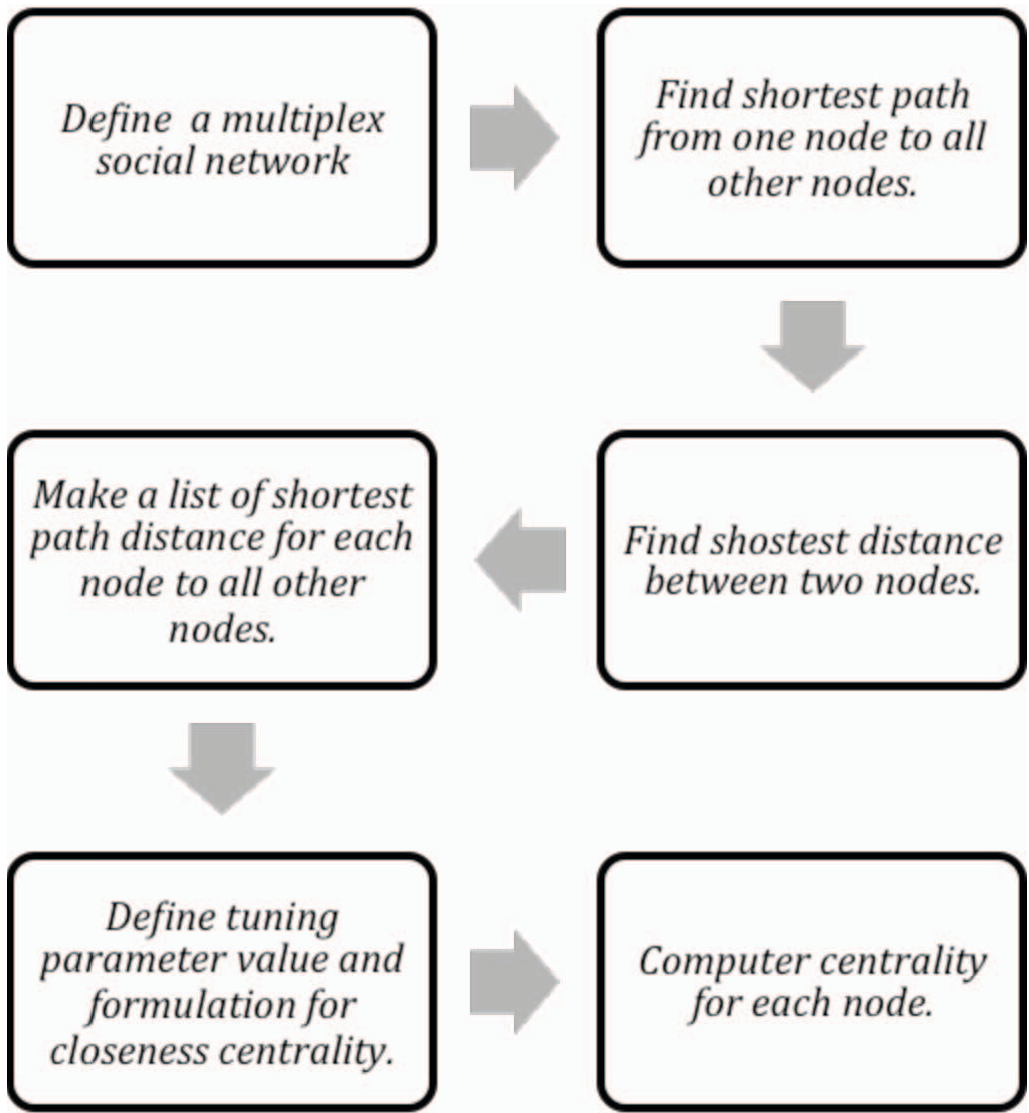
1. Shortest Paths in Multi-Layers
The algorithm first calculates the shortest path between nodes and , regardless of whether they reside in the same layer or different layers .
2. The CCC Formula
The mathematical heart of the paper is the following formulation:
- (The Balancing Act): A tuning parameter. If , the model prioritizes cross-layer connections, emphasizing nodes that bridge different types of social spheres.
- Intuition: The formula rewards nodes that are not just "local heroes" within one network (like a popular person on Twitter) but are "global bridges" across multiple platforms (a person influential on Twitter, LinkedIn, and in-person).
Experiments: Where the Simple Model Fails
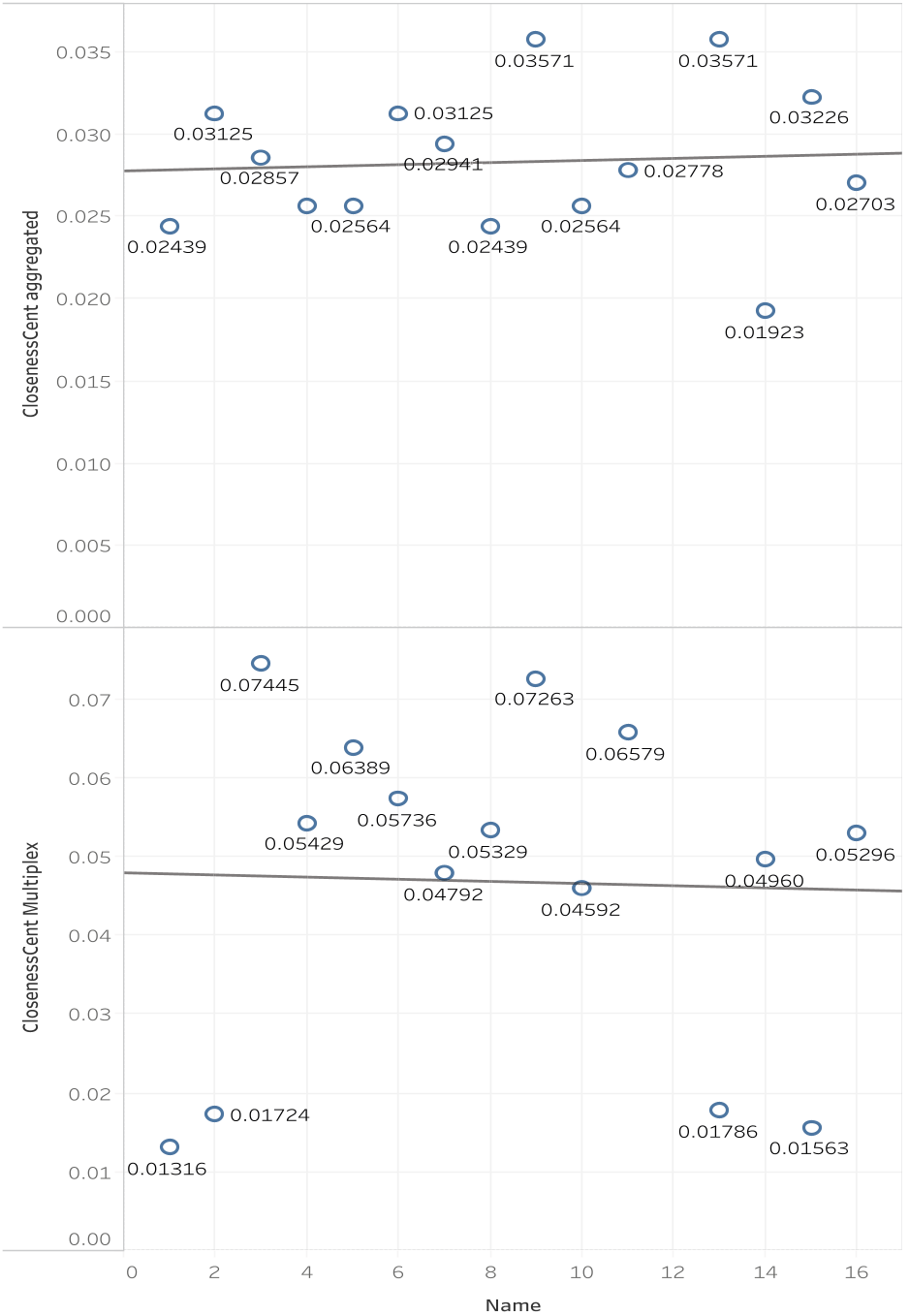
The authors tested CCC against two iconic datasets: Danio-Rerio (Biological interactions) and Florentine Families (Political/Business ties).
Key Finding 1: Danio-Rerio (Zebrafish)
With low overlap between layers, the multiplex approach revealed a starkly different reality than the aggregated one.
- Multiplex (CCC): 17% of nodes reached maximum centrality.
- Aggregated: Only 8.5% were high-influence.
- Conclusion: Small, independent interactions across layers "add up" to influence that the aggregated model completely misses.
Key Finding 2: The Florentine Families
In this network of marriage and business ties, high overlapping means if you are powerful in business, you are likely powerful in marriage alliances too. Here, 70% of nodes showed high closeness, indicating a highly stable and redundant power structure.
Critical Analysis & Future Outlook
Why it matters: CCC provides a more granular "influence score." In a corporate setting, this could distinguish between a manager who is only influential via formal reporting lines versus one who has informal influence across social and project-based layers.
Limitations:
- Complexity: With a running time of , the complexity scales with the number of layers (). For massive networks (e.g., millions of nodes across dozens of layers), further optimization or heuristic approaches will be necessary.
- Weighting: The tuning parameter is manually set. Future work could involve learning this parameter from data to see which layers "actually" drive influence.
Conclusion: The shift from simplex to multiplex is the next frontier of network science. This paper provides the foundational "ruler" to measure distance in this multi-dimensional space.