
DHNS: Bridging the Semantic Gap in Social Media Cross-Media Search
Cross-Media Semantic Correlation Learning Based on Deep Hash Network and Semantic Expansion for Social Network Cross-Media Search
The paper introduces DHNS (Deep Hash Network and Semantic Expansion), an end-to-end cross-media search framework that combines deep feature learning with hash-code quantization. It addresses social network data challenges by leveraging graph-based semantic expansion and joint optimization of cross-entropy loss, quantization loss, and similarity constraints.
Executive Summary
TL;DR: The DHNS (Deep Hash Network and Semantic Expansion) model introduces a robust end-to-end pipeline for cross-media retrieval, specifically designed to handle the "messy" nature of social network data. By combining graph-based text expansion with a unified deep hashing optimization, it significantly boosts search accuracy (MAP) while maintaining millisecond-level inference speeds.
Background: In the landscape of Information Retrieval, DHNS serves as a specialized SOTA (State-Of-The-Art) framework that bridges the gap between traditional hand-crafted feature hashing and modern deep learning representation, focusing on the specific pain points of text sparsity in social networks.
Problem & Motivation: The Sparsity Trap
Existing cross-media search methods—which allow users to search for images using text or vice versa—often fail when deployed on platforms like Twitter or Flickr. The reasons are two-fold:
- Text Sparsity: User-generated tags are often one-word, noisy, or incomplete.
- The Two-Step Information Loss: Most models learn continuous features first and then "force" them into binary codes using a sign function, which destroys the semantic structure carefully built by the neural network.
The authors' insight was to treat the relationship between images and words as a topological graph, allowing the model to "fill in the blanks" for sparse text before performing unified hashing.
Methodology: Deep Expansion and Unified Hashing
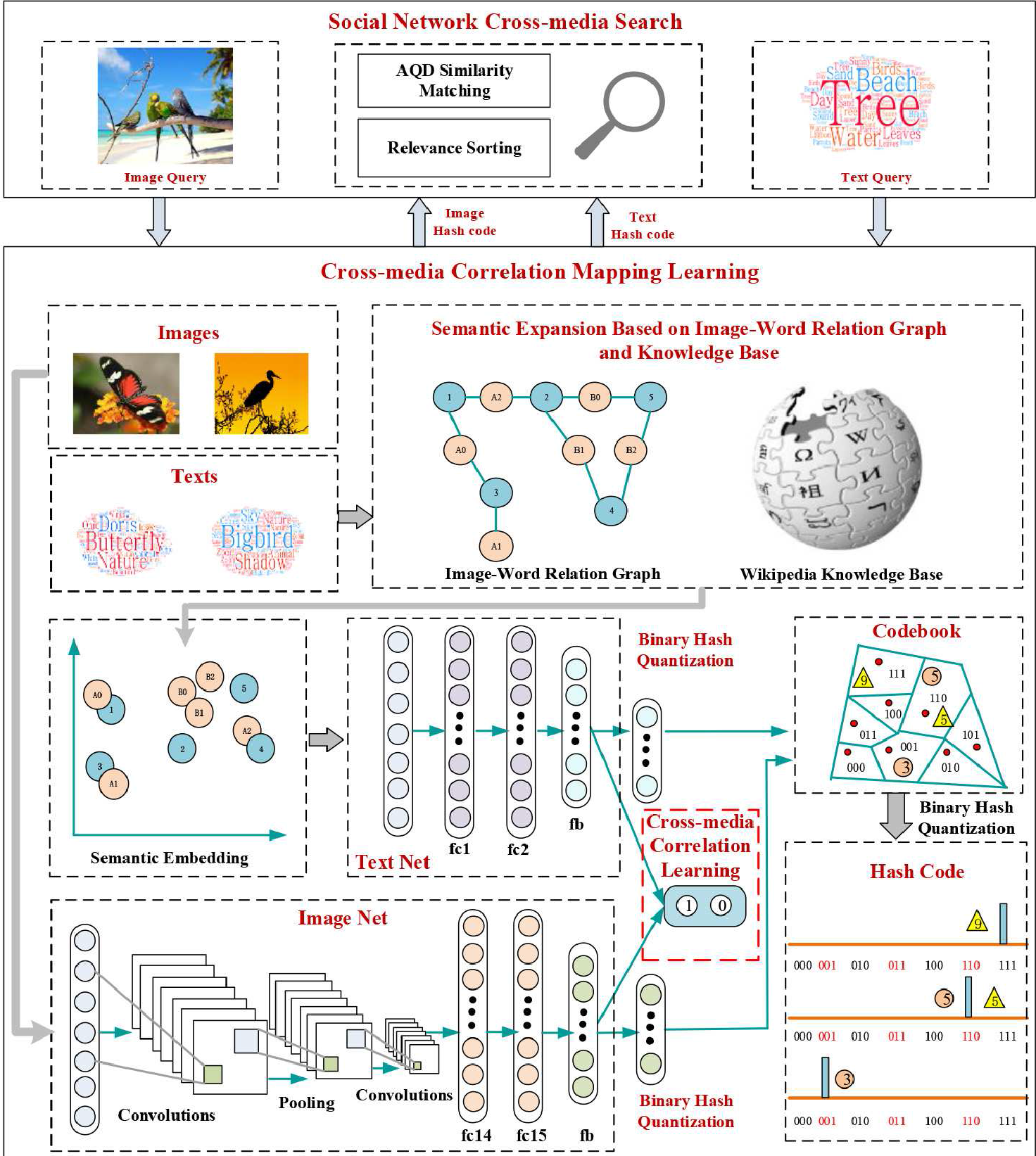
1. Semantic Relationship Expansion
Instead of relying solely on provided tags, DHNS constructs an image–word relation graph. By performing a DeepWalk (random walks on the graph), the model discovers latent associations. For instance, if "ocean" and "surfboard" frequently appear together in a graph, a sparse tag "ocean" can be expanded with the context of "surfboard." This is further bolstered by the Wikipedia external knowledge base.
2. The DHNS Architecture
The model consists of two specialized branches:
- Image Net: Utilizes a VGG-16 backbone to extract visual features, followed by a bottleneck layer that maps images into a latent space.
- Text Net: Processes the expanded semantic embeddings through a Multi-Layer Perceptron (MLP) to generate comparable text features.
3. Unified Optimization
The "secret sauce" of DHNS is its objective function, which balances three goals:
- Correlation Learning: Minimizing cross-entropy to ensure similar images and texts are close in latent space.
- Quantization Quality: Minimizing the error between continuous features and their discrete binary hash codes.
- Similarity Constraint (Deep CCA): Using trace norm minimization to further align the high-level distributions of different modalities.
Experiments & Results
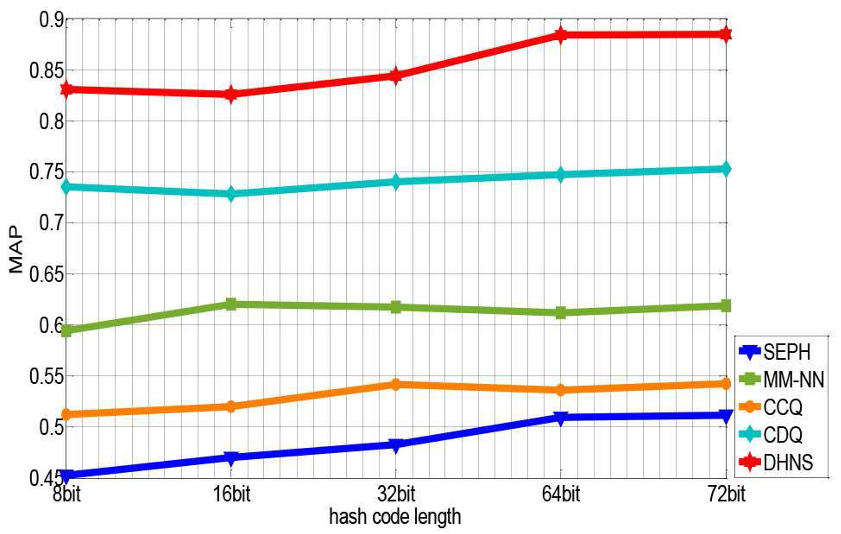
The authors evaluated DHNS on NUS-WIDE and MIR-Flickr 25k.
- SOTA Dominance: DHNS consistently surpassed benchmarks like CDQ and CCQ. Notably, in the Text-to-Image (T→I) task, DHNS achieved a MAP of 0.8810 on NUS-WIDE (64 bits), a massive leap compared to baseline methods that struggled with the dataset's noise.
- Efficiency: With a search time of 3.8 ms per query, the model demonstrates that deep feature extraction doesn't have to come at the cost of scalability.
Critical Analysis & Conclusion
Takeaway: DHNS proves that cross-media search is not just about the "vision" or the "text," but the interaction between them. By expanding sparse text via graph theory, the model provides the deep net with a much richer signal to learn from.
Limitations: While powerful, the reliance on a static external knowledge base (Wikipedia) may not capture rapidly evolving social media slang or trending topics in real-time.
Future Work: Integrating dynamic knowledge graphs or large language models (LLMs) like GPT-4 to handle text expansion could further maximize the "semantic intelligence" of this hashing framework.