
The "Hyper-Feminized" Orc: How We Mix Linguistics and Visuals to Build Virtual Identities
Cross-modal compensation between name and visual aspect in socially active avatars
This study investigates the phenomenon of "cross-modal compensation" in virtual identity creation using World of Warcraft avatars. It identifies that player-chosen names for non-human female avatars are structurally "hyper-feminized" via increased vowel sequences to compensate for their lack of human-like visual features.
TL;DR
When players create non-human female avatars (like Orcs or Trolls) in virtual worlds, they don't just pick a name—they engage in a subconscious act of cross-modal compensation. This study reveals that the more "monstrous" an avatar looks, the more "feminine" its name becomes linguistically, specifically through an accumulation of vowels.
Background: The Psychology of the Avatar
In the digital realm, an avatar is the bridge between the real and the virtual. While we might think choosing a name and a race are separate clicks in a character creator, they are actually deeply intertwined. This paper explores the "cross-talk" between what we see (the visual) and what we hear or read (the linguistic).
The Problem: Are Name and Look Independent?
Previous research in cyberpsychology often isolated visual customization from linguistic naming. However, the author hypothesized that if a character lacks certain human-like gender cues in their visual design, the player might feel a psychological need to "correct" or "compensate" for this via the name. In a social environment like World of Warcraft (WoW), where identity is currency, this compensation becomes a vital tool for social interaction.
Methodology: Mining the Data of Azeroth
The researcher analyzed 1,261 names from North American WoW servers, specifically targeting active players (level 10+ and guild-affiliated). The data was split into two distinct groups:
- The Alliance (Human-like): Humans, Dwarves, Gnomes, etc.
- The Horde (Non-human/Monster-like): Orcs, Trolls, Undead, Tauren.
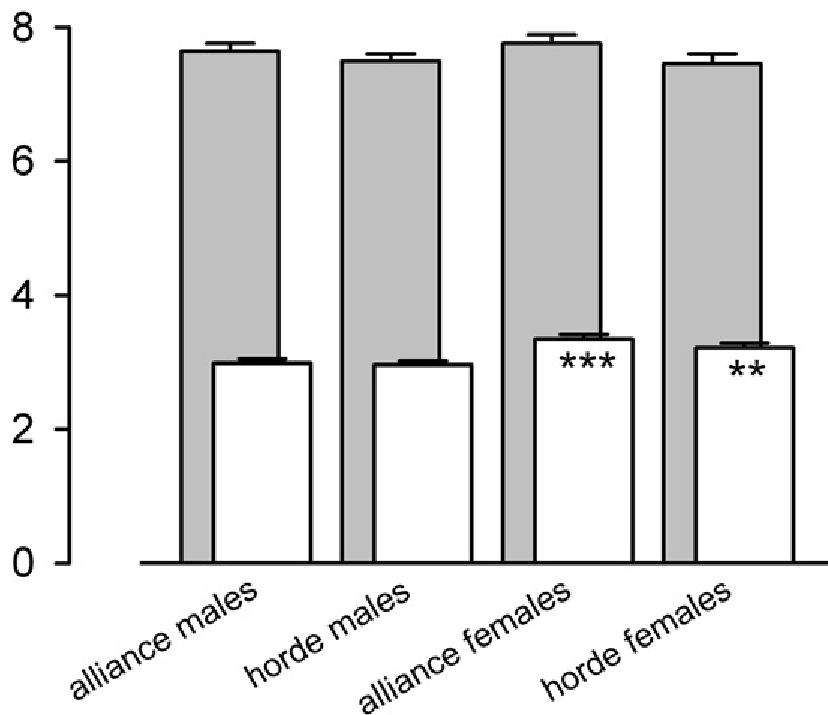
The analysis didn't just look at the names themselves but at their phonotypic structure—specifically the ratio of vowels to consonants.
Core Insight: Vowels as a "Linguistic Feminizer"
The results were striking. Across all races, female names contained significantly more vowels than male names. In English-speaking cultures, vowels are often perceived as "softer" and more "melodic," making them a standard marker for femininity.
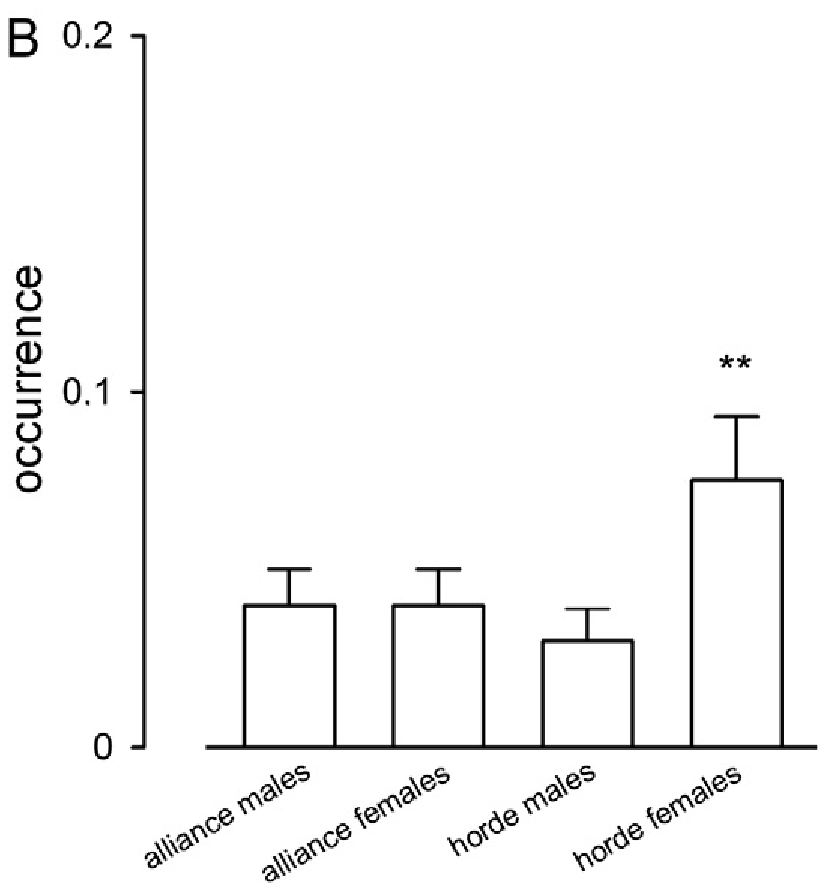
However, the real breakthrough appeared when comparing human-like females to monster-like females:
- Alliance Females (Human-like) used more double-vowel sequences (e.g., "ee", "aa").
- Horde Females (Non-human) pushed the limit with triple-vowel sequences.
Why this matters (The "Why")
This suggests that players perceive a "greater distance" from the human norm when playing a monster race. To ensure other players still recognize their character as female during social interactions, they hyper-feminize the name. If the eyes see a monster, the ears must hear a melody. This is cross-modal compensation in action.
Deep Insight & Conclusion
This study provides a fascinating look at the Inductive Bias we bring from the real world into virtual settings. Even when we have the freedom to be anything—an undead zombie or a giant cow—we still rely on traditional linguistic cues to anchor our social identity.
Takeaways for the Future
- For Game Designers: Naming systems and procedural name generators should account for racial "monstrosity" to help players achieve the desired level of embodiment.
- For Researchers: Identity is not a siloed experience. Our brains constantly balance different sensory modalities to maintain a coherent sense of self.
Limitations: The study is limited to English-speaking players. Vowel/consonant dynamics vary wildly across languages, and future work should explore if these "feminization" rules apply in non-alphabetical languages or different cultural contexts.