
Bridging Social Silos: Constructing Virtual Networks Across Heterogeneous Sites
Cross-Site Virtual Social Network Construction
The paper introduces a graph-based framework and a visual tool for constructing Virtual Social Networks across heterogeneous sites. By utilizing Explicit Semantic Analysis (ESA) and a Graph Propagation algorithm, it successfully matches users from different platforms (e.g., medical support groups) who share similar interests but use different vocabularies.
TL;DR
As social niches become more fragmented, users with shared needs—such as patients with chronic diseases—often find themselves isolated on different platforms. This paper presents a graph-based methodology to break these walls by linking users across different websites. By mapping local vocabularies to a universal semantic space (Wikipedia) and propagating similarities through a multi-partite graph, the authors create a "Virtual Social Network" that transcends site boundaries.
The Problem: The Vocabulary Gap
Generic social networks like Facebook are broad, but niche sites (e.g., TuDiabetes vs. DiabetesSisters) offer deeper support. However, these communities suffer from the Vocabulary Gap:
- Different Terminologies: Users on one site might use clinical terms, while others use slang or symptoms.
- Lack of Overlap: Traditional collaborative filtering fails because there is no shared user ID or common feature set between two independent websites.
- Isolation: A new diabetic patient on Site A might never discover a perfect "mentor" on Site B simply because they are on different servers.
Methodology: Semantic Anchors and Graph Propagation
The authors propose a three-tier architecture to solve this:
1. The Multi-Partite Graph
The system represents the entire ecosystem as a composite graph.
- Intra-site: Bipartite graphs () connect users to the keywords they use in posts (weighted by TF-IDF).
- Inter-site: A matching graph () connects keywords from Site 1 to Site 2 based on semantic similarity.
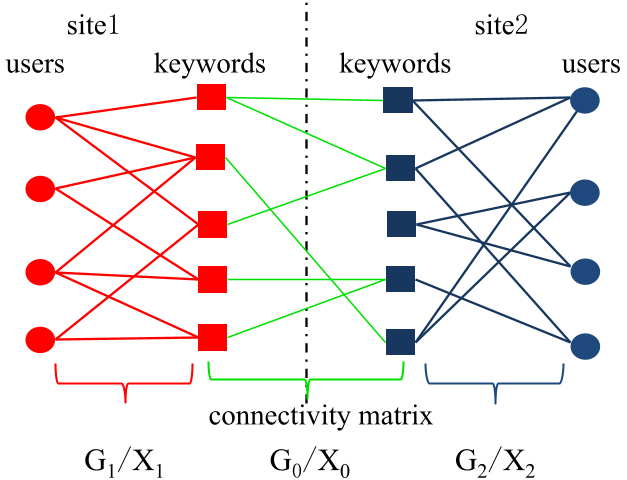
2. Semantic Matching via Wikipedia
To connect "Doctor" on Site A with "Physician" on Site B, the authors use Explicit Semantic Analysis (ESA). Each keyword is projected into a high-dimensional concept space derived from Wikipedia. If two keywords co-occur in or relate to the same Wikipedia articles, they are linked in the graph with a weight equal to their cosine similarity.
3. Global Similarity Propagation
Once the "bridges" (keyword-keyword links) are built, the system calculates user-to-user similarity across sites. Since there are no direct links between users of Site 1 and Site 2, the algorithm "propagates" similarity scores: This mathematical approach (based on the iterative power method) calculates the Global Similarity, effectively asking: "If User A uses keywords that are semantically similar to keywords used by User B, how likely are they to share a social bond?"
Experimental Visualization
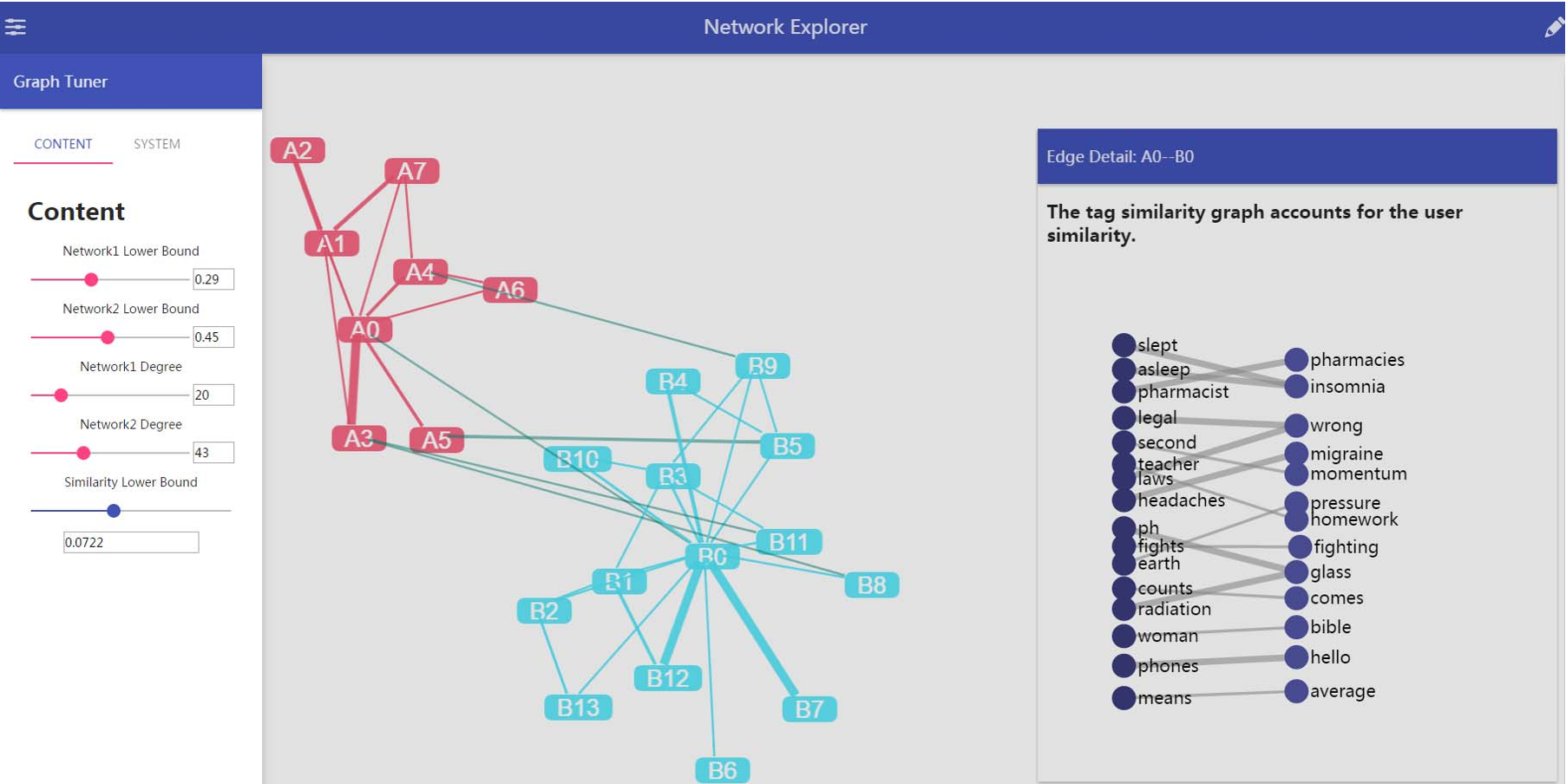
The authors built a graphic tool to demonstrate this on diabetes support networks. The tool visualizes:
- Red/Blue Nodes: Users from different sites.
- Green Edges: The "Virtual" cross-site links discovered by the algorithm.
- Interactive Controls: Users can adjust thresholds for "Network Degree" and "Similarity Lower Bound" to filter the most relevant connections.
Critical Analysis
Why it Works
The brilliance lies in the Inductive Bias that semantic relatedness is a proxy for social compatibility. By using Wikipedia as an external "translator," the system moves beyond keyword matching to Concept Matching.
Limitations
- Temporal Dynamics: The paper doesn't account for how user interests evolve over time.
- Scalability: While the propagation algorithm is efficient, computing ESA for millions of keyword pairs can be computationally expensive.
- Data Quality: The method relies heavily on the quality of user-generated content (posts). If a user posts very little, their "keyword vector" will be too sparse for accurate matching.
Future Outlook
As we move into the era of LLMs, the "Semantic Matching" phase of this work could be significantly enhanced by Embedding Models (like OpenAI's text-embedding-3). However, the Graph Propagation logic remains a robust foundation for any system aiming to unite fragmented digital communities into a single, cohesive virtual society.