
Beyond Self-Checkboxes: Why Your Twitter Feed Predicts Your Reading Interests Better Than You Can
Cross-system Recommendation: User-modelling via Social Media versus Self-Declared Preferences
This paper introduces a cross-system news recommendation approach that bootstraps user models from social media data (Twitter) using a vector-space model. The research demonstrates that passive user modeling via social media significantly outperforms explicit user-declared preferences in real-world news recommendation accuracy.
TL;DR
Researchers from the University of Nottingham have demonstrated that a simple algorithm analyzing your Twitter history can generate more accurate news recommendations than a list of topics you manually select. By leveraging a "Passive" cross-system user model, the study achieved a statistically significant improvement in relevance scores, proving that our digital shadows are more honest and detailed than our self-declared interests.
Background: The Fatigue of Manual Personalization
Most web services ask new users to "pick 5 topics you like" to solve the Cold-Start problem. However, this approach is flawed. Users are often too lazy to update these lists, and the categories provided (e.g., "Technology", "World News") are usually too broad to capture specific tastes. This paper investigates whether we can bypass this manual step by mining data from one system (Social Media) to power another (News Recommendation).
Methodology: Passive vs. Active Modeling
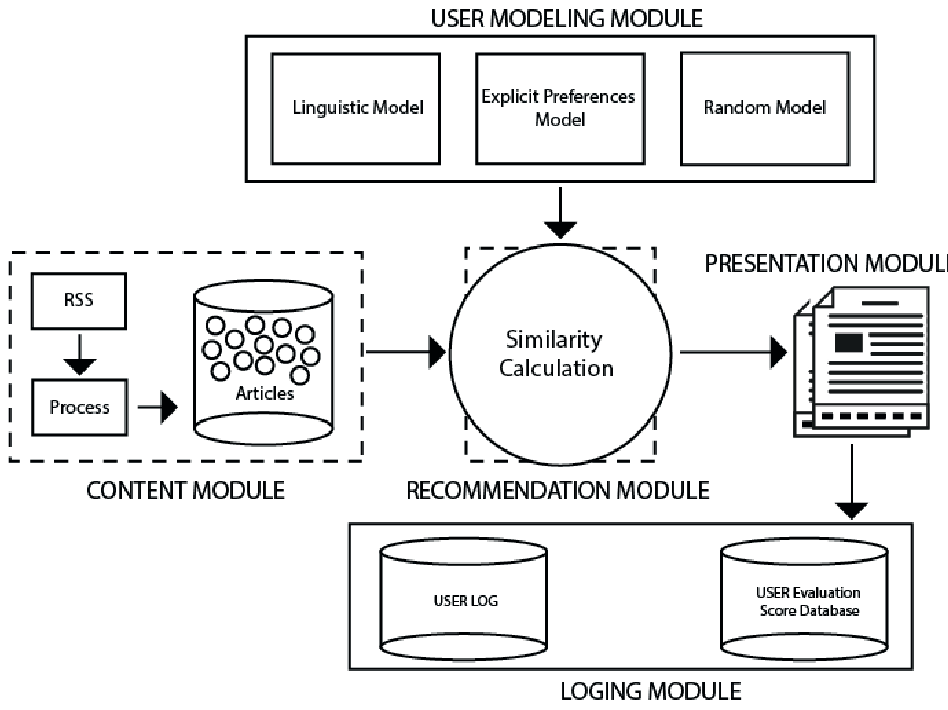
The researchers built an experimental platform to compare three distinct user modeling techniques:
- Passive Model: Mining the user's 150 most recent tweets. These are parsed into a "Bag of Words" and transformed into a TF-IDF Vector Space Model (VSM).
- Manual Model: Users explicitly rate their interest in standard categories like Science, Politics, or Health.
- Random Baseline: Serving random articles to establish a floor for performance.
The engine calculates the Cosine Similarity between the user's profile vector and the news article's vector to determine the ranking.
Key Findings: The Power of Granularity
The experimental results were clear: the Passive model (Mean: 4.30) beat the Manual model (Mean: 4.13) and the Random baseline (Mean: 3.81).
The most fascinating part of the study is the Qualitative Analysis. The authors found that the Passive model could "see through" broad categories. For example:
- Niche Interests: A user who didn't select "Sports" as a manual interest was recommended a "UK" news article about Chelsea FC because they had tweeted about "Mourinho" (the coach).
- Breaking Trends: A user was recommended articles about the Nepal earthquake because their recent tweets shared empathy for the region, something a static "World News" checkbox couldn't capture as effectively.
Deep Insight: Different Worlds of Preference
Curiously, the correlation between the models' performances was extremely low (). This indicates that the Manual model and the Passive model are capturing entirely different dimensions of a user's personality.
- The Manual model represents who we think we are or who we want to be.
- The Passive model reflects our actual current focus and granular behavior.
Critical Analysis & Future Outlook
While the study used a relatively "naive" VSM approach, its success is a testament to the value of cross-system data. However, there are limitations:
- Privacy: Mining social media requires intrusive access.
- Context Decay: Tweets from three years ago might not reflect today's news interests.
Takeaway: The future of recommendation lies in Hybrid Models. By combining the intentionality of manual selection with the granular, dynamic nature of social media footprints, systems can finally escape the "coarse label" trap and provide truly personalized content.
Conclusion
This work validates that cross-domain feature transfer is not just a theoretical fix for cold starts—it is a pathway to superior recommendation quality. For developers, the message is clear: stop asking users what they want and start looking at what they do.