
Crowd Anatomy: Decoding Behavioral Traces to Optimize Microtask Quality
Crowd Anatomy Beyond the Good and Bad: Behavioral Traces for Crowd Worker Modeling and Pre-selection
This paper introduces a multidimensional worker typology (DW, CW, FD, SD, RB, LW, SW) based on behavioral traces to model and pre-select crowd workers. Using Random Forest classifiers on mousetracking and interaction data, the authors demonstrate a robust method to identify high-quality workers in real-time.
TL;DR
Researchers have moved beyond the binary "good vs. bad" worker classification. By analyzing behavioral traces—such as mouse movements and window toggling—this paper introduces a 7-tier worker typology. Using a Random Forest classifier, the authors achieved up to a 10% accuracy boost in task results by pre-selecting "Competent Workers" without increasing the time spent on tasks.
The Problem: The "Black Box" of Crowd Work
In the world of Amazon Mechanical Turk (AMT) and CrowdFlower, requesters usually treat workers as a black box. You post a Human Intelligence Task (HIT), you get a result, and you hope that Majority Voting or a quick Qualification Test filters out the noise.
However, the authors argue that "Good" workers are not all the same. Some are Diligent (slow but perfect), while others are Competent (fast and perfect). Conversely, "Bad" workers range from Fast Deceivers (spammers) to Less-competent (earnest but struggling). Standard metrics fail to distinguish these, leading to wasted budget and sub-optimal data.
Methodology: Listening to the Mouse
The researchers tracked 1,800 HITs across two domains: Content Creation (Image Transcription) and Information Finding (finding celebrity middle names).
The Worker Typology
The study defines seven distinct identities based on performance, motivation, and behavior:
- Diligent Workers (DW): High accuracy, high time investment.
- Competent Workers (CW): High accuracy, low time (The "Gold Standard" worker).
- Fast Deceivers (FD): Spammers looking for a quick buck.
- Smart Deceivers (SD): Workers who mimic effort to bypass simple time-check validators.
- Rule Breakers (RB): Provide partial or mediocre responses.
- Less-competent (LW): High effort, but lack the skills/accuracy.
- Sloppy Workers (SW): Honest but rushed.
Machine Learning via Behavioral Traces
Instead of just looking at the final answer, the authors used Javascript to track:
- tabSwitchFreq: How often they left the page.
- tBeforeInput: Interaction delay.
- totalMouseMoves: Physical engagement level.
 (Figure: Task Design for modeling complexity and difficulty)
Crucial Experiments & Results
The core of the paper lies in its ability to predict these types and then pre-select them for new tasks.
Predictive Power
The Random Forest model was highly successful at identifying Competent Workers (CW) with 91% accuracy in content creation tasks. Interestingly, the model found that "mouse movement" and "window focus frequency" were more predictive of quality than simple time-on-task metrics.
Performance Gains
When the system pre-selected only workers predicted to be "Competent," the results were staggering:
- Image Transcription: +7% accuracy over the baseline.
- Information Finding: +10% accuracy over the baseline.
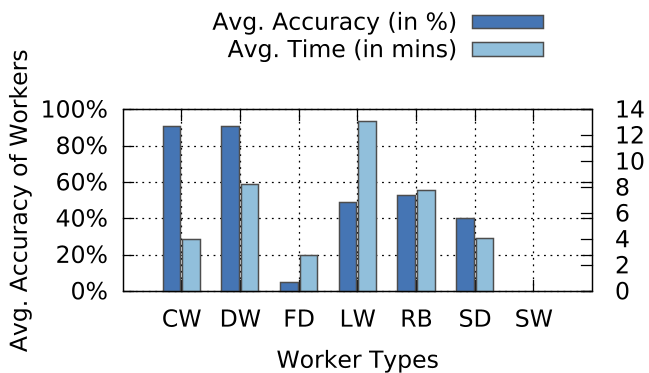 (Figure: Average accuracy and completion time by worker type)
In tasks with high complexity, the "No Type" (random selection) approach performed abysmally (see Figure 8 in the paper), as the first workers to finish complex tasks are almost always Fast Deceivers or Slop-workers.
Deep Insight: Beyond Quality Control to Fairness
The most profound takeaway is the potential for Fairness and Transparency. By identifying "Less-competent" workers (who have high intent but low skill), platforms can offer targeted training instead of simple bans. This moves crowdsourcing from a "one-and-done" gig economy toward a professionalized, developmental environment.
Summary & Future Outlook
This work proves that a worker’s "digital fingerprint"—how they move their mouse and manage their browser—is a window into their professional competence.
- Impact: Requesters save money by avoiding spammers and smart deceivers.
- Constraint: The study mainly focused on microtasks; how this scales to "Macrotasks" (complex coding or writing) remains an open question for future researchers.