
Crowd-Authoring: Breaking the Hyper-Individualism of Academic Scholarship
Crowd-authoring: The art and politics of engaging 101 authors of educational technology
The paper introduces "Crowd-authoring," a novel large-scale collaborative methodology where 101 international scholars co-authored a 9,000-word manuscript. It posits that increasing author quantity can enhance academic quality through collective intelligence, achieving a successful proof-of-concept in the social sciences.
TL;DR
Is it possible for 101 scholars to write a single, coherent academic article without the quality "spoiling like broth"? Dr. Abdulrahman Essa Al Lily argues yes. By proposing Crowd-Authoring (Authorship 2.0), this paper documents a radical experiment in "massively distributed collaboration," moving academic writing from a solitary endeavor to a politically charged, collective "intellectual battleground."
Background: Moving Beyond the "Lone Genius"
In the social sciences, the "authoring hyper-individualism" model has long reigned supreme. While the physical sciences have embraced papers with thousands of authors (e.g., CERN's physics papers), the social sciences remain stuck in small-team silos. Al Lily’s work positions itself at the intersection of sociology and the philosophy of science, arguing that collective intelligence—if managed correctly—inevitably leads to superior academic quality.
The Problem: Why Don't We Collaborate More?
The paper identifies a paradoxical gap: academics frequently advise society to embrace "crowd" approaches (crowdsourcing, crowdfunding) but fail to apply these methods to their own authorship. The barriers are not just technical but deeply political. Issues such as:
- Academic Egos: Authors fear their contributions will be masked or "diluted."
- The "Free-Rider" Problem: Concerns about individuals gaining bylines without contributing work.
- The Tyranny of Metrics: Promotion committees often struggle to credit a paper with 100+ authors.
Methodology: The Mechanics of Managing 101 Minds
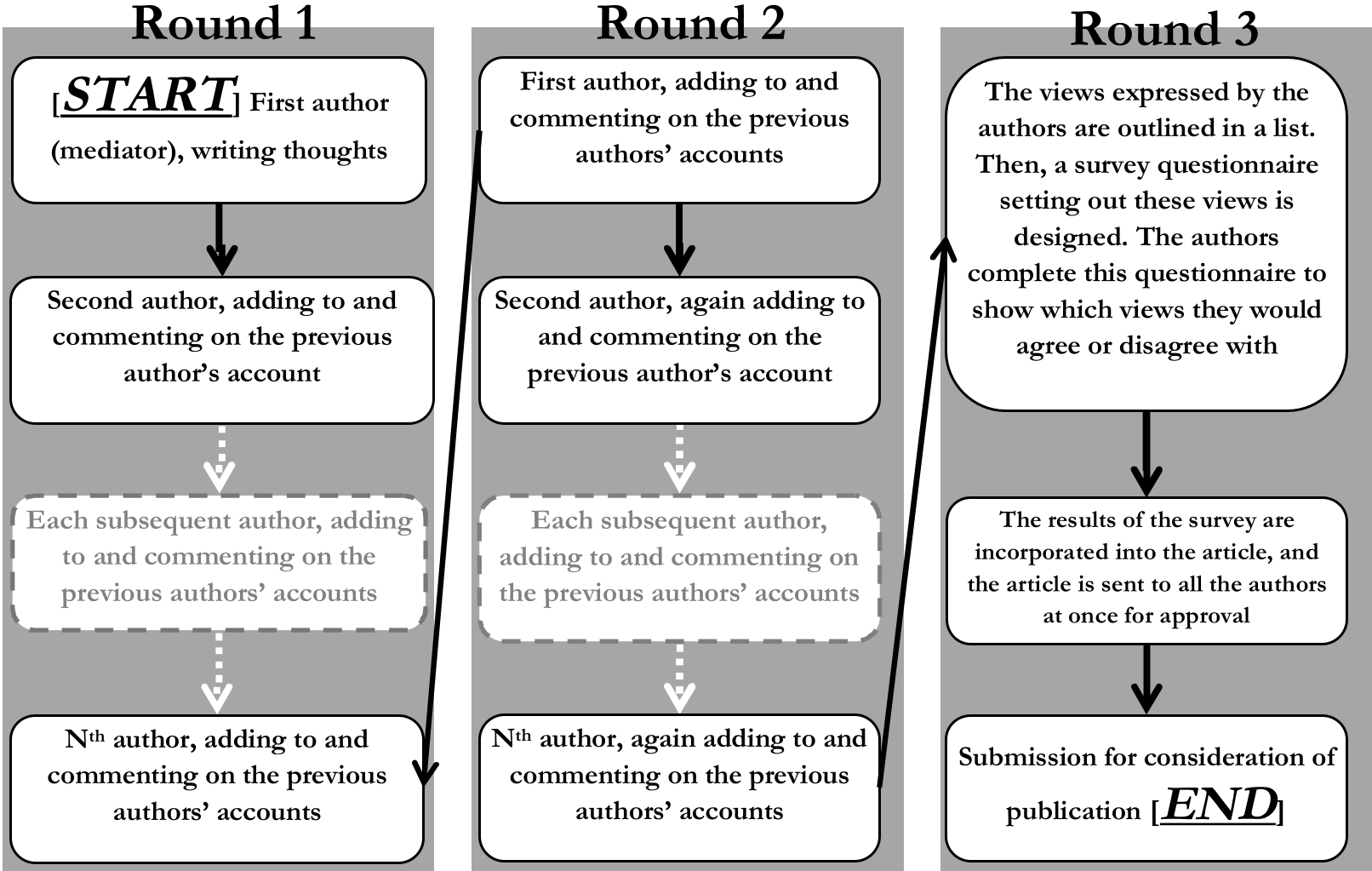
To solve the "too many cooks" dilemma, Al Lily designed a structured three-round workflow inspired by the Delphi Method, but with a twist: instead of seeking consensus, the goal was to highlight tensions and diversity.
1. The Recruitment (Doubled Triangulation)
The mediator sent nearly 2,000 invitations over 20 weeks, using a "doubled triangulation" mechanism to ensure geographic and professional diversity.

2. The Collaborative Rounds
- Round 1: Authors respond to a provocative initial draft.
- Round 2: Authors comment on each other's contributions anonymously, creating a critical "arena."
- Round 3: A final survey categorizes areas of agreement and persistent disagreement, documenting the collaborative "battle."
Insights from the "Battleground"
The experiment revealed that crowd-authoring is a high-stakes political act. Some authors attempted to plagiarize, while others withdrew because the tone was "too negative" or "politically imbalanced." However, the anonymity allowed for a level of raw, honest critique rarely seen in traditional peer review.
Key Findings & Resistance
The study categorized the reasons why scholars refused to participate—ranging from administrative workloads to a lack of faith in the methodology itself.

Critical Analysis & Future Outlook
Al Lily’s work proves that large-scale authorship is technically feasible in the social sciences. More importantly, it challenges the definition of an "author." If a scribe writes others' work, and a compiler organizes it, the "Crowd-Author" (turba-auctor) represents a second generation of scholarship: Authorship 2.0.
Limitations
- Mediator Power: The first author (mediator) still wields significant influence over the initial draft and final compilation.
- Scalability: Beyond 100 authors, the process risks descending into "authoring obesity" or administrative collapse without dedicated software.
The Future: An Assembly of Action
The author concludes by recommending the formation of a permanent "Assembly of Authoring"—a global body of scholars funded to produce authoritative, multi-perspective papers on a regular basis. This vision transforms the scientist from a passive observer into a member of an "Assembly of Action," using collective voice to drive social intervention.
Takeaway: Crowd-authoring is not just about writing; it is a "virtual public sphere" where the act of collaboration becomes as important as the resulting paper.