
From Feeling to Fleeing: Deciphering the Psychological Link Between Crowd Emotion and Action
A study on relation between crowd emotional feelings and action tendencies
This research establishes a specialized framework of 13 crowd-specific emotional feelings (6 positive, 7 negative) and investigates their correlation with 11 action tendencies. By categorizing crowds into "Event" and "Non-Event" types, the study provides a psychological foundation for designing self-report software aimed at enhancing real-time crowd management and social HCI.
TL;DR
Researchers at Delft University of Technology have mapped the specific emotional landscape of crowds, identifying 13 unique "emotional feelings" and their direct links to 11 behavioral tendencies. Unlike generic emotion models, this work distinguishes between the "Event Crowd" (e.g., festivals) and the "Non-Event Crowd" (e.g., commuting), offering a blueprint for future self-report tools that help managers move beyond CCTV to understand why a crowd moves the way it does.
The "Outsider" Problem in Crowd Management
For decades, managing thousands of people has been a game of "detecting the abnormal." Security cameras and proximity sensors treat humans as moving points on a graph—detecting flows and bottlenecks but remaining blind to the psychological pressure cooker within.
The authors argue that current HCI and management strategies suffer from two flaws:
- Negative Bias: Crowds are often viewed as inherently dangerous or chaotic.
- Emotional Ambiguity: Using daily emotion scales (like "happy" vs. "sad") fails to capture the unique sensations of a crowd, such as the sense of "belongingness" or the physical/psychological claustrophobia of "feeling stuffy."
Methodology: Building a Crowd-Specific Taxonomy
The researchers conducted four distinct studies to bridge the gap between abstract feeling and concrete action.
1. Defining the Vocabulary
By surveying 110 participants, the study found that crowd emotions overlap very little with Scherer’s 39 daily emotions. Terms like Bustling, Togetherness, and Breathless emerged as descriptors that combine physical sensation with social context.
2. Visualization and Mapping
The 13 refined emotional feelings were visualized into cartoon prototypes to be used in digital self-report tools, ensuring a shared visual language for participants across cultures.
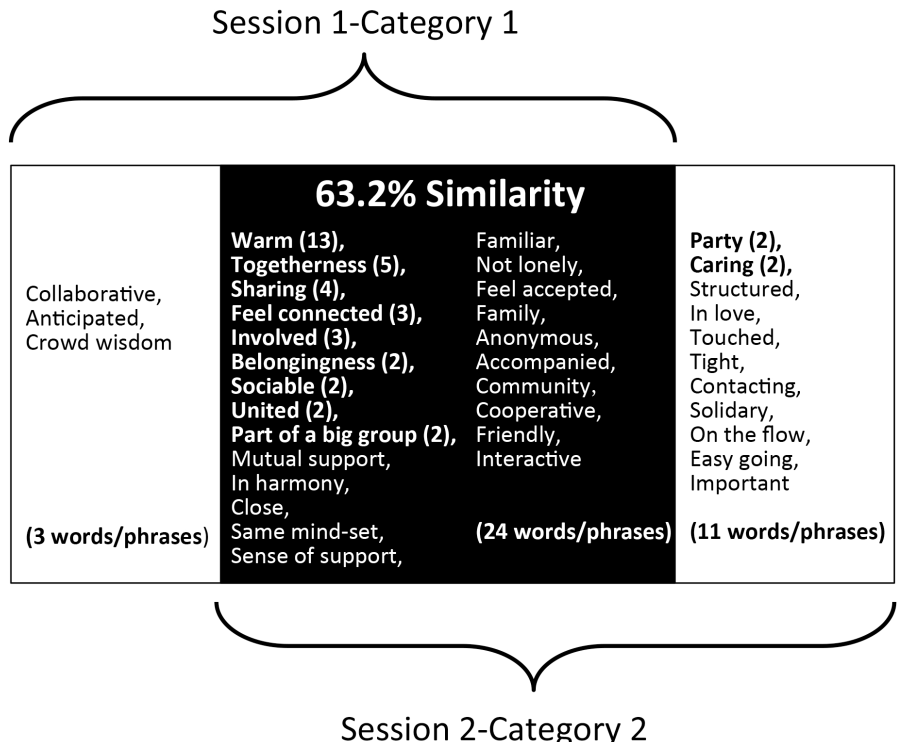 Figure: Prototype visualizations of positive crowd emotional feelings.
Mapping Emotions to Actions: The Heat Map Insights
The core of the paper lies in its "Action Readiness" analysis. The researchers linked the 13 feelings to 11 tendencies, such as Protection, Avoidance, Attending, and Exuberance.
Event vs. Non-Event Dynamics
- In Event Crowds (Festivals, Concerts): "Excited" is the peak feeling. Interestingly, even when intensity is high, action tendencies like Protection and Avoidance are largely absent.
- In Non-Event Crowds (Commuting, Queues): "Feeling Stuffy" and "Confused" dominate. Surprisingly, "Anxiety" behaves differently depending on its strength. Strong Anxiety triggers high arousal and restlessness (the need to move), whereas Weak Anxiety triggers a need to "be with" others for protection.
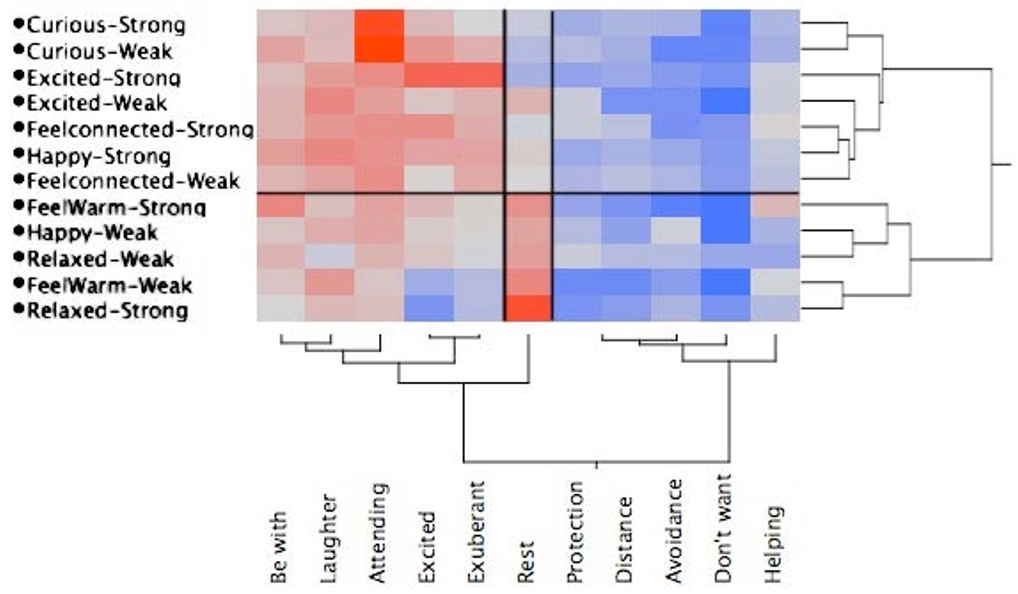 Figure: The correlation between positive emotional feelings and action tendencies in Event Crowds.
Deep Insight: The Value of "Insider" Data
The study highlights a critical "helping" paradox: Participants in Non-Event crowds showed a higher tendency to help others when feeling positive than those in Event crowds. In a festival setting, people are often so self-absorbed in the experience that their "helping" tendency remains low, even when happy.
SOTA Comparison & Limitations
Compared to previous work by Russell or Martella, which focused on 2D arousal scales or physical proximity graphs, this work provides high-resolution psychological data.
Limitations:
- Recall Bias: The data relies on remembered experiences rather than real-time "in-the-moment" reporting.
- Normalcy Bias: The study avoids "extreme" situations (riots or disasters), where the link between emotion and action might undergo a phase transition into panic.
Conclusion: The Future of Social HCI
This research paves the way for "Crowd Emotion Monitors"—apps where users can report "Feeling Small" or "Alert." For a manager, seeing a sudden spike in "Weak Anxiety" across a transit station would be a signal to provide information to reduce confusion, whereas "Strong Anxiety" would signal a need for more physical space to prevent restlessness from turning into a surge. This is the transition from reacting to crowd movement to proactively managing crowd psychology.
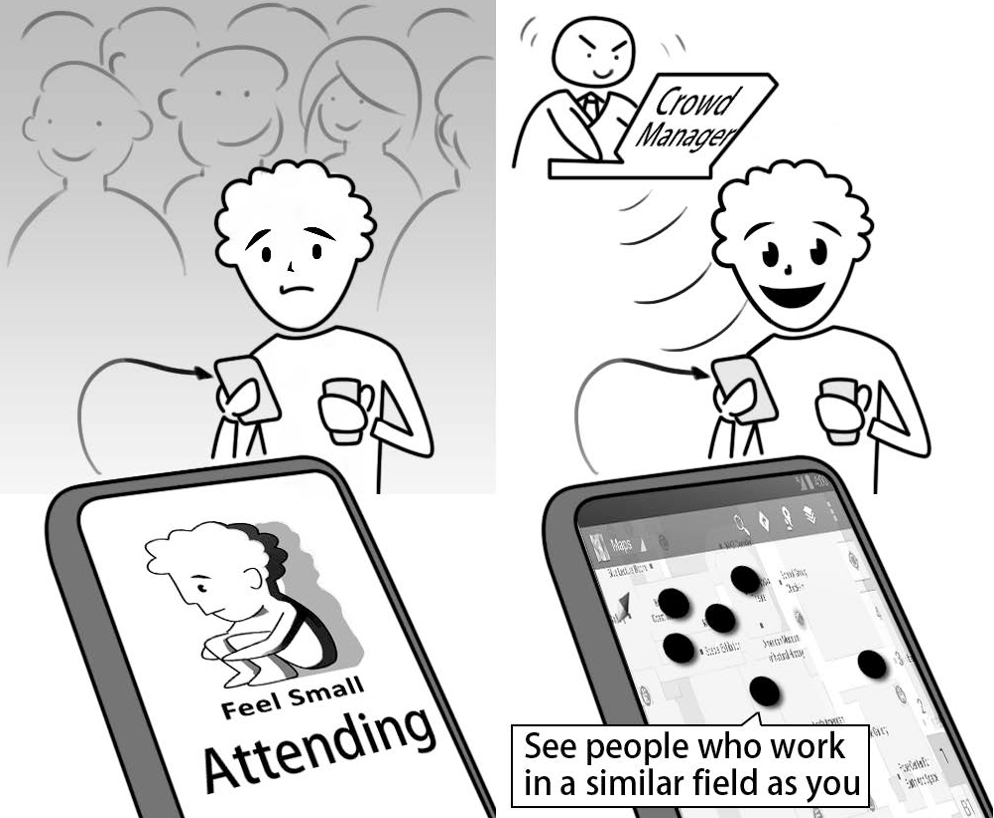 Figure: A conceptual self-report tool allowing crowd managers to intervene based on psychological feedback.