
Crowd vs. Experts: Is Nichesourcing the Key to Deep Metadata?
Crowd vs Experts: Nichesourcing for Knowledge Intensive Tasks in Cultural Heritage
This paper introduces "Nichesourcing" to address knowledge-intensive annotation tasks in Cultural Heritage. By deploying a comparative experiment on the Rijksmuseum flower collection, the authors demonstrate that while experts provide higher botanical accuracy (41% vs 20%), crowd workers can still offer valuable common-name annotations for complex datasets.
TL;DR
Transcribing "a flower" is easy; identifying a Rosa Gallica in a 19th-century monochrome lithograph is a "knowledge-intensive" challenge. This paper explores Nichesourcing—a specialized variety of crowdsourcing—to bridge the gap between expensive museum experts and the scalable but general-purpose crowd. The results? The crowd can actually do it, but "majority voting" isn't enough when the difficulty spikes.
The Problem: The "Generic Metadata" Trap
Museums like the Rijksmuseum Amsterdam hold hundreds of thousands of prints. Currently, these are often tagged with broad, low-value terms like "bird" or "flower" because high-level botanical identification requires time and specialized skills that curators simply don't have. Traditional crowdsourcing (like Amazon Mechanical Turk) is great for identifying "a cat," but fails when the task requires identifying "fantasy" flowers versus specific botanical species in stylized art.
Methodology: Designing for Expertise
The researchers set up a comparative testbed between 4 domain experts and 75 crowd workers. They categorized 86 prints from the Rijksmuseum into four buckets based on Prominence (is the flower the main subject?) and Quantity (single vs. multiple flowers).
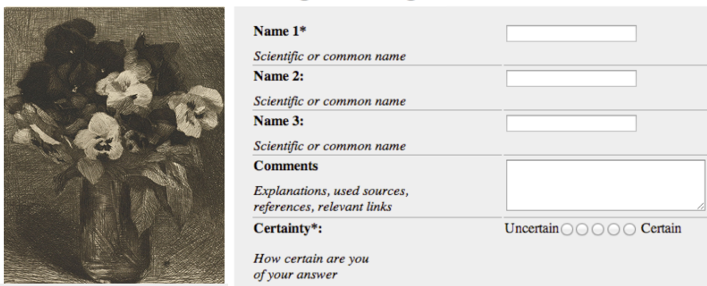
The interface didn't just ask for a tag; it captured:
- Specificity: Workers were pushed to provide the most specific name possible.
- Certainty Score: A 1-5 scale to measure internal confidence.
- Qualitative Feedback: Comments to explain why a tag was "unable" to be provided.
Key Insights from the Results
The study revealed a fascinating "Expertise Gap." While experts provided botanical names 41% of the time, the crowd managed it 20% of the time. While this seems low, it confirms that 1 in 5 crowd tags reached an expert level of specificity for just 5 cents per image.
Performance Table
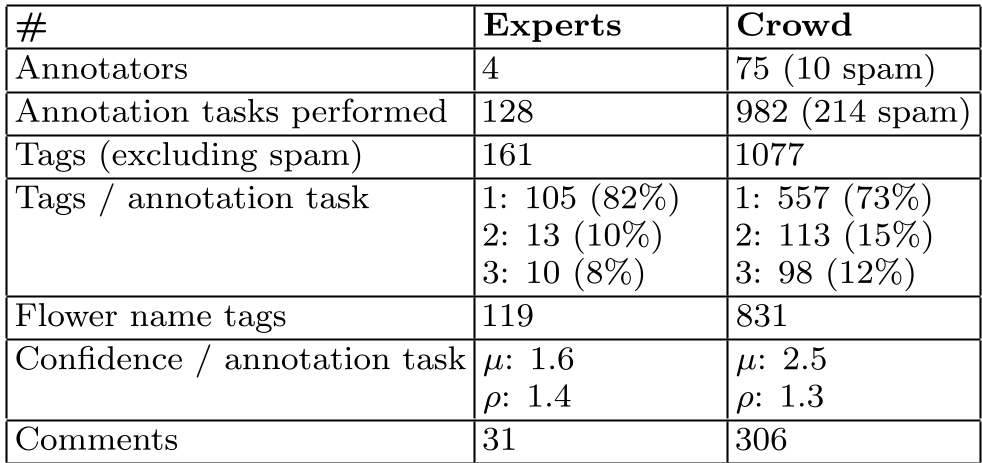
The Complexity Tax: As the number of flowers increased (the MP and MNP categories), the agreement between annotators plummeted. In these "knowledge-intensive" scenarios, the classic Majority Voting algorithm (the gold standard for simple crowdsourcing) failed. If the crowd doesn't know the answer, they don't converge on a single wrong answer—they diverge.
Critical Analysis: Why This Matters
The most profound takeaway is that Task Difficulty is the primary driver of behavior.
- Low Difficulty (Single/Prominent): The crowd and experts behave similarly; majority voting works.
- High Difficulty (Multiple/Non-prominent): The crowd provides common names, while experts provide botanical ones.
The authors suggest a "More Articulated Process." In modern AI terms, this is effectively a Pipeline Approach: use the general crowd to detect and segment the flowers (easy), and then route those specific cropped images to a "niche" crowd or an expert-in-the-loop system for classification (hard).
Conclusion & Future Outlook
This paper, while an early exploratory study, laid the groundwork for how we handle specialized datasets today. In the age of AI, the "Nichesourcing" model is evolving. Instead of using the crowd to provide final tags, we now use them to create high-quality "Gold Standard" datasets to train specialized Vision Transformers.
If you are building a system for Cultural Heritage or any field with a "Long Tail" of domain knowledge (like medical imaging or legal tech), the lesson is clear: Don't just ask the crowd "What is this?"; ask them "How sure are you?" and split the task by visual complexity.
Referenced Paper: Oosterman, J., et al. (2014). "Crowd vs. Experts: Nichesourcing for Knowledge Intensive Tasks in Cultural Heritage." WWW '14.