
Crowd Foraging: Redefining Mobile Crowdsourcing via Opportunistic Intelligence
Crowd Foraging: A QoS-Oriented Self-Organized Mobile Crowdsourcing Framework Over Opportunistic Networks
The paper introduces "Crowd Foraging," a self-organized mobile crowdsourcing framework that utilizes Device-to-Device (D2D) communications in opportunistic networks to proactively recruit nearby workers. By formulating worker recruitment as an online multiple stopping problem, the authors derive an optimal threshold-based policy that achieves a 30-40% QoS improvement over classic recruitment baselines.
TL;DR
Crowd Foraging is a proactive, self-organized framework that allows mobile requesters to recruit nearby workers via D2D (Bluetooth/WiFi-Direct) links. By treating worker recruitment as a mathematical "Multiple Stopping Problem," the framework significantly boosts Quality of Service (QoS) and reduces task latency compared to traditional centralized platforms like Amazon mTurk.
Background & Motivation: The Latency of Centralization
Most mobile crowdsourcing today is passive. A requester posts a task to a cloud server and waits—often for hours—for a worker to find and claim it. In applications like location-based sensing or urgent image transcription, this delay is unacceptable. Furthermore, centralizing every small task creates massive traffic and storage bottlenecks.
The authors propose a shift from "centralized posting" to "opportunistic foraging." Imagine walking through a conference or a campus; your phone "sniffs" out nearby users, evaluates their potential "work ability" based on their movement patterns or expertise, and recruits them on the spot via D2D communication.
Methodology: The Science of "When to Stop"
The core of the paper lies in solving the Exploitation vs. Exploration tradeoff. If you encounter a worker with 70% ability, do you recruit them now or wait for a potential 90% worker later?
1. Modeling Work Ability
The authors use extensive data-driven analysis (Folksonomy datasets like Delicious and CiteULike, and mobility traces like Dartmouth) to prove that worker interest and visiting frequency follow a Gamma Distribution. This provides a robust mathematical foundation for predicting the quality of future encounters.
2. The Online Multiple Stopping Problem
The recruitment is modeled as a sequential decision process. The requester wants to recruit workers to maximize the sum of service quality . The optimal solution is derived using backward induction, leading to a Threshold-Based Policy:
- Threshold : This value represents the minimum service quality a requester should accept at time when workers are still needed.
- Dynamic Nature: These thresholds are non-increasing over time—as the deadline approaches, the requester becomes less "picky."
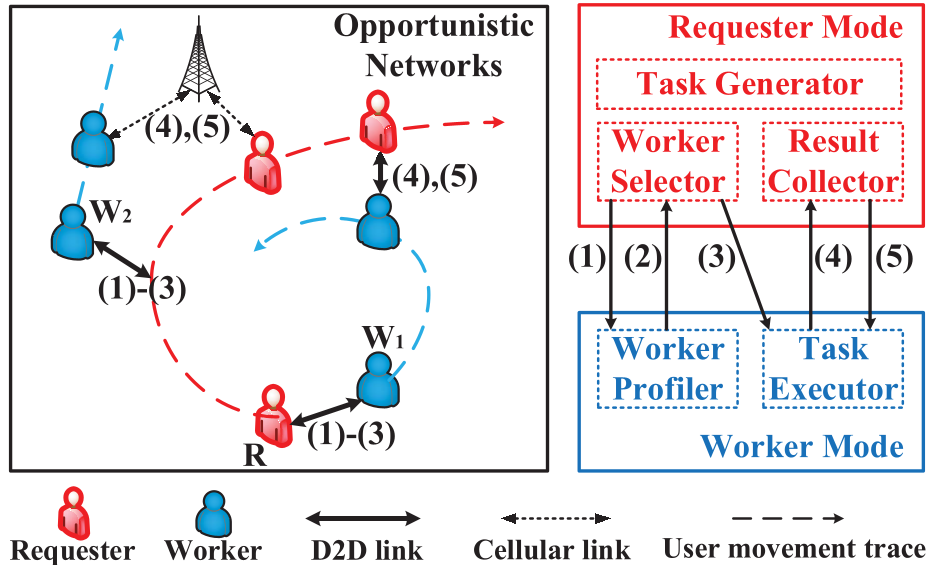 Figure 1: The Crowd Foraging working procedure involving D2D recruitment and result collection.
Experiments: Superior QoS Performance
The authors tested "Crowd Foraging" against three baselines using the ONE Simulator and real user traces (Infocom06/MIT Reality):
- Greedy: Recruit anyone better than your current average.
- mSecretary: A variant of the classic secretary problem (skip the first workers to set a benchmark).
- Random: Arbitrary recruitment.
Key Findings:
- QoS Gains: The proposed policy consistently achieved 30-40% higher QoS than the baselines across diverse network densities.
- Real-time Adaptation: It performed exceptionally well under "Hard-Deadline" scenarios (1-0 Step Function) where tasks expire quickly.
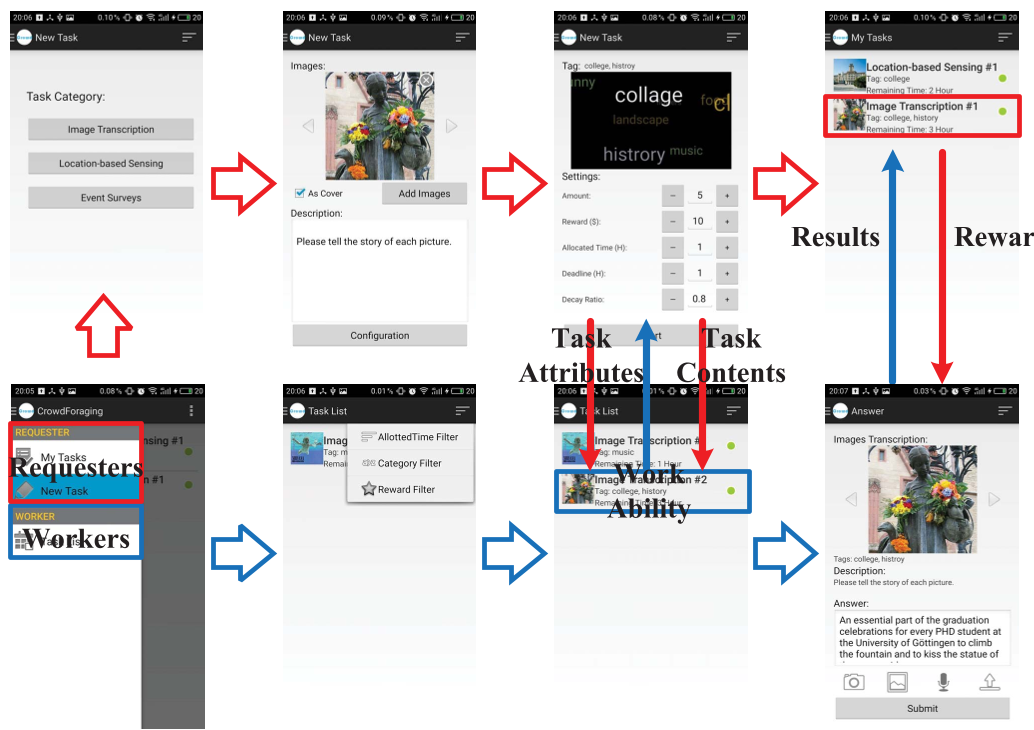 Figure 2: QoS Ratio Comparison under different worker requirements.
Prototype Success: Practical and Lightweight
Theoretical gains often come at the cost of battery life. However, the Android prototype analysis showed:
- Energy Efficiency: Continuous Bluetooth discovery consumed only 6.8mW.
- Computation Speed: Calculating optimal thresholds for a task requiring 20 workers took only 1.5 seconds.
Critical Analysis & Deep Insight
The brilliance of this work is its One-Hop Constraint. While previous academic works focused on complex multi-hop routing (forwarding tasks through many people), this paper realizes that in a dense urban environment, your immediate neighbors are usually sufficient. This insight simplifies the protocol, reduces multi-hop "noise," and makes the framework feasible for modern smartphones.
Limitations:
- Trust & Reputation: While mentioned, a decentralized framework is highly vulnerable to "malicious workers" providing fake results. Future iterations would need a robust, offline-compatible reputation system.
- Incentive Compatibility: The current model assumes workers accept rewards based on a fixed probability. Dynamic bargaining in D2D encounters remains an open challenge.
Conclusion
Crowd Foraging stands as a powerful "Cyber Foraging" paradigm. For developers and researchers in 5G/6G D2D technologies, this paper provides a concrete mathematical blueprint for how to unlock the hidden "human CPU" power available in our immediate physical proximity.