
Crowd Guilds: Professionalizing the Gig Economy through Strategic Re-centralization
Crowd Guilds: Worker-led Reputation and Feedback on Crowdsourcing Platforms
This paper introduces "Crowd Guilds," a centralized worker-led organizational structure for crowdsourcing platforms like Amazon Mechanical Turk and Daemo. By implementing double-blind peer assessment and hierarchical leveling, the system establishes a self-governing reputation mechanism that significantly outperforms current decentralized metrics.
TL;DR
Crowdsourcing has long been defined by radical decentralization, but this "independence" has a dark side: broken reputation systems and race-to-the-bottom wages. Crowd Guilds fixes this by looking backward to medieval history to build forward-looking tech. By allowing workers to peer-review each other and "level up," the authors created a reputation signal that is actually more accurate than the platform's own metrics.
The Paradox of Decentralization
On platforms like Amazon Mechanical Turk (MTurk), workers are treated as isolated nodes. While this ensures "the wisdom of crowds" via independent judgment, it destroys the institutions that define professional work: mentorship, quality certification, and collective bargaining.
The most visible failure is Reputation Inflation. When everyone has a 99% approval rating, no one is special. Requesters can't find experts, and experts can't justify higher fees. The authors argue that to fix the crowd, we must partially re-centralize it through worker-led collectives.
Methodology: The Guild Infrastructure
The researchers implemented Crowd Guilds on Daemo, an open-source crowdsourcing platform. The core engine is a "Double-Blind Peer Assessment" loop:
- Random Sampling: The system automatically pulls 10% of a worker's submissions.
- Hierarchical Review: A Level 2 worker reviews Level 1's work. This preserves authority and ensures the "expert" actually understands the task.
- Actionable Feedback: Beyond just a score, reviewers provide "I Like, I Wish, What If" critiques.
- Continuous Leveling: Workers don't just stay in one spot; a moving average of their last 10 reviews determines if they get promoted to higher pay grades or demoted for subpar work.
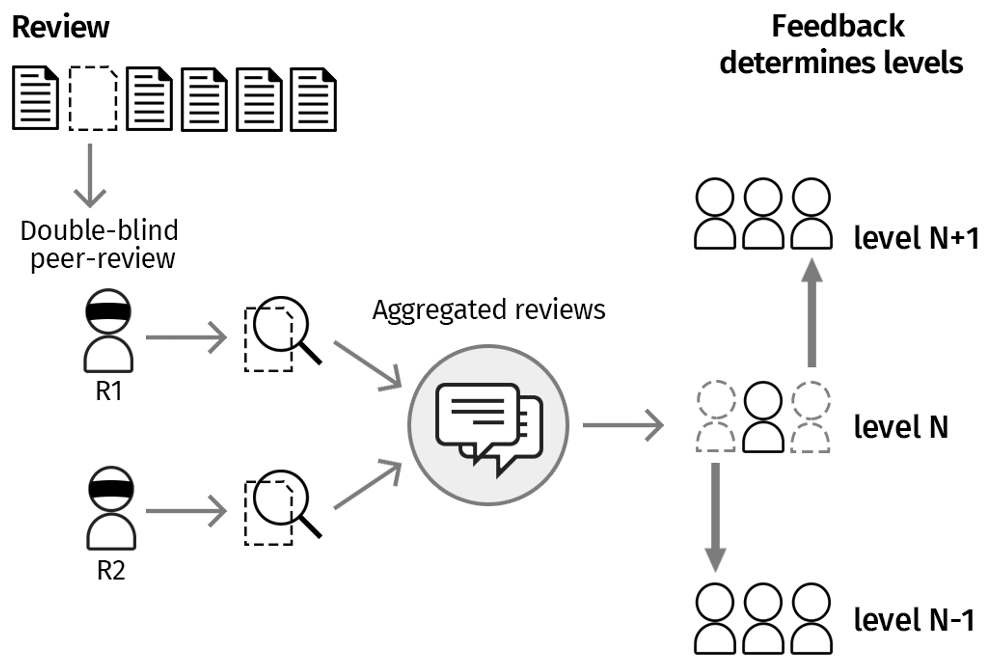 Figure 1: The Crowd Guild workflow where peer-review drives leveling and reputation.
Experiments & Results: Accuracy Over Flattery
In a field study comparing a "Guild" group against a "Control" group, the results were striking:
- True Quality Prediction: The Guild ratings strongly correlated with "ground-truth" accuracy (tasks where the answer was known). MTurk's standard reputation signals had zero significant correlation.
- The End of Inflation: In the Guild condition, workers became more discerning. They weren't afraid to give lower scores because they knew the rating carried weight for the community's integrity.
- Pragmatism Wins: Guild members gave direct, "professionalized" advice (e.g., "You missed the second requirement") whereas control members gave vague emotional support.
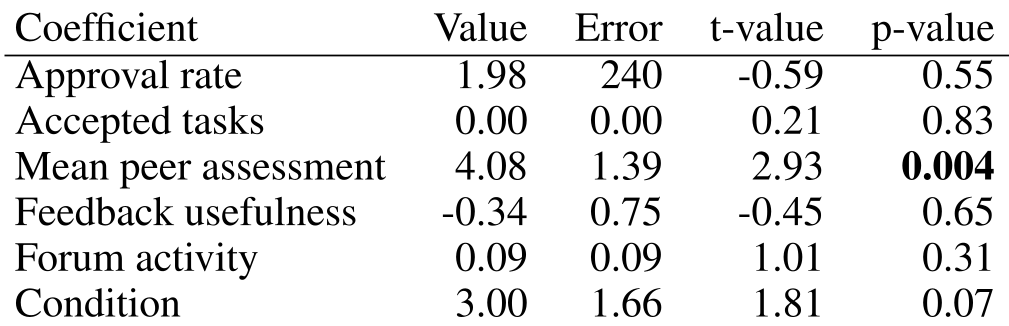 Table 1: Regression showing that Mean Peer Assessment is the only significant predictor of actual worker accuracy.
Deep Insight: "Us vs. Us" instead of "Us vs. Them"
One of the most fascinating findings is how Guilds shift the social dynamic. Usually, it's Workers vs. Requesters (or the Platform). Guilds introduce a horizontal accountability.
While some "Lone Wolf" workers disliked having their fate in the hands of peers, the majority found that the guild provided a path to higher status and better pay. The study even explored Collective Rejection, where 3% of a guild could vote to "blackball" a task that paid too little, essentially automating a strike.
Conclusion & Future Outlook
Crowd Guilds prove that worker communities can govern themselves more effectively than algorithmic managers. However, challenges remain:
- Scalability: Can a guild of 10,000 stay fair, or will it become an oligarchy?
- Cold Start: How do you start a guild when no one is "Level 2" yet?
The takeaway for the industry is clear: Trust is a social product. If we want high-quality AI training data and ethical labor conditions, we must give workers the tools to certify themselves.
Takeaway: Peer-governance isn't just a social ideal; it's a statistically superior way to manage quality in the gig economy.