
CrowdAE: Elevating Crowdsourced Web Accessibility Through Managed Human Inspection
CrowdAE: A Crowdsourcing System with Human Inspection Quality Enhancement for Web Accessibility Evaluation
CrowdAE is a specialized crowdsourcing-based Web Accessibility Evaluation (WAE) system that integrates a tri-fold mechanism—learning, assignment, and review—to improve the reliability of manual accessibility testing. It achieves superior accuracy in evaluating large-scale Chinese government websites compared to prior manual-crowd hybrid models.
TL;DR
Web Accessibility Evaluation (WAE) is a critical but labor-intensive task that current automated tools cannot handle alone. CrowdAE introduces a structured crowdsourcing framework that transforms ordinary volunteers into competent evaluators through a dedicated learning path, intelligent task matching, and a rigorous review cycle, significantly boosting the accuracy of large-scale accessibility audits for government infrastructure.
Context: The Professionalism Gap in Crowdsourcing
While the World Wide Web continues to expand, digital barriers for people with disabilities remain pervasive. Traditional WAE relies on a hybrid of automatic tools and manual inspection. However, manual testing by experts is unscalable and expensive.
Crowdsourcing seems like a logical solution, but there is a catch: WAE is a professional skill. Most volunteers lack the nuanced understanding of WCAG (Web Content Accessibility Guidelines) or local standards like YD/T 1761-2012. Without a quality control layer, crowd-contributed data is often too "noisy" to be actionable for government-level compliance.
The CrowdAE Methodology: Beyond Simple Task Distribution
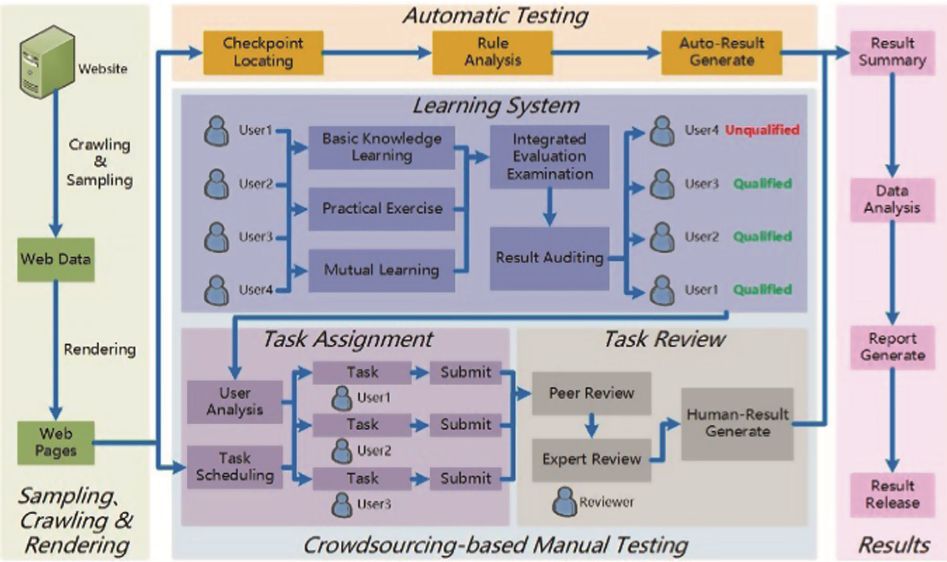
The core innovation of CrowdAE lies in its "Crowdsourcing-based Manual Testing" module. Instead of assigning tasks indiscriminately, the system follows a three-stage lifecycle:
1. The Learning System (The "Novice-to-Expert" Pipeline)
Before touching real tasks, evaluators enter a training environment. This includes:
- Theory Learning: Basic accessibility concepts.
- Practical Self-Checking: A recommendation engine provides similar examples to help users understand specific checkpoints.
- Qualification Tests: Only those who pass a standardized test are allowed to participate in formal evaluations.
2. Intelligent Task Assignment
The system doesn't just push tasks; it schedules them based on personalized analysis. If an evaluator is confused by a specific page's complexity, they can opt out, prompting the system to dynamically re-assign the task to someone with a more suitable profile.
3. Multi-Tier Task Review
To ensure the "Ground Truth," CrowdAE employs a hierarchy of reviews:
- Multiple Judgments: Each checkpoint is scrutinized by several evaluators.
- Peer & Expert Review: When results diverge, the system triggers a review process to resolve conflicts, ensuring the final report generated is reliable.

Real-World Impact: Government Scale Testing
The authors validated CrowdAE by evaluating 30 Chinese government websites in 2017 and comparing the results to the data from 2016 (collected via the older CWAES system).
Key Findings:
- Accuracy Boost: The accuracy rate of manual inspections saw a measurable increase across different categories of websites.
- Scalability: By utilizing 30 diverse volunteers (varying ages and vocations), the system proved it could manage heterogeneous contributors without sacrificing professional standards.
Depth Insight: Why It Works
The success of CrowdAE suggests that the "Crowdsourcing" label is often a misnomer for what should actually be called "Distributed Human-in-the-Loop Professional Services." By implementing a Learning System, the authors effectively reduced the Inductive Bias of untrained evaluators. The inclusion of people with disabilities in the crowd also provides a "lived experience" layer that purely automated or expert-only audits might miss.
Future Outlook & Limitations
While CrowdAE significantly improves accuracy, the two-week training period represents a high barrier to entry for casual volunteers. Future iterations could explore:
- AI-Assisted Training: Using LLMs to provide real-time feedback to evaluators during the learning phase.
- Cross-Domain Adaptation: Applying this structured crowdsourcing model to other professional domains such as medical data labeling or legal document review.
In conclusion, CrowdAE demonstrates that with the right pedagogical and structural safeguards, the "power of the crowd" can be refined into a high-precision instrument for social good.