
CrowdCO-OP: Transforming the Gig Economy from Piecework to Participation
CrowdCO-OP : sharing risks and rewards in crowdsourcing
The paper introduces CrowdCO-OP, a novel crowdsourcing reward mechanism that transitions from traditional piecework payments to a risk-sharing co-operative model. By pooling rewards and redistributing them based on time spent rather than tasks completed, it achieves a standardized hourly wage and mitigates the financial risks of unfair rejections and poorly rewarded tasks.
TL;DR
The current crowdsourcing landscape is a "wild west" where workers bear all the risk. CrowdCO-OP proposes a paradigm shift: move away from paying per task (piecework) and toward a cooperative, time-based reward system. The result? Workers feel more secure, "cheating" plummets, and the quality of complex data annotations actually increases.
The "Efficiency Trap" in Crowdsourcing
In traditional platforms like Amazon Mechanical Turk, a worker's income is a direct function of . If a task is unexpectedly difficult or a requester is unfair, the worker loses time—their only currency.
This creates a toxic incentive structure:
- Cherry-picking: Workers avoid new or complex tasks to minimize risk.
- The "Rush" Effect: Workers prioritize speed over quality to maximize their hourly rate.
- Information Asymmetry: Requesters hold all the power, often rejecting work without justification.
Methodology: Sharing the Burden
The authors' core insight is that risk is easier to bear when shared. They developed a platform where rewards are pooled. If a group of 10 workers earns 10 per hour they contributed, regardless of whether their specific task was the "unlucky" one that took too long or got rejected.
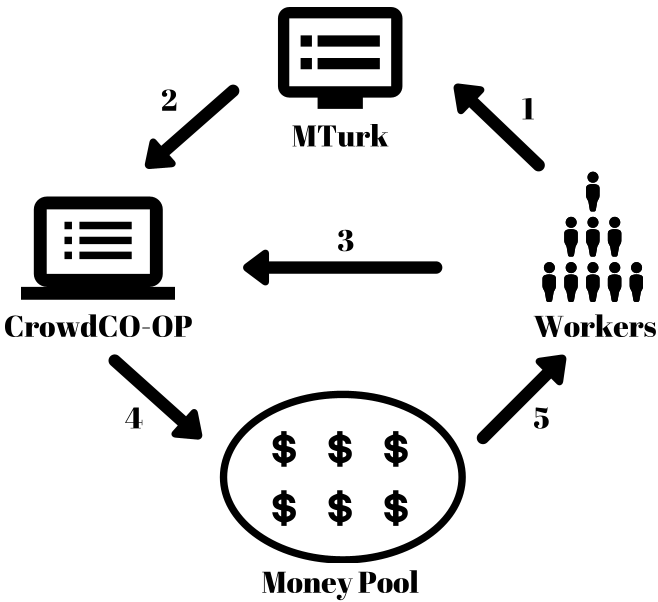
The study utilized a 2x2 factorial design, testing Shared vs. Piecework rewards and Visible vs. Hidden incentives.
Experimental Insights: Quality Over Speed
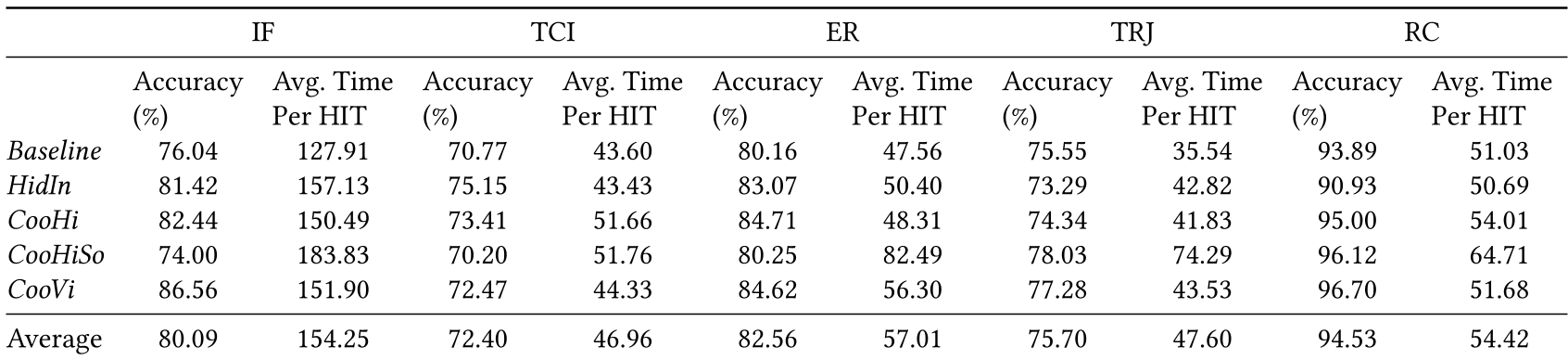
The most striking finding was in specialized tasks like Information Finding (IF). In the Baseline (piecework) group, workers rushed. In the CooVi (Cooperative Visible) group, they spent significantly more time—and the accuracy followed.
Key Performance Metrics:
- Accuracy Boost: In complex Entity Resolution, the co-op group outperformed the baseline.
- Death of the Cheater: Malicious actors who submit tasks in <1 second to "farm" money found the co-op model unprofitable, as they were paid for time, not volume.
Challenging the "Free-Rider" Myth
A common criticism of cooperative models is the "free-rider" problem—people doing nothing while getting paid. However, the authors found:
- Minimal Slow-Workers: Only 0.4% of HITs were completed by truly slow workers.
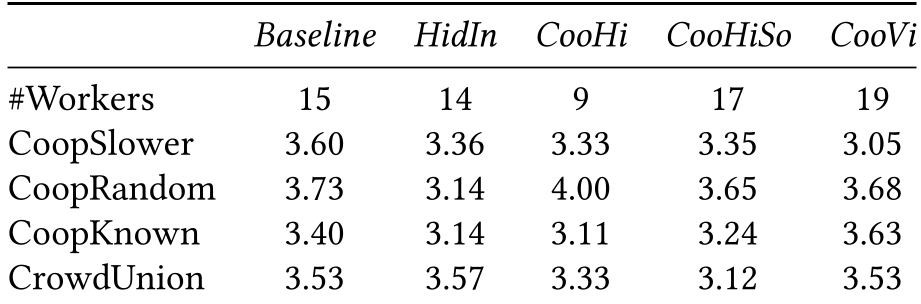
- Peer Approval: Surprisingly, workers in the post-survey agreed that it was fair for slower peers to get the same hourly rate, fostering a sense of a "Crowd Union."
Deep Insight & Conclusion
CrowdCO-OP proves that the "malicious worker" is often a product of a malicious system. By removing the frantic pressure of piecework, we see the emergence of a professional, diligent workforce.
Future Outlook: This model could pave the way for "Platform Cooperativism" in the wider gig economy—imagine Uber drivers sharing the risk of "no-passenger" hours or Upwork freelancers pooling resources for sick leave. The technology exists; now we need the social shift.