
CrowdDefense: Unmasking Sophisticated Spam in Crowdsourcing via Trust Vectors
CrowdDefense: A Trust Vector-Based Threat Defense Model in Crowdsourcing Environments
CrowdDefense is a novel trust vector-based threat defense model designed to protect crowdsourcing platforms from spam workers. By leveraging a Crowdsourcing Trust Network (CTN) and a Worker Trust Vector (WTV), it achieves a high honest worker selection rate of over 95%, significantly outperforming traditional reputation-based baselines.
TL;DR
Crowdsourcing platforms are increasingly under siege by "spam workers" who don't just submit poor work, but actively manipulate the system through collusion. CrowdDefense moves beyond simple star ratings, introducing a Worker Trust Vector (WTV) that analyzes a worker's position within a global trust network. By evaluating trust from the perspective of different requester tiers, it filters out 95% of attackers even when they are heavily supported by accomplices.
The Problem: The "Reputation Laundering" Crisis
In platforms like Amazon Mechanical Turk (AMT), the primary filter is the "Approval Rate." However, attackers have evolved. They utilize three primary strategies to masquerade as elite workers:
- S1 (Imitation): Copying profiles of high-performing workers.
- S2 (Reputation Boosting): Creating fake tasks (Shadow HITs) and hiring accomplices to provide perfect ratings.
- S3 (Strategic Collusion): Mixing honest work with malicious voting to stay under the radar.
Traditional Reputation-based systems see these attackers as "good" because their metrics are artificially inflated. Verification-based models (test questions) are too expensive to run at scale once the pool is poisoned.
The Methodology: Decoding the Trust Network
The authors propose that while a spammer can fake a high score, they cannot fake a healthy network position.
1. Crowdsourcing Trust Network (CTN)
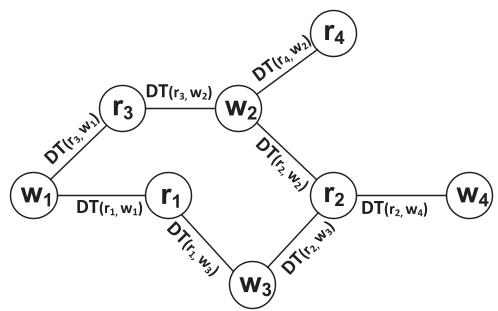
Instead of isolated scores, CrowdDefense maps the entire ecosystem. Nodes consist of Requesters () and Workers (), connected by edges weighted by Direct Trust (DT)—the actual approval rate of specific transactions.
2. Strength of Trust (SOT) & Trust Traces
The core innovation is how the model infers trust across indirect links. If Requester A trusts Worker B, and Worker B is hired by Requester C, what is the "Trust Trace" () between A and C? CrowdDefense uses a random walk-based SOT estimation algorithm to find "Trust Paths."
3. The Worker Trust Vector (WTV)
A worker is no longer represented by a single number, but by a 3-element vector:
- Deterministic Trust (DeT): Trust derived from authenticated (verified) requesters.
- Non-Deterministic Trust (NDeT): Trust from active reputable users.
- Ordinary Trust (OT): Trust from the general user base.
The Intuition: A spammer might boost their by colluding with fake accounts, but they will almost always have a low because they cannot easily trick the platform’s manually verified requesters.
Experimental Battleground
The model was tested against the soc-sign-epinions dataset (over 800k edges). The authors simulated three increasingly complex threat patterns (A, B, and C) involving spam requesters, "grey" requesters (who mix behaviors), and "grey" workers.
Performance vs. Baselines
CrowdDefense was compared against CrowdTrust, H2010e, and the standard AMT model.
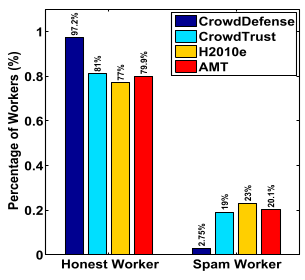
- Accuracy: CrowdDefense maintained a selection purity of ~95% honest workers.
- Resilience: While baselines saw their honest worker ratio drop to 47% as spammers increased, CrowdDefense remained stable.
- Cliques: The model successfully identified "collusion cliques" by noticing that spammers only had high trust traces leading back to their specific group of accomplices.
Critical Insight: Why it Works
The genius of CrowdDefense lies in its Inductive Bias. It assumes that "Trust is not transferable through a single point of failure." By requiring a worker to be trusted by three distinct classes of requesters, it forces attackers to infiltrate the most secure part of the platform (Authenticated Requesters) to succeed—a task that is economically or technically prohibitive for most botnets.
Conclusion & Future Outlook
CrowdDefense marks a shift from attribute-based security (what is your score?) to structural security (where do you stand in the network?).
Limitations: The reliance on "Authenticated Requesters" suggests a centralized bottleneck. If these accounts are compromised, the metric could be weaponized.
Future Work: The authors aim to tackle even more complex threats, likely moving toward dynamic, time-aware trust graphs that can catch "sleepy" spam accounts that wait months before attacking.