
Beyond Just Labels: CrowdED and the Quest for Standardized Crowdsourcing Quality Control
CrowdED and CREX: Towards Easy Crowdsourcing Quality Control Evaluation
This paper introduces CrowdED (Crowdsourcing Evaluation Dataset) and CREX (CReate Enrich eXtend), a benchmarking ecosystem designed to standardize the evaluation of crowdsourcing Quality Control (QC) methods. CrowdED provides a multi-domain, information-rich dataset featuring 280,000+ contributions with detailed worker profiles, while CREX offers a framework for collaborative data extension and campaign management.
TL;DR
The reliability of crowdsourced data is the bedrock of Modern AI training, yet the tools we use to evaluate Quality Control (QC) are fragmented and insufficient. This paper presents CrowdED, a high-fidelity dataset that bridges the gap between worker demographics, task semantics, and label quality, alongside CREX, a framework that allows researchers to collaboratively expand this benchmark.
The "Silo" Problem in Crowdsourcing Research
In the academic landscape of crowdsourcing, most papers follow a predictable pattern: propose a new aggregation algorithm, test it on a private or limited dataset (like the classic RTE or ImageNet subsets), and claim victory.
However, as the authors point out, this creates an evaluation vacuum. If Method A relies on worker history (Reputation) and Method B relies on worker demographics (Selection), they can almost never be compared on the same dataset because standard benchmarks usually strip away "extraneous" metadata. We are essentially comparing apples to oranges in a dark room.
Methodology: The Anatomy of a Future-Proof Dataset
The authors didn't just collect more labels; they redesigned the metadata schema for crowdsourcing. CrowdED is built on four pillars of specification:
- S1: Richness: Capturing not just the result, but the context (23 worker features).
- S2: Diversity: Spanning multiple domains (Sport, Fashion, Disaster Relief) and task types (Sentiment, Extraction).
- S3: Abundance: Ensuring a "Dense" contribution matrix where workers overlap significantly to test aggregation stability.
- S4: Extensibility: Providing the CREX framework to prevent the dataset from becoming obsolete.
The CREX Framework
The true innovation lies in the CREX framework, which acts as a "pipeline-as-a-service" for dataset creation.
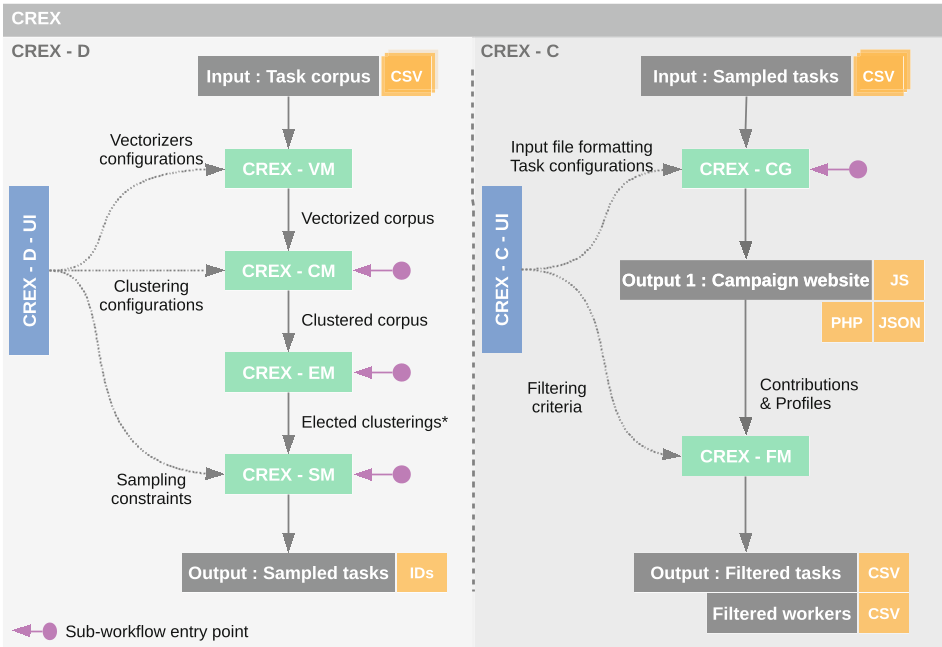
- CREX-D (Data Preparation): Uses NLP (TF-IDF and Doc2Vec) to cluster raw tasks, ensuring researchers sample a representative "slice" of different task types.
- CREX-C (Campaign Management): Dynamically generates the UI and handles the backend database, mapping individual worker behaviors (like time spent per page) directly to their contributions.
Experimental Validation: Plugging the Gap
The authors performed a rigorous qualitative audit of existing datasets (like TREC 2011, RTE, and Product Search) against CrowdED.
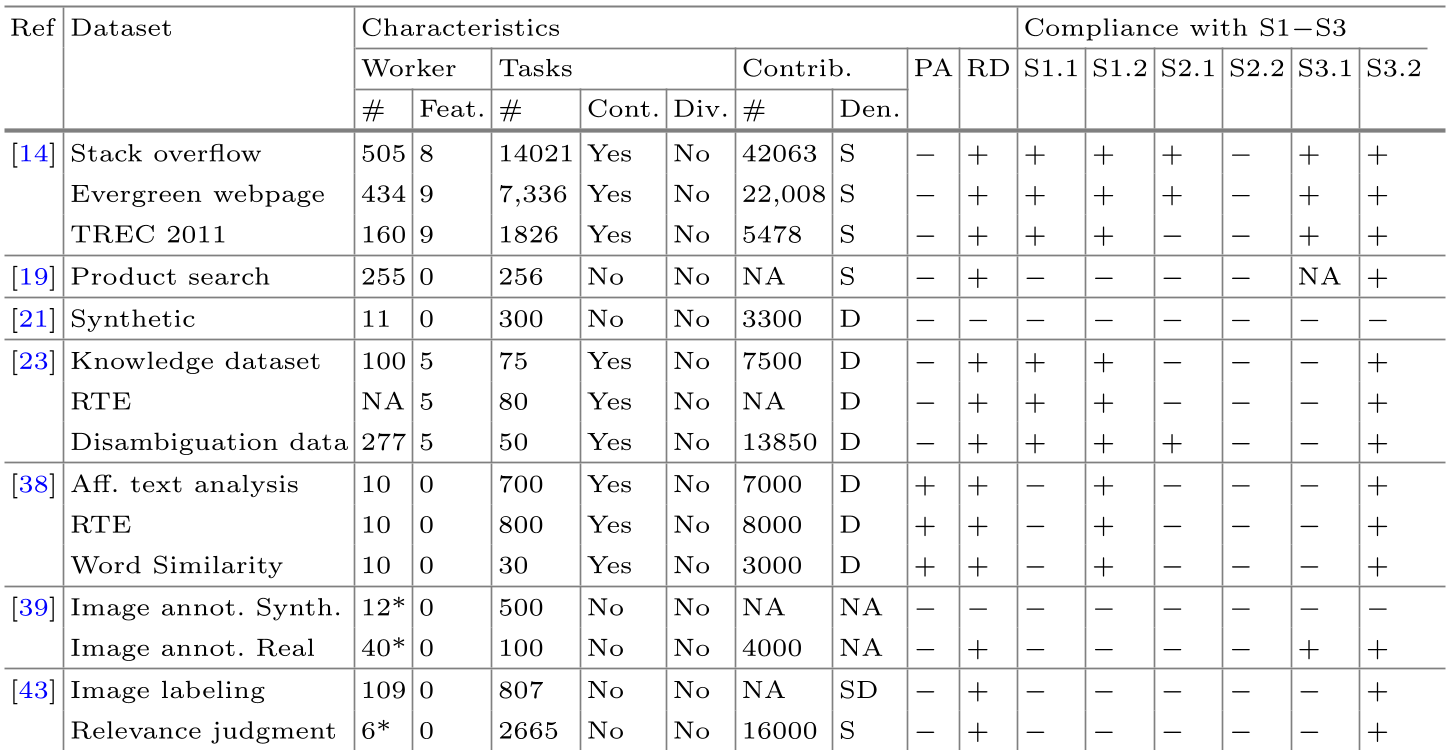
The results are stark: prior datasets are almost entirely "Sparse" or "Semi-Dense," and nearly all fail to provide declarative worker profiles. CrowdED, by contrast, provides a "Dense" set of 200 workers who have answered every task in the set, providing a rare "ground-truth-gradient" for testing how quickly different algorithms converge.
Critical Insight: The Behavioral Dimension
One of the most valuable aspects of CrowdED is the inclusion of Behavioral Features. Most QC methods assume workers are static entities. By tracking time-to-complete and profile-consistency ratings, CrowdED allows researchers to model worker fatigue and malicious intent—phenomena that are ubiquitous in real-world crowdsourcing but missing from the math of many theoretical papers.
Conclusion & Future Outlook
CrowdED and CREX move the needle from "data collection" to "data science" within the crowdsourcing domain. By adhering to FAIR principles, the authors ensure that this isn't just a static file on a server, but a living ecosystem.
Limitations: While the dataset is rich, 525 tasks is still modest in the era of LLMs. However, the strength of the CREX framework means the community can (and should) contribute to scaling this to thousands of tasks while maintaining the high metadata standards set by the authors.
Future Work: We expect to see this dataset used to train Context-Aware Quality Control systems that can predict worker reliability before they even cast their first vote, based purely on their profile and the semantic difficulty of the task at hand.