
CrowdEV: Accelerating Software Development via Expert-Supervised Micro-Tasks
CrowdEV: Crowdsourcing Software Design and Development
CrowdEV is a novel software development framework that integrates expert supervision with micro-task crowdsourcing. By decomposing requirement engineering and development into granular, parallelizable units (RET, MDT, FDT), it achieved the development of a campus SNS application in just 5 days.
TL;DR
CrowdEV is a crowdsourcing ecosystem designed to transform the slow, linear process of software development into a highly parallelized, micro-task-driven engine. By combining the agility of the crowd with the precision of expert Project Managers and Architects, the framework reduced the development cycle of a functional SNS app from 17 days to a mere 5 days.
Problem & Motivation: The Agony of Traditional Development
In the modern Internet era, "software is eating the world," yet the way we build it remains largely artisanal. Traditional "offline" requirement-gathering and isolated team development creates a bottleneck. While crowdsourcing (e.g., Amazon Mechanical Turk) works for image labeling, it traditionally fails for software because:
- Interdependence: Code in one module often relies on another that hasn't been written yet.
- Quality Variance: The "crowd" lacks the cohesive vision required for a unified software architecture.
- Communication Overhead: Explaining the context to dozens of transient workers often takes longer than writing the code.
The authors’ insight was to bridge this gap by introducing Expert Supervision. Instead of a "flat" crowd, they proposed a hierarchy where experts handle the high-level design, while the crowd executes modularized technical "micro-tasks."
Methodology: The Four Pillars of CrowdEV
The core of CrowdEV lies in its structured workflow, dividing responsibilities among four distinct roles:
- Requester: Provides the raw idea.
- Project Manager (Expert): Translates ideas into a formal Product Requirement Document (PRD).
- Architect (Expert): Decomposes the PRD into technical modules.
- Worker (Crowd): Executes micro-tasks.
The Task Hierarchy
To enable parallelism, the platform defines three task types:
- RET (Requirement Enrich Task): The crowd refines features and scenarios.
- MDT (Module Develop Task): High-level architectural components.
- FDT (Function Develop Task): Granular coding tasks often involving individual functions or UIs.
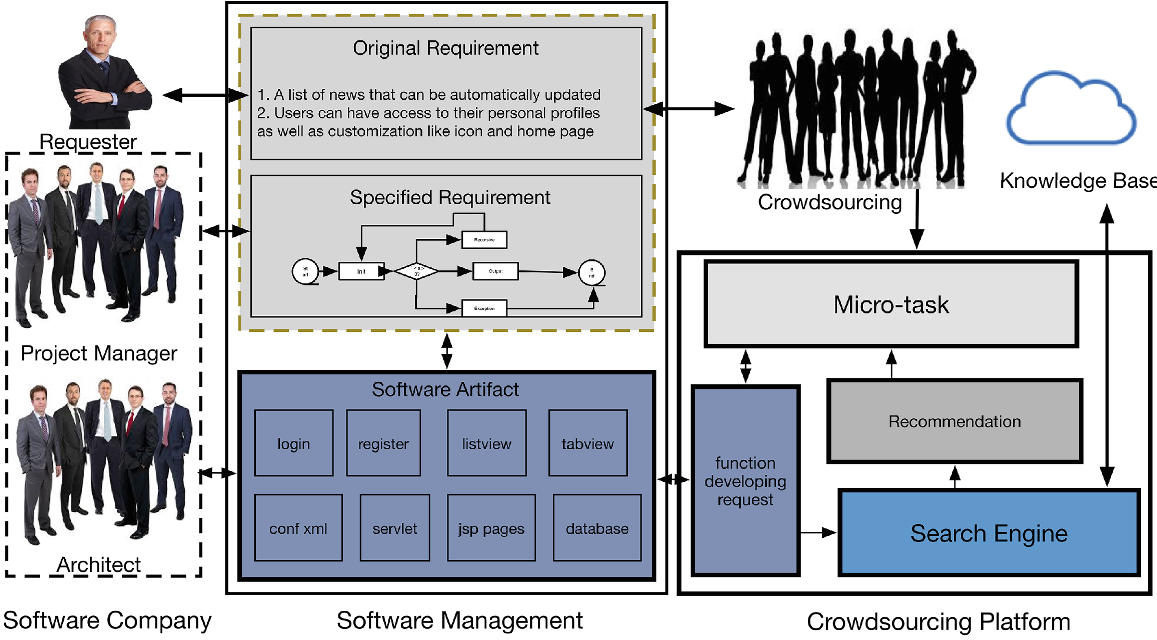
Overcoming Dependencies
How do you write a function that calls another function that doesn't exist yet? CrowdEV utilizes code recommendation (fetching similar snippets from GitHub) and pseudo-call replacement, allowing developers to proceed with "placeholder" logic that is finalized during the assembly phase led by the Architect.
Experiments & Results: A 3.4x Speedup
The authors validated CrowdEV by developing a campus Social Networking Service (SNS) app.
Comparative Performance
Using 9 student workers and 2 professionals, the team completed the project in 5 days. A similar open-source project with the same amount of participants took 17 days.
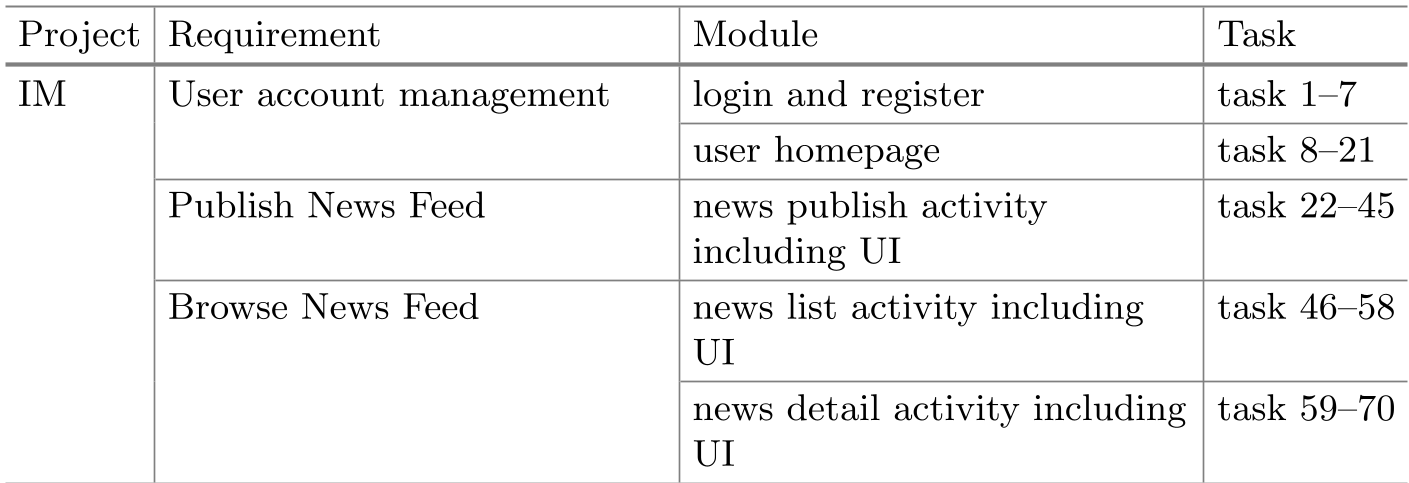
The project generated 70 developmental micro-tasks, demonstrating that even a relatively small codebase (1,044 lines) can be hyper-fragmented to maximize parallel efficiency.
Critical Analysis & Conclusion
Takeaway
CrowdEV proves that the "Human Computation" model can be scaled to complex engineering tasks if the Inductive Bias of a professional architect is applied to the workflow. The expert provides the "skeleton," while the crowd provides the "muscle."
Limitations
- Architect Bottleneck: As noted by the authors, the Architect still bears a heavy burden in designing and assembling modules. In a larger project, this individual could become a single point of failure.
- Platform Restriction: The current implementation is limited to Android development. Expanding this to full-stack or cross-platform environments would significantly increase the complexity of the "pseudo-call" management.
Future Outlook
With the rise of Generative AI (LLMs), the "Worker" role in CrowdEV may soon be filled by AI agents, while the "Expert" roles remain human-centric. This hybrid "Human-AI Crowdsourcing" could potentially reduce the 5-day cycle to hours.