
CrowdEyes: Breaking the Lab Walls with Crowdsourced Eye Tracking
CrowdEyes: crowdsourcing for robust real-world mobile eye tracking
CrowdEyes is a hybrid mobile eye tracking solution that integrates crowdsourcing with automated gaze mapping to overcome classical computer vision failures in real-world environments. By leveraging human workers via an optimized pipeline, it achieves high-fidelity pupil localization and semantic fixation tagging even under challenging conditions such as extreme sunlight, eyewear, and makeup.
TL;DR
Eye tracking in the "real world" is notoriously difficult—sunlight, glasses, and even mascara can break the best algorithms. CrowdEyes bridges this gap by outsourcing the difficult task of pupil localization to human workers. By combining an smart frame-selection algorithm (MS-SSIM) with a novel "validate-and-refine" workflow, the system achieves 100% detection robustness where traditional computer vision (CV) fails.
The "In-the-Wild" Wall
Automated pupil detection algorithms are masterpieces of geometry, yet they are incredibly fragile. In a lab, they work perfectly. In a cafeteria or under direct sunlight, they collapse. Why?
- Optical Noise: Reflections from glasses and contact lenses create "phantom pupils."
- Occlusion: Droopy eyelids (ptosis) or heavy makeup (mascara) hide the edges that CV depends on.
- Dynamic Lighting: IR-based sensors are blinded by the IR spectrum in natural sunlight.
Historically, researchers dealt with this by simply excluding "difficult" participants—a practice that introduces massive demographic bias.
Methodology: Human Cognition vs. Bruteforce Math
The authors realized that while a computer might struggle to distinguish a pupil from a dark smudge of eye shadow, a human can do it instantly. However, crowdsourcing is usually expensive and slow. CrowdEyes solves this via a four-stage pipeline:
1. MS-SSIM Frame Selection
Capturing at 30Hz-95Hz produces massive redundancy. Instead of sending every frame to workers, CrowdEyes uses Multi-Scale Structural Similarity (MS-SSIM) to identify clusters of near-identical frames. This reduces the crowd workload by 80%, slashing costs while maintaining tracking continuity.
2. The Refinement Loop (The Secret Sauce)
Instead of just firing "bad" workers, CrowdEyes uses a Validation and Refinement interface. If a worker's click deviates too much from sequential physics (e.g., the pupil "teleports" 50 pixels in a millisecond), they are prompted to review their work on a grid and adjust it.
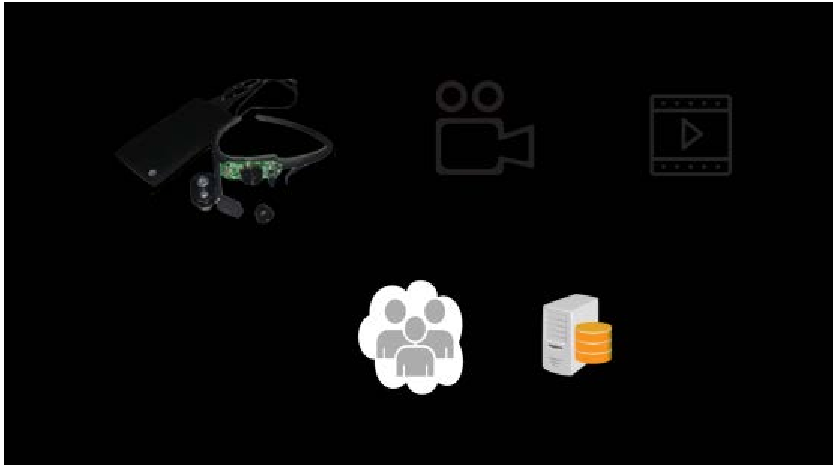 Figure 2: The CrowdEyes ecosystem, linking DIY hardware to a remote crowdsourcing server.
Experimental Results: A Total Victory in Robustness
The paper evaluated the system against the Labeled Pupils in the Wild (LPW) dataset. While state-of-the-art algorithms like ExCuSe or Swirski yielded massive errors or zero detection in 15-20% of cases, CrowdEyes reached 100% coverage.
- Accuracy: 97% of crowdfunded points were within 20px of the ground truth in high-noise outdoor settings.
- Semantic Depth: Beyond just "where" someone looked, the crowd was used to label "what" they saw (e.g., "Sandwich," "Cash Register"), achieving a substantial Fleiss' kappa of 0.67.
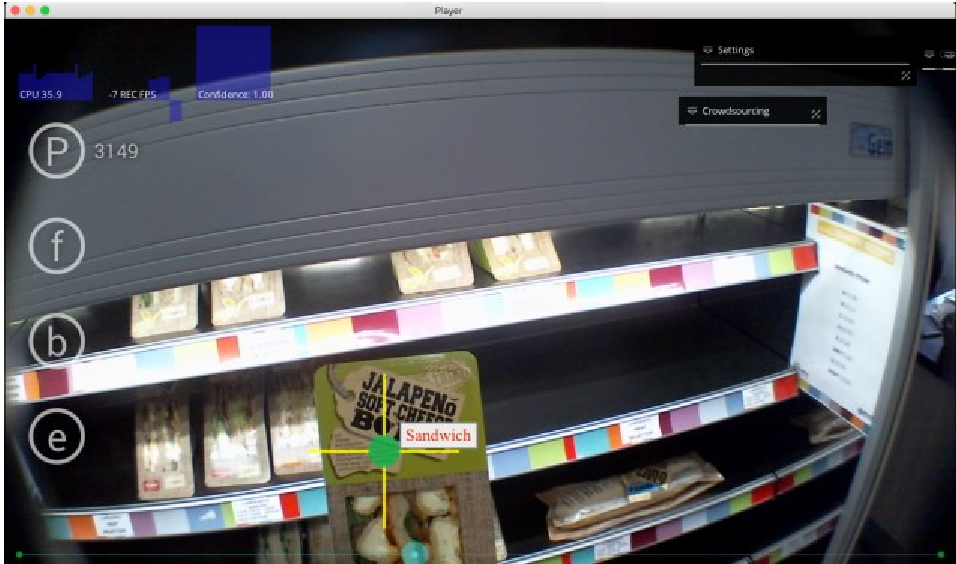 Figure: The CrowdEyes Player showing real-time semantic labeling derived from the crowd.
Critical Insight: The Value of "Fair" Quality Control
One of the most profound takeaways from this research is the human element of crowdsourcing. By allowing workers to refine rather than rejecting them immediately, the authors found that 77% of workers successfully corrected their entries. This not only improved data quality but also increased worker retention—workers were more likely to return to a task where they felt their effort wasn't wasted due to a single mistake.
Conclusion & Future Impact
CrowdEyes effectively commoditizes high-end mobile eye tracking. At approximately $1.40 per minute of processed data, it allows researchers without deep CV expertise to conduct studies in truly unconstrained environments.
More importantly, this framework provides a goldmine for AI: the high-quality labels generated by the crowd can be used as training data for deep neural networks, eventually helping "teach" automated models how to handle the very eye makeup and reflections that currently defeat them.