
CrowdGame: Slashing Labeling Costs via Adversarial Game-Based Crowdsourcing
CrowdGame: A Game-Based Crowdsourcing System for Cost-Effective Data Labeling
CrowdGame is a game-based crowdsourcing system designed for cost-effective large-scale data labeling. It utilizes an adversarial minimax strategy between "Rule Generators" and "Rule Refuters" to select high-quality labeling rules, achieving up to a 10x reduction in crowdsourcing costs compared to traditional per-tuple labeling.
TL;DR
CrowdGame is an innovative system that addresses the "data bottleneck" in machine learning by using a game-theoretic approach to crowdsourcing. Instead of paying workers to label every single row, it uses them to validate and refute labeling rules. Through an adversarial minimax game between "Generators" and "Refuters," the system achieves high-accuracy labeling at 1/10th the cost of traditional methods.
The Scalability Wall in Data Labeling
As deep learning models grow, their hunger for labeled data becomes a financial liability. Traditional crowdsourcing (e.g., Amazon Mechanical Turk) typically follows a per-item labeling model. If you have 1,000,000 tuples, paying for each one—even at cents per task—is unsustainable.
While "Weak Supervision" frameworks like Snorkel have introduced labeling functions to automate this, they face a critical "Garbage In, Garbage Out" problem. If your rules are noisy or have poor coverage, the resulting labels are useless. The authors of CrowdGame recognized that the real challenge isn't just applying rules, but selecting the most effective ones from a sea of noisy candidates.
Methodology: The Adversarial Minimax Game
CrowdGame's brilliance lies in its Two-Player Adversarial Game framework. It treats the pursuit of a perfect rule set as a strategic contest:
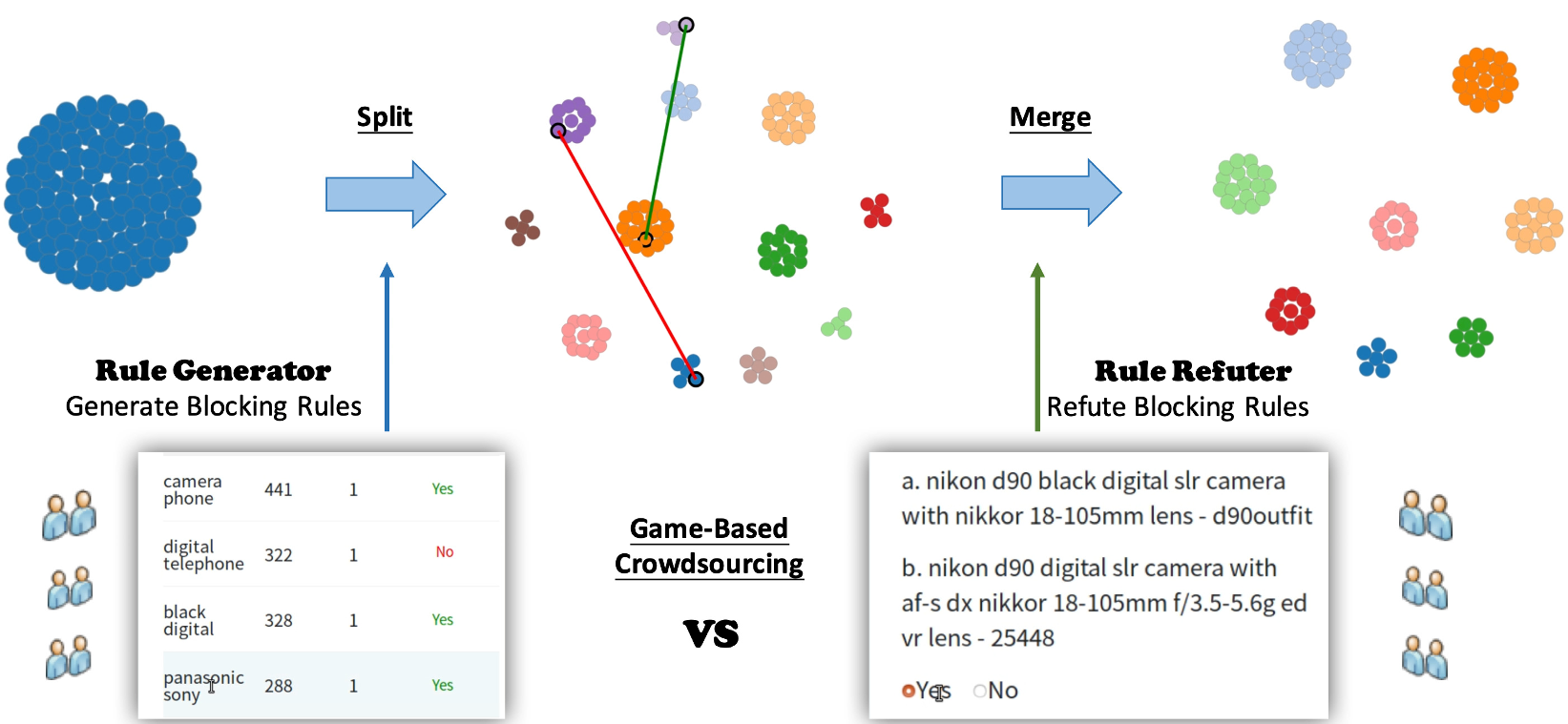
- Rule Generator (The Optimist): This component (backed by crowd workers) aims to select rules that cover the maximum amount of data with the least amount of "perceived" error. Its goal is to minimize the total loss.
- Rule Refuter (The Skeptic): This component searches for "edge cases"—representative tuples covered by the Generator's rules that are likely to be incorrectly labeled. By asking workers to check these specific tuples, it exposes weak rules and maximizes the loss.
This "cat-and-mouse" game continues until the rules become stable (i.e., the Refuter can no longer find significant errors in the Generator's rules).
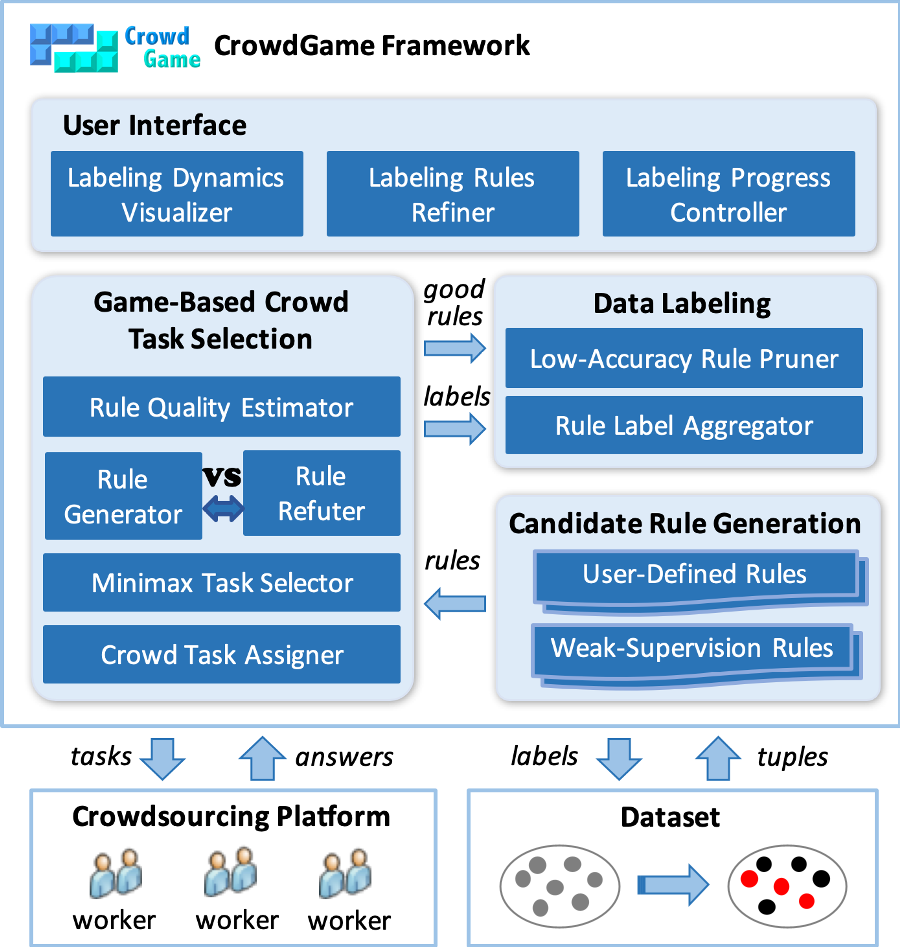
Core Applications: Entity Matching & Relation Extraction
The authors demonstrated the system's effectiveness in two notoriously difficult domains:
- Entity Matching: Identifying if two product descriptions (e.g., from Abt and BestBuy) refer to the same item. CrowdGame generates "Blocking Rules" using word embeddings to identify discriminative keyword pairs like
⟨Canon, Panasonic⟩(which implies a non-match). - Relation Extraction: Identifying relationships like
spousein sentences. The system uses textual patterns (e.g., the word "husband" appearing between two names) as candidate rules and refines them through the game.
Performance & Insights
The results are compelling. By focusing on High-Quality Rule Selection rather than mass-labeling:
- Efficiency: Achieved a 10x cost reduction in Entity Matching.
- Stability: The system provides a visual UI where users can watch "clusters" of data split and merge. When the splitting and merging stabilize, the user knows the labeling is accurate without further spending.
- Hybrid Approach: CrowdGame allows for a "Rule + Model" hybrid, where uncovered tuples can be processed by a machine learning model trained on the newly validated rules.
Critical Analysis & Conclusion
CrowdGame shifts the Inductive Bias of crowdsourcing. Instead of assuming workers are just "labeling machines," it treats them as "logic verifiers."
Limitations: The system's performance is heavily dependent on the initial candidate rule generation. If the automated heuristics (like word mover's distance) fail to produce any viable candidates, the "Generator" has nothing to work with. Furthermore, for extremely niche domains where workers lack the knowledge to "refute" a rule, the adversarial game might converge on a false local optimum.
Future Outlook: As we move toward Foundation Models, the "CrowdGame" approach could be adapted into "LLM-Game," where an LLM acts as the Generator/Refuter, and humans only step in as the final arbiters for the most contentious rules.
Key Takeaway
If you are building a dataset, don't label data; label the logic. CrowdGame proves that a structured, adversarial approach to rule validation is the most cost-effective path to SOTA performance in data-heavy tasks.