
CrowDiffuse: Bridging Social Networks and Physical Crowd Dynamics
CrowDiffuse: information diffusion over crowds with social network
CrowDiffuse is a novel simulation framework that integrates Reynolds’ flocking model with social network theory to model information diffusion in physical crowds. It proposes a dual-condition mechanism (Spatial and Social) to determine how information propagates among moving agents, achieving more realistic simulation results than single-perspective models.
TL;DR
CrowDiffuse is a pioneering framework presented at SIGGRAPH '12 that merges the physics of moving crowds with the logic of social networks. By requiring agents to be both socially connected and physically close to share information, the model provides a high-fidelity simulation of how ideas, moods, or data propagate in the real world.
Background & Positioning
In classical simulation, we often saw a rift: Crowd Simulation focused on avoiding collisions and pathfinding (Spatial), while Information Diffusion focused on graphs and influence (Social). CrowDiffuse acts as the bridge, situating itself as a multi-modal simulation framework that considers human movement and interpersonal relationships simultaneously.
The Core Challenge: The Gap Between Proximity and Relationship
Why is this necessary? In a crowded train station, you are physically close to hundreds of people (Spatial), but you are unlikely to exchange deep information or be influenced by them unless you know them (Social). Conversely, you have social ties to friends across the city, but you cannot communicate through environmental cues unless you are physically near them. Previous models failed by ignoring one of these two essential constraints.
Methodology: The Spatio-Social Filter
The authors utilize Reynolds’ Flocking Model (1987) to handle agent movement and the DBLP co-authorship database to represent a real-world social network.
The "Magic" of the model lies in its dual-gated diffusion:
- Spatial Condition: Agent A must be within the visual/local radius of Agent B.
- Social Condition: There must be a pre-existing link in the network (Link-based) or they must belong to the same social cluster (Community-based).
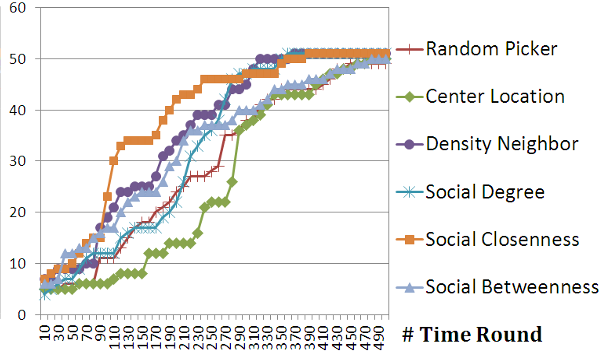 Figure: The diffusion propagation over time, showing the transition from a few informed nodes to an almost entirely informed crowd.
Targeted Diffusion Strategies
The paper investigates how to "seed" the crowd to maximize spread. They compared:
- Spatial Strategies: Random, Center Location, Densest Neighborhood.
- Social Strategies: Degree, Closeness, and Betweenness Centrality.
Experimental Insights
The results provided a clear hierarchy of influence. Socially-driven strategies significantly outperformed spatial ones.
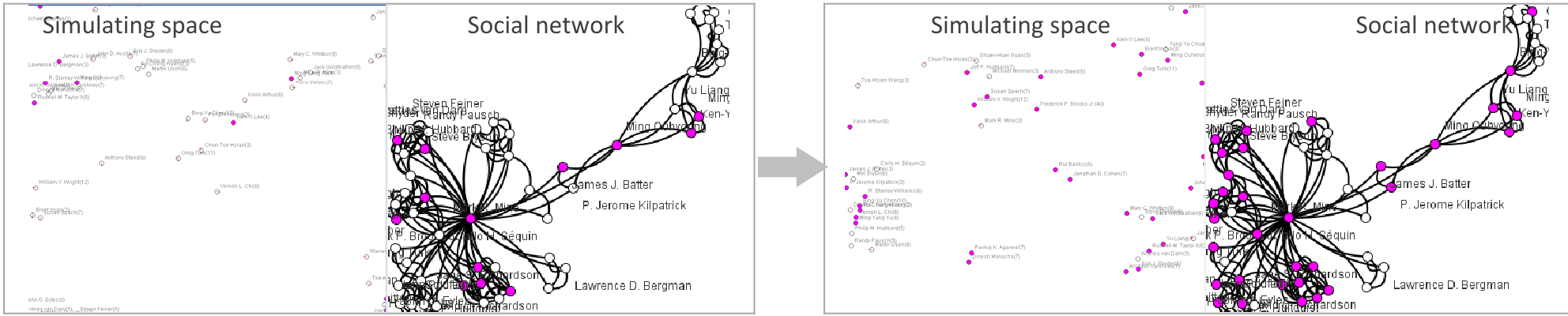 Figure: Comparison of different seeding strategies. Social metrics (in blue/green) consistently outpace spatial metrics.
Key Findings:
- Closeness Centrality is King: Choosing agents who have the fewest "hops" to others in the social network leads to the fastest diffusion.
- Social is the Bottleneck: In a moving crowd, finding someone becomes easy over time (Spatial), but having a social connection (Social) remains a rare and powerful catalyst.
Critical Analysis & Future Outlook
Contribution: CrowDiffuse moved the field away from "anonymous agents" toward "socially-aware individuals." This has profound implications for urban planning, viral marketing, and emergency response.
Limitations:
- The model assumes a static social network; in reality, social ties can be formed through spatial proximity (making a new friend at an event).
- The use of the DBLP dataset (academic co-authorship) may not perfectly represent the dynamics of a casual physical crowd at a mall or stadium.
Conclusion: This work remains a foundational reference for anyone looking to model complex human interactions by reminding us that where we are (Space) is only half the story; who we know (Social) is what truly drives the flow of information.