
CrowdMashup: Balancing Technical Mastery and Social Synergy in Crowdsourcing Teams
CrowdMashup: Recommending Crowdsourcing Teams for Mashup Development
CrowdMashup is a novel recommendation framework designed to form optimal crowdsourcing teams for Web Mashup development. It utilizes NLP-based sentiment analysis on StackOverflow to infer developer skills and applies graph-based clique detection to ensure social synergy, outperforming traditional skill-only or random selection methods.
TL;DR
Building a Web Mashup is like conducting an orchestra—you need the right instruments (APIs) and the right players (Developers). While we have great tools to find APIs, finding the right team is still a manual struggle. CrowdMashup automates this by analyzing StackOverflow data to find developers who not only know the APIs but also actually get along, using a mix of Sentiment Analysis and Graph Theory.
The Missing Link in Mashup Development
Modern mashups (like a real estate app combining Google Maps, Zillow APIs, and Facebook Social login) are complex. Historically, researchers focused on what to use (API recommendation) rather than who should build it.
The authors identify two fatal flaws in current approaches:
- Interest vs. Skill: A developer might know Java, but if they hate working with the Google Maps API, their productivity drops.
- The "Lone Wolf" Problem: A team of five geniuses who have never spoken to each other often performs worse than a cohesive group of mid-level developers who have a history of helpful interaction on StackOverflow.
Methodology: From NLP to Graph Cliques
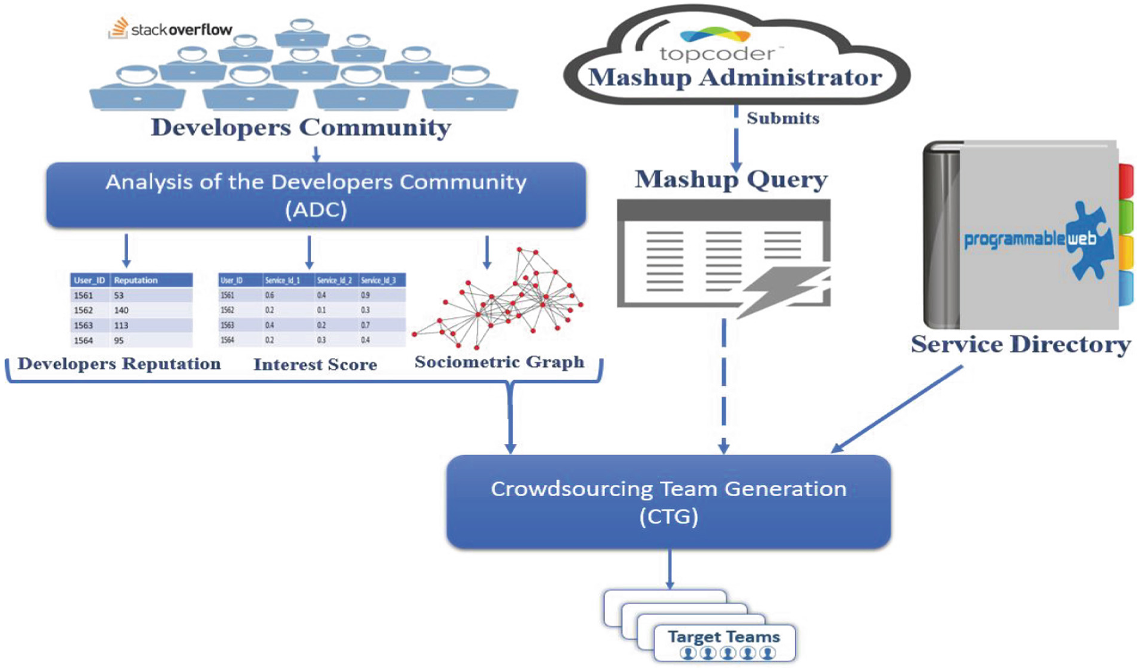
The CrowdMashup architecture is split into an offline analysis phase (ADC) and an online generation phase (CTG).
1. Inferring Technical "Interest"
The system doesn't just look at reputation points. It uses Stanford NLP to perform sentiment analysis on millions of StackOverflow comments.
- Positive sentiment toward an API (e.g., "Google Visualization is efficient") increases an interest score.
- Missing data? They use the Alternating Least Squares (ALS) method—the same tech behind Netflix recommendations—to predict if a developer would be interested in an API they haven't used yet.
2. The Sociometric Graph
Social relationships are modeled as a weighted undirected graph. If Developer A replies to Developer B's question, a link is formed. The weight is determined by the frequency of these interactions.
3. The Algorithm: Hunting for Cliques
To form a team, the system searches for Cliques—subsets of the graph where every member has interacted with every other member.
- Case 1: If a perfect clique of the required size exists, that’s your team.
- Case 2/3: If not, it looks for "Shared Cliques" and fills gaps by prioritizing either raw skill (CTG-Skills) or social connectivity (CTG-Sociometric).
Experimental Results
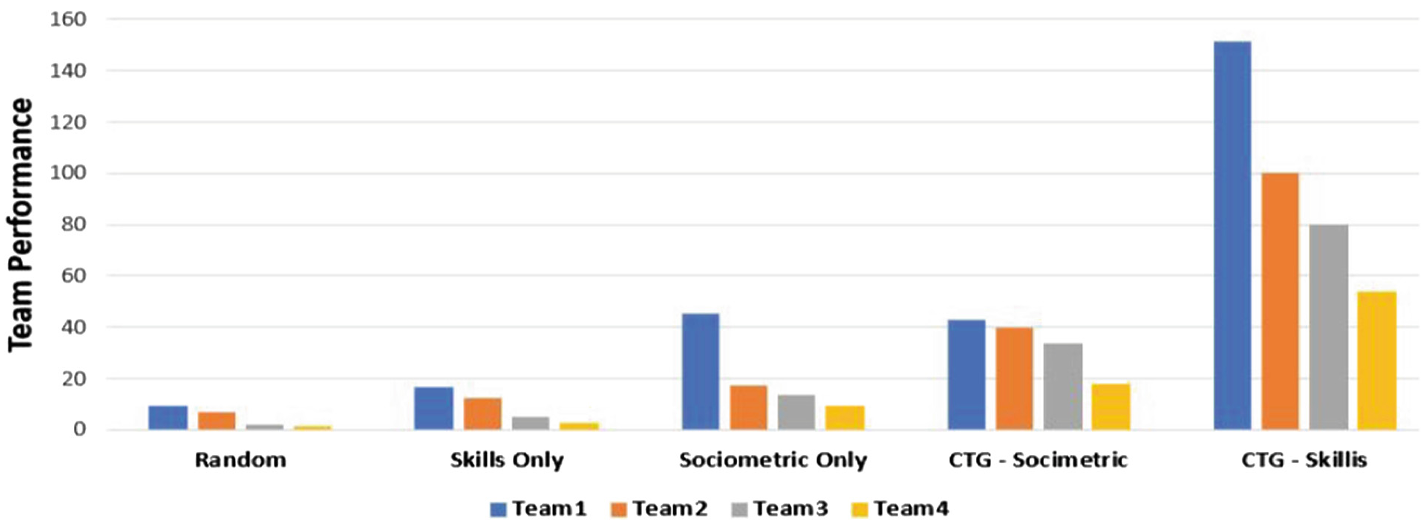
The authors tested their prototype against four other strategies: Random, Skills-Only, Sociometric-Only, and their own CTG variants.
Key Findings:
- Superiority of Hybrid Metrics: CTG-Skills consistently outperformed all others. It turns out that having a social baseline plus high skills is the "secret sauce" for SOTA performance.
- Team Size Matters: The performance peaks at team sizes of 3–7. As teams get larger (e.g., 25+), the likelihood of finding a cohesive social clique drops significantly, leading to a performance decay.
Deep Insight: Why This Matters
The real brilliance of CrowdMashup is its use of "social proxy data." It treats StackOverflow not just as a Q&A site, but as a Latent Social Network. In an era where remote work and crowdsourced "gig" development (like Topcoder) are becoming the norm, being able to mathematically guarantee that a team will have "chemistry" before they even start is a massive industrial advantage.
Limitations: The reliance on sentiment analysis might be skewed by "noisy" comments, and the model currently doesn't account for time zones or developer availability. However, as a foundational step toward "Social-Aware Software Engineering," CrowdMashup is a significant milestone.