
CrowdOp: Balancing the Purse and the Clock in Human-Powered Databases
8693_CrowdOp Query optimization for declarative crowdsourcing systems.
CrowdOp is a cost-based query optimization framework for declarative crowdsourcing systems that optimizes selection, join, and complex queries. It introduces a multi-objective optimization approach to achieve a Pareto balance between monetary cost and response latency, outperforming traditional rule-based crowdsourcing systems.
TL;DR
CrowdOp is a sophisticated query optimizer designed for crowdsourcing systems that treats "Human Intelligence" as a queryable resource. Unlike previous systems that use simple rules, CrowdOp uses cost-based optimization to navigate the complex trade-off between monetary cost and wall-clock latency, ensuring users get their results as fast as their budget allows.
Context: When SQL Meets the Crowd
Crowdsourcing systems like Amazon Mechanical Turk (AMT) have allowed us to solve "human-hard" problems (like identifying images or matching ambiguous records) using SQL-like interfaces. However, the "Execution Plan" for a human query is very different from a silicon one. In a standard DB, time is the main cost. In the crowd, you pay for every "operator" with real dollars, and latency is measured in hours or days, not milliseconds.
The Core Challenge: The Cost-Latency Frontier
Prior systems like Deco utilized rule-based optimization (e.g., always push filters down). While logical, this doesn't work for the crowd. If you have 10 filters, running them one-by-one (Sequential) saves money by filtering out tuples early, but it takes forever (High Latency). Running them all at once (Parallel) is fast but expensive because you pay to check conditions on tuples that might have been filtered out anyway.
CrowdOp addresses this by formalizing two objectives:
- Cost Minimization: Find the cheapest way to get the answer, regardless of time.
- Budget-Bounded Latency: Find the fastest way to get the answer without exceeding $X dollars.
Methodology: The Three Pillars of CrowdOp
1. Selection Optimization
CrowdOp uses Dynamic Programming (DP) to decide whether to batch selection conditions together or sequence them. The intuition is based on selectivity: conditions that filter out the most data for the least cost should be prioritized, but they might be batched to save "iterations."
2. The CFILL-CJOIN Framework
Joining two tables via the crowd is notoriously difficult. CrowdOp introduces a "Fill-then-Join" approach:
- CFILL: Crowdsource the missing attributes used for joining.
- CJOIN: Perform the actual matching.
The optimizer builds a Partition Tree (similar to a hash join logic) and uses a greedy algorithm to decide how much "partitioning" is worth the cost before the actual join is performed.
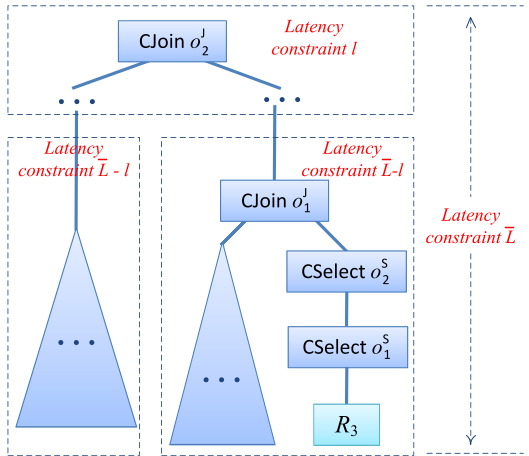 Fig 1: The recursive structure used for optimizing complex selection-join pipelines.
3. Complex Query Allocation
For queries involving both joins and selections, the optimizer must allocate the "Latency Budget" across different branches of the tree. CrowdOp solves this by ensuring that every subtree is locally optimal for its allocated latency, building the plan from the bottom up.
Experimental Validation
The authors tested CrowdOp on both simulations and the real Amazon Mechanical Turk platform.
| Query | Budget | Total Cost | Latency (Iterations) |
|---|---|---|---|
| CQ2 | $240 | $238.5 | 8 |
| CQ2 | $280 | $271.7 | 5 |
As shown in the results, as the budget increases, CrowdOp automatically shifts from a deep, sequential plan to a shallower, parallel plan, reducing iterations from 8 to 5.
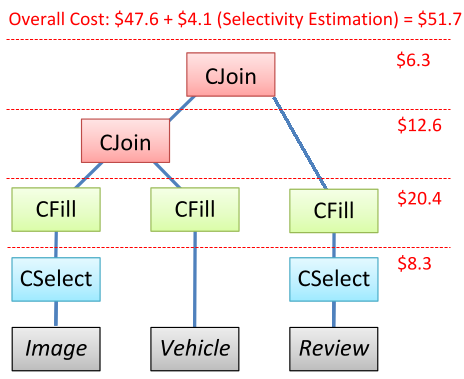 Fig 2: A real-world plan generated for AMT. Notice how the structure changes to meet the 60 budget constraints.
Critical Insight & Future Outlook
CrowdOp's true value lies in its mathematical rigor applied to the "noisy" world of human labor. By treating latency as the "height" of a query tree and cost as the "sum of nodes," it provides a predictable framework for businesses to use crowdsourcing at scale.
Limitations: The model assumes workers are mostly available and their costs are static. In a real market, worker availability fluctuates, and "Quality" is a moving target. Future iterations would benefit from integrating Real-time Market Pricing and Adaptive Quality Control into the DP state space.
Takeaway for the Industry
If you are building human-in-the-loop AI systems (like RLHF pipelines), the lesson from CrowdOp is clear: Don't just optimize for quality; optimize for the trade-off curve. Efficiently allocating human tasks is as much a database optimization problem as it is a UI/UX one.