
CrowdOp: Balancing the Purse and the Clock in Crowdsourced Databases
CrowdOp: Query optimization for declarative crowdsourcing systems
This paper introduces CROWDOP, a cost-based query optimization framework for declarative crowdsourcing systems. It optimizes SQL-like queries by balancing monetary cost and execution latency using three core crowd-powered operators: CSELECT, CJOIN, and CFILL.
TL;DR
Crowdsourcing effectively solves tasks that AI struggles with, but managing human workers at scale is complex. CROWDOP is a declarative query optimizer that treats the crowd like a distributed database engine. By modeling both the monetary cost and latency (time), it generates near-optimal execution plans for Selection, Join, and Fill operations, outperforming existing systems by up to 80% in cost efficiency.
Background: The Price of Human Intelligence
Declarative crowdsourcing (e.g., CrowdDB, Qurk) allows users to write SQL and let the system handle "human intelligence tasks" (HITs). However, human workers aren't just slow CPUs; they cost real money and their response times are unpredictable. Traditional optimizers were rule-based (e.g., "always push down selections"), which works for silicon but fails for humans where grouping tasks can save massive amounts of money or time.
The Core Challenge: The Cost-Latency Trade-off
If you want results fast, you might ask 100 workers to check 100 items in parallel. This is low latency but high cost. If you want it cheap, you might ask workers to filter items sequentially so you only pay for the "survivors" in the next round. This is low cost but high latency.
CROWDOP formulates this as a Cost-Bounded Latency Minimization problem: "Find me the fastest execution plan that doesn't exceed $X dollars."
Methodology: How CROWDOP Works
1. The CFILL-CJOIN Framework
Joining two tables via the crowd (e.g., as matching car reviews to car images) is prohibitively expensive ( comparisons). CROWDOP introduces the CFILL operator to create a "human hash join."
- Step 1 (Fill): Ask workers to identify the "Make" of a car for each image.
- Step 2 (Join): Only ask workers to compare images and reviews that share the same "Make."
The optimizer uses a Partition Tree to decide which attributes are worth filling. If an attribute doesn't filter enough pairs to justify its "Fill" cost, the optimizer skips it.
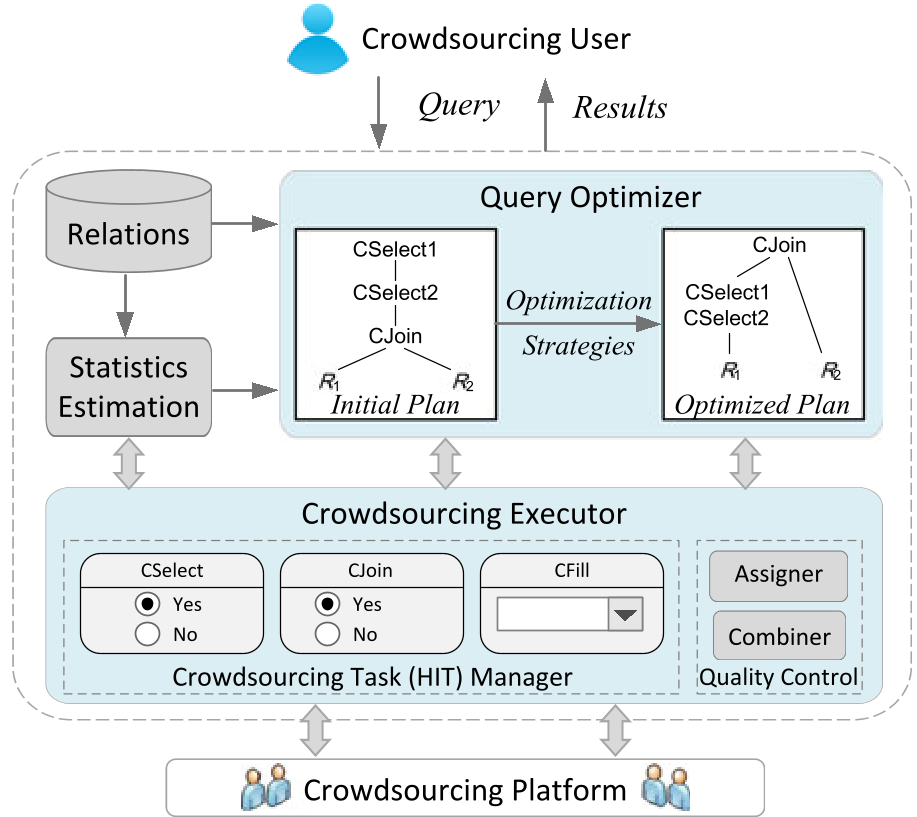 Figure 1: The CROWDOP Architecture showing the flow from SQL Query to HIT management on AMT.
2. Dynamic Programming for Selections
For selection queries (multiple filters), CROWDOP uses Algorithm 2. It sorts conditions by selectivity and uses dynamic programming to decide which conditions to batch together in a single phase to hit the latency target without wasting money.
Experimental Validation
The authors tested CROWDOP on Amazon Mechanical Turk (AMT) using car datasets. They found that real-world latency follows a "long tail"—most tasks finish quickly, but a few stragglers take hours. CROWDOP's "phase-based" latency model targets the 75-80% completion mark to keep pipelines moving.
 Table 1: CROWDOP vs. CrowdDB and Qurk. CROWDOP consistently finds lower-cost plans by optimizing the CFILL-CJOIN interplay.
In complex "Select-Join" queries, CROWDOP achieved:
- 70% cost reduction compared to rule-based CrowdDB.
- Significant latency improvements by intelligently allocating "time budgets" across different parts of the query tree.
Critical Insight & Future Outlook
The brilliance of CROWDOP lies in its treatment of the "human-operator" as a stochastic variable with a price tag. While this paper focused on manual workers, the logic is highly applicable to LLM Orchestration today. Just as CROWDOP decides whether to "Fill" an attribute to save on "Join" costs, modern AI agents must decide whether to perform a "Retrieval" step to save on "Context Tokens" (cost) and "Generation Time" (latency).
Limitations: The model assumes attribute independence for selectivity, which rarely holds in real-world data (e.g., Car Make and Model are correlated). Future work incorporating correlations could further refine cost estimations.
Conclusion
CROWDOP moves crowdsourcing from a "hit-or-miss" manual process into a disciplined engineering domain. By providing a mathematical framework for the cost-latency trade-off, it enables developers to build complex human-in-the-loop applications with predictable budgets and timelines.