
CrowdIQ: Bridging the Semantic Gap in Web Tables via Declarative Crowdsourcing
CrowdIQ: A Declarative Crowdsourcing Platform for Improving the Quality of Web Tables
CrowdIQ is a declarative crowdsourcing platform designed to enhance the quality of structured web tables by addressing issues like missing headers and data conflicts. It introduces CrowdIQL, a specialized SQL-like declarative language, and leverages a hybrid approach combining machine preprocessing with human intelligence.
TL;DR
Web tables are a goldmine of structured data, but they are often messy, incomplete, or lack semantic headers. CrowdIQ is a scalable platform that solves this by allowing users to write simple, SQL-like commands (CrowdIQL) to trigger optimized crowdsourcing tasks. By combining machine learning (via Probase) to provide "hints" and human intelligence to verify them, CrowdIQ makes table cleaning both cost-effective and highly accurate.
The "Dirty Data" Bottleneck
Despite the abundance of web tables, utilizing them directly is often impossible. Automated algorithms struggle with semantics recovery—for instance, identifying that a list of names refers to "CEOs" rather than "Employees" is trivial for a human but complex for a machine. While specialized tools exist for specific sub-tasks, the community lacked a universal framework that could handle diverse table issues flexibly.
Methodology: The Core of CrowdIQ
The brilliance of CrowdIQ lies in its declarative approach. Instead of manually designing UIs for every table cleaning task, the requester uses CrowdIQL.
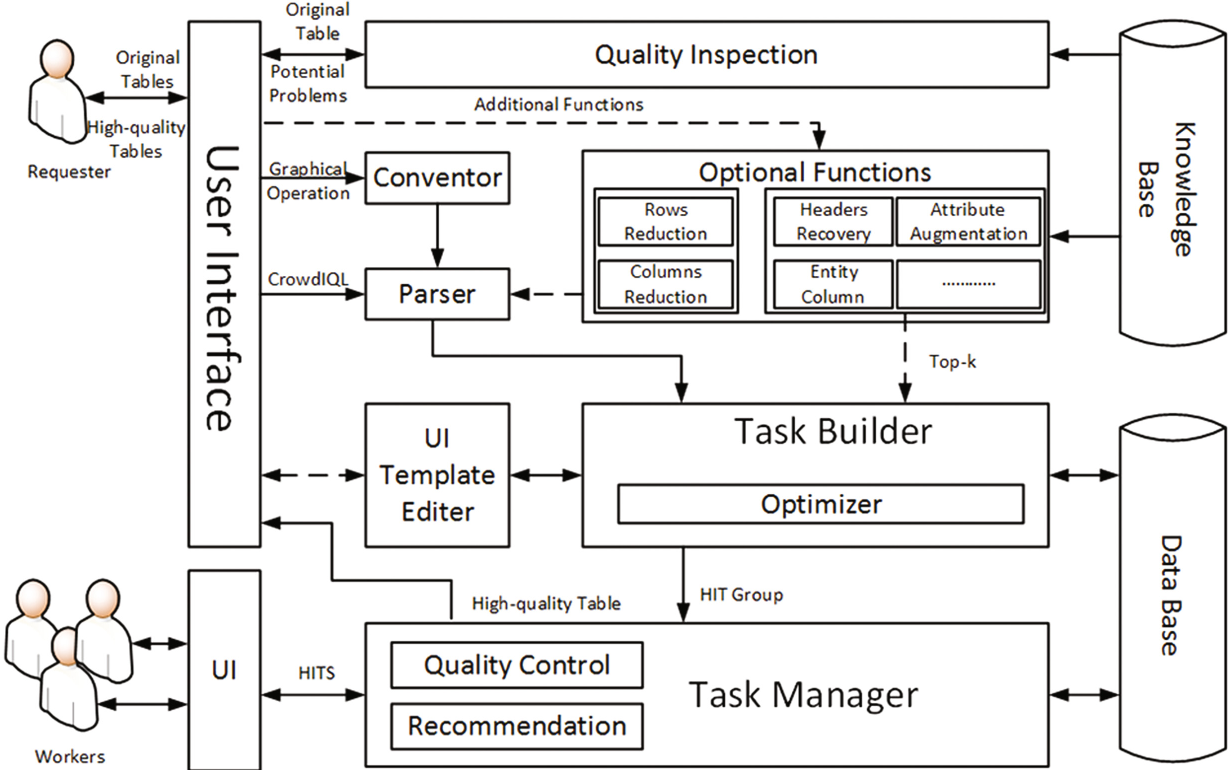
1. The Architecture
The system follows a pipeline: Inspection → Parsing → Task Building → Quality Control.
2. CrowdIQL: SQL for Humans
The language introduces powerful keywords that change how humans interact with data:
SHOWING: Instead of showing a massive table to a worker, it only presents "representative" samples, reducing cognitive load.USING ALGORITHM: This integrates machine preprocessing. For example, the system can use the Probase knowledge base to generate top-k candidates, turning a difficult "Fill-in-the-blank" task into an easy "Multiple-choice" question.
Experiments and Optimization
CrowdIQ focuses on two main pillars for improving efficiency:
- Data Minimization: Through clustering or sampling, the platform prompts the crowd with the least amount of data necessary to reach a conclusion, saving significant costs.
- Quality Control: A cumulative contribution model tracks worker performance. If a worker consistently provides high-quality labels for table headers, their "weight" in the final decision-making process increases.
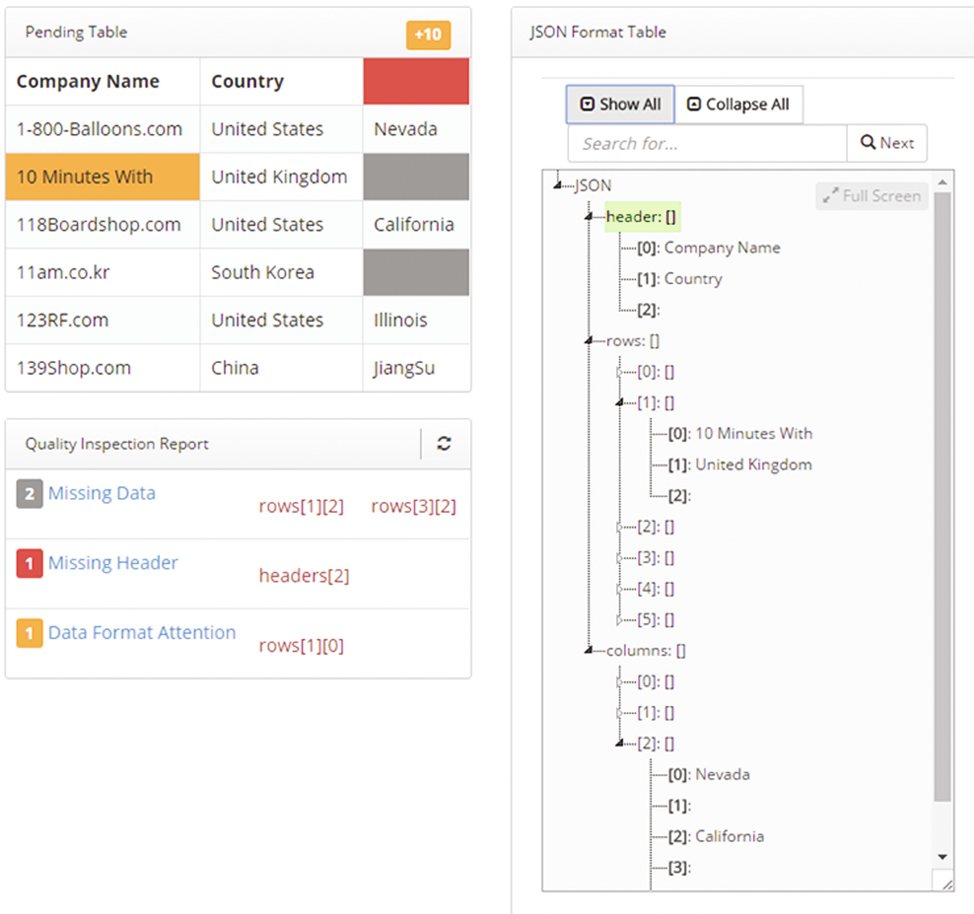 The platform converts relational tables into JSON, allowing for dynamic attribute insertion (like
 entity_column) during the cleaning process.
Critical Analysis & Conclusion
Takeaway
CrowdIQ represents a significant step toward "Declarative Data Cleaning." By abstracting the complexities of UI design and worker management behind a simple syntax, it allows researchers to focus on the what rather than the how of data quality.
Limitations & Future Work
- Cold Start: The system relies heavily on Probase for candidate generation; if the table contains highly niche or private domain data, the machine-assist benefits might diminish.
- LLM Integration: With the rise of Large Language Models, the "Optional Functions" module could be significantly enhanced by using LLMs to generate more nuanced candidates than traditional knowledge bases.
In summary, CrowdIQ provides a robust blueprint for hybrid human-machine systems, proving that a well-designed declarative interface can bridge the gap between messy web data and high-quality structured knowledge.