
BayesDGC: Bridging Deep Learning and Bayesian Inference for Crowdsourcing
Crowdsourcing aggregation with deep Bayesian learning
The paper introduces BayesDGC, a fully Bayesian deep generative model for crowdsourcing aggregation. It integrates Deep Neural Networks (DNNs) for representation learning with probabilistic graphical models to infer latent true labels from noisy worker annotations.
Executive Summary
TL;DR: BayesDGC is a novel framework that solves the noisy label aggregation problem in crowdsourcing by marrying Deep Neural Networks (DNNs) with Fully Bayesian Graphical Models. It treats the DNN as a feature-aware prior and uses a sophisticated Natural-Gradient Stochastic Variational Inference algorithm to estimate ground truth labels and worker reliability simultaneously.
In the landscape of weakly supervised learning, this work stands as a significant advancement, moving beyond simple heuristic label cleaning toward a theoretically grounded, end-to-end probabilistic deep learning architecture.
Problem & Motivation: The Limits of "Wisdom of Crowds"
Crowdsourcing services like Amazon Mechanical Turk provide vast amounts of data, but at a cost: noise. Annotators have varying expertise, biases, and levels of diligence.
Prior works have two major flaws:
- Feature Blindness: Many probabilistic models (like the classic Dawid-Skene) only look at the labels themselves, ignoring the actual data features (e.g., the pixels in an image) that explain why a label might be difficult.
- Lack of Rigor in Deep Learning: While some recent methods use DNNs to handle features, they often treat the problem as a deterministic optimization task. This sacrifices the interpretability and uncertainty quantification provided by probabilistic graphical models.
The authors' insight was to use a DNN to generate "potentials" for a graphical model, creating a hybrid that is both powerful and mathematically principled.
Methodology: The BayesDGC Architecture
The core of BayesDGC is a joint distribution model. It consists of:
- The DNN Prior: A feature-dependent neural network that suggests a label distribution based on input features .
- The Worker Model: A set of confusion matrices (parameterized via Dirichlet priors) that capture the probability of worker providing label given true label .
- The Inference Engine: Unlike standard EM algorithms which are slow, BayesDGC uses Natural-Gradient SVI. This allows the model to scale to large datasets while performing second-order optimization for the Bayesian parameters and SGD for the neural network.
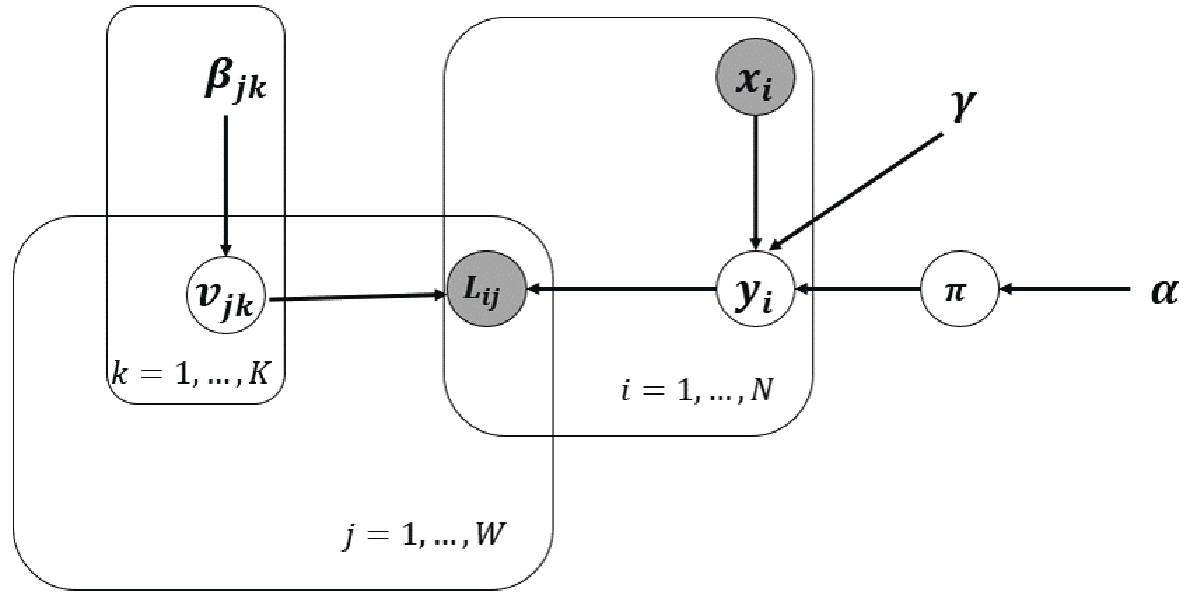 Figure 1: Plate notation showing the dependency between features (X), global parameters (), latent labels (Y), and observed worker annotations (L).
Experiments & Results: Stability and Accuracy
The researchers tested BayesDGC against several heavyweights, including Majority Voting (MV), Dawid-Skene (DS), and the feature-integrated Yutc model.
Key Findings:
- Superior Accuracy: In the 22 real-world datasets, BayesDGC was almost always the top performer.
- Efficiency in Data-Scarce Scenarios: When only 10% of annotations were available, BayesDGC’s gain over non-feature-aware methods was most pronounced, proving that the DNN prior successfully "fills in the gaps" left by unreliable workers.
- Stability: Unlike the linear Yutc model, which showed erratic performance across different datasets, BayesDGC remained stable due to its deep representation capacity and automated Bayesian parameter tuning.
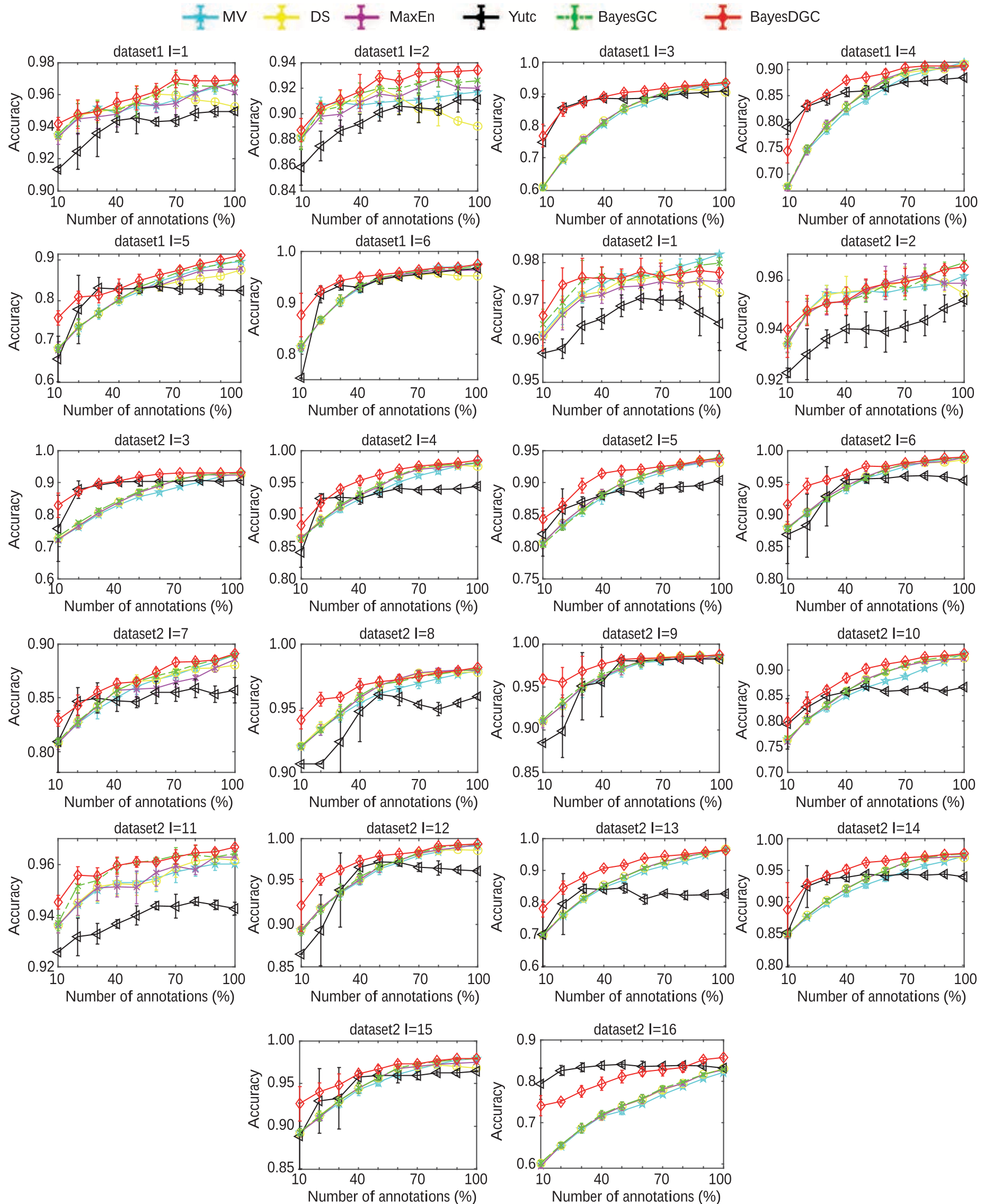 Figure 2: Performance comparison across various real-world datasets showing BayesDGC's consistent edge.
Critical Analysis & Conclusion
Takeaways
The marriage of DNNs and Bayesian graphical models isn't just a trend; it's a necessity for robust AI. BayesDGC proves that we can have the "best of both worlds": the expressive power of deep learning and the robust uncertainty handling of Bayesian statistics.
Limitations & Future Work
While BayesDGC is a major step forward, it assumes workers are independent. In reality, workers often exhibit correlated biases (e.g., multiple workers might share the same cultural bias or linguistic misunderstanding). The authors acknowledge this and plan to extend the framework to correlated worker models and multi-label scenarios, which involve much higher computational complexity.
In conclusion, BayesDGC provides a blueprint for how to build labels you can trust from a crowd you might not.