
Credible MCS: Bridging Social Cognition and Task Assignment in the IoT
A Crowdsourcing Assignment Model Based on Mobile Crowd Sensing in the Internet of Things
This paper introduces a novel crowdsourcing assignment model for Mobile Crowd Sensing (MCS) in IoT environments. It combines social relationship cognition with the Analytic Hierarchy Process (AHP) to effectively assign sensing tasks to credible service providers based on multi-dimensional user preferences.
Executive Summary
TL;DR: This paper tackles the "trust gap" in Mobile Crowd Sensing (MCS) by proposing a crowdsourcing assignment model that doesn't just look for any available sensor, but the most credible one. By combining social relationship modeling with the Analytic Hierarchy Process (AHP), the authors created a framework that matches Service Requesters (SR) with Service Providers (SP) through trusted social links, improving task success rates by over 11%.
Context: Within the IoT landscape, this work occupies a critical intersection between Social Computing and Distributed Systems. It moves beyond simple proximity-based sensing toward "Human-Centered Sensing," where social trust is the primary currency.
The "Trust Gap" in Mobile Sensing
Modern MCS assumes a utopian world where every smartphone user is willing and honest. In reality:
- Incentive & Trust: Users won't forward data for strangers.
- Information Overload: Heterogeneous data makes it hard to identify quality providers.
- Dynamic Mobility: People move semi-randomly, making fixed routing protocols obsolete.
The authors' core insight is that human movement is not random—it is event-driven and socially constrained. By modeling these social "anchors," we can predict where a user will be and how reliable they are as a data source.
Methodology: The CAHP Framework
The core of the paper is the Crowdsourcing Algorithm based on AHP (CAHP). The assignment logic is split into three distinct dimensions:
1. The Decision Triad
- SQF (Service Quality Factor): Gauges historical performance (Success rate, delay, and satisfaction).
- LRF (Link Reliability Factor): Measures the "strength" of the social bridge between the requester and provider.
- RHF (Region Heat Factor): Estimates the "presence" of the user in a target area using duration and frequency.
2. Multi-Level Decision Making
The AHP allows the system to weigh these factors differently based on user preference. If a user needs data fast, LRF is prioritized; if they need accuracy, SQF takes the lead.
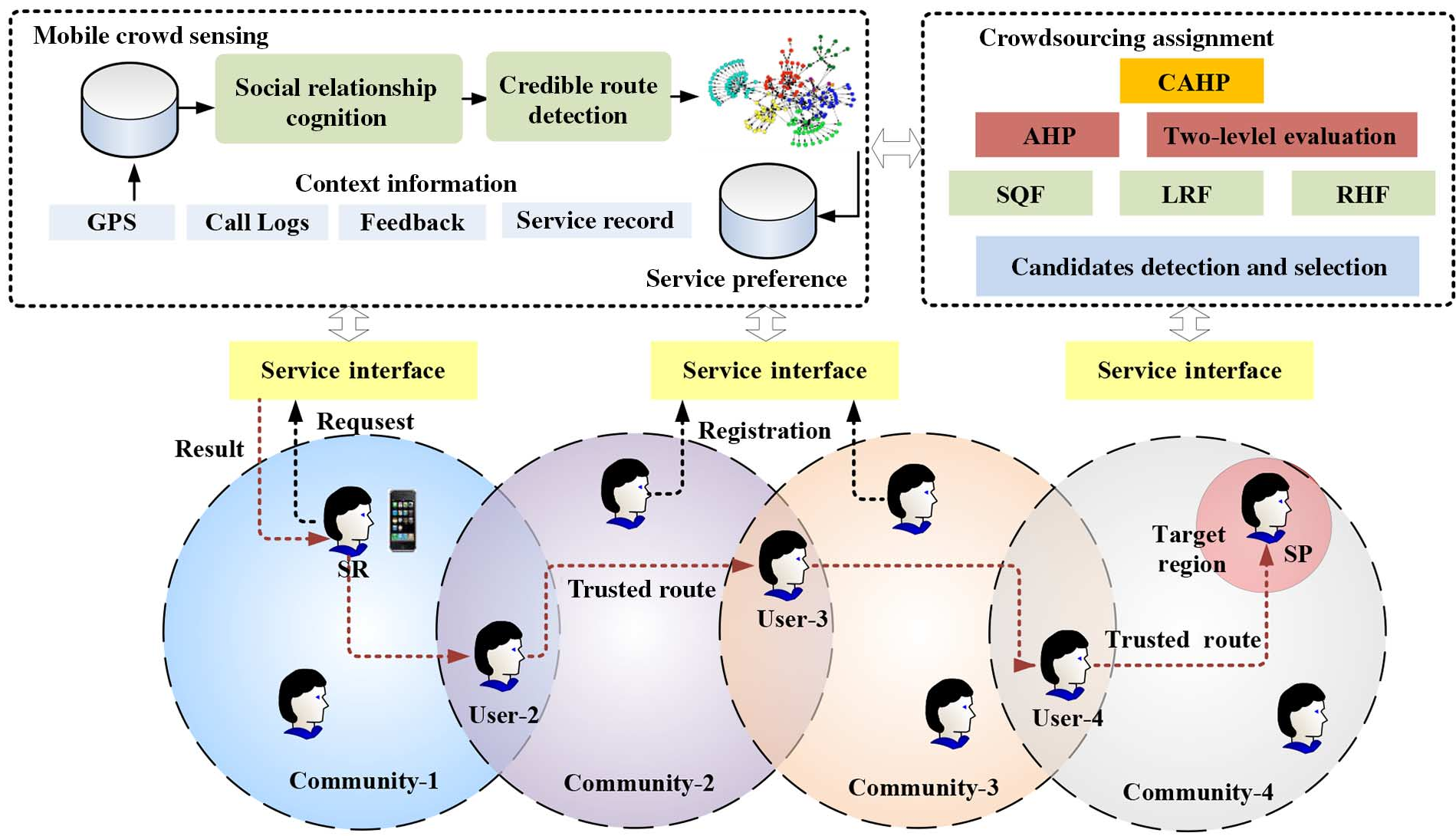 Above: The proposed crowdsourcing model architecture showing the interaction between the MCS module, Data Center, and the Assignment module.
3. Community-Based Routing
The model utilizes "Service Communities." If an SR and SP are in different communities, the system finds "bridge nodes"—users who belong to both or sit on the margins—to facilitate a trusted handover of the sensing request.
Experimental Results
Using the MIT Reality Mining dataset, the researchers simulated a 64-node network over 180 days.
- Success Rates: The model achieved an Awareness Success Rate (ASR) of ~11.4% higher than Random Selection.
- Efficiency: Service Link Time (SLT) was reduced by 17.6%, proving that social-aware routing finds paths faster than "blind" flooding or random hopping.
- Robustness: Even in "Busy" or "Unstable" network states (high request frequency/low user stability), the CAHP model maintained a significantly higher success rate compared to the baseline.
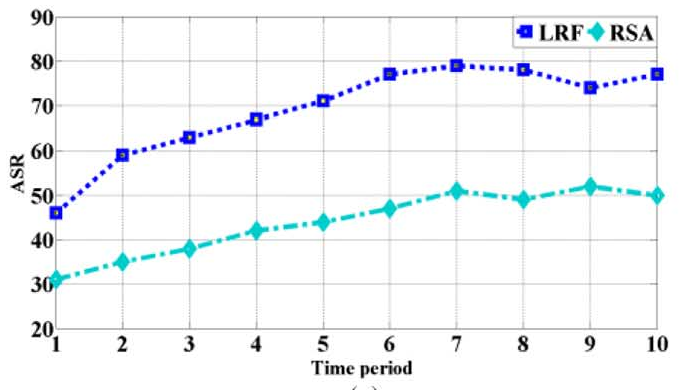 Figure: Performance in stable vs. unstable environments. Notice how the GA-based approach (LRF/SQF/RHF variants) maintains a higher baseline as nodes become less stable.
Critical Insight & Discussion
The true value of this work lies in its Inductive Bias: it assumes that human social structures are a viable proxy for network reliability. While many IoT papers focus on hardware efficiency, this paper focuses on social efficiency.
Limitations:
- The model relies heavily on historical "Interaction Data." For a new user (the "Cold Start" problem), the model might struggle to calculate an accurate SQF.
- Privacy: The extraction of "Region Heat Factors" requires tracking user location patterns over 180 days, which raises significant privacy concerns that would need to be addressed via Differential Privacy or Federated Learning in a real-world product.
Conclusion
This paper serves as a blueprint for the next generation of IoT services where social trust and sensing are inseparable. By quantifying the "human element" through AHP, the authors have turned subjective social relationships into an objective routing metric.