
LiCS: Redefining Indoor Localization through the Lens of Crowd Intelligence
Locating in Crowdsourcing-Based DataSpace: Wireless Indoor Localization without Special Devices
This paper introduces LiCS (Locating in Crowdsourcing-based DataSpace), an indoor localization algorithm that leverages crowdsourced wireless signals (WiFi and Bluetooth) from mobile devices. By recognizing human crowd behavior patterns, LiCS achieves accurate room-level localization without requiring special hardware or labor-intensive pre-training (site surveys).
TL;DR
The challenge of indoor positioning—accurate enough for room-level services but cheap enough for zero-cost deployment—has long been the "holy grail" of LBS. LiCS (Locating in Crowdsourcing-based DataSpace) breaks the tradition of manual site surveys. By harvesting the ubiquitous WiFi and Bluetooth signals from the "crowd" in our social environments, it builds a self-evolving localization model that achieves ~2.6m accuracy without a single dedicated beacon.
The "Infrastructure" Trap
For decades, indoor localization has been stuck between two extremes:
- High-Precision, High-Cost: Systems like RADAR or specialized acoustic beacons require physical installation and constant maintenance.
- Fingerprinting Fatigue: Methods that record RSSI (Received Signal Strength Indication) maps require engineers to walk every square inch of a building. If a router moves or a wall is built, the entire database becomes obsolete.
The authors of LiCS ask a fundamental question: Why can't the environment map itself? Since we all carry mobile devices, our collective movement patterns (Crowd Dynamics) contain the latent structure of the physical space.
Methodology: From Crowd Behavior to Coordinates
LiCS operates on a "Social-to-Physical" mapping. The system architecture follows a mobile-based network-assisted flow:
 Note: The image above illustrates the Data Analysis Center (DAC) receiving "signal triples" to compute positions.
1. Identifying the "Crowd"
The authors use an Expectation-Maximization (EM) algorithm to cluster users. By analyzing "Friendship" and "LocationID" (timestamps + check-ins), they define a crowd as a group within a 10m radius within a 15-minute window. This clustering effectively creates a "Logical Map" of the building without needing its architectural blueprints.
2. The Time-Serial Estimation Model
The core of LiCS is a non-linear estimation formula (Eq. 1) that predicts the target's next location based on its history.
- : Connection weights representing temporal correlation.
- : A logistic sigmoid function acting as a hidden-layer transfer, allowing the model to capture complex signal-shadowing effects that simple linear models miss.
Experimental Showdown: LiCS vs. LiFS
The team deployed LiCS in a sprawling academic complex (nearly 40,000 m²). They compared it against LiFS (a popular "survey-free" benchmark).
Key Performance Indicators:
- The Bluetooth Advantage: LiCS with Bluetooth performed significantly better than WiFi. Why? Bluetooth signals attenuate more sharply over distance, creating "sharper" gradients that the EM algorithm can distinguish more easily.
- Accuracy Distribution: In laboratory settings, 80% of LiCS (Bluetooth) queries had an error under 2.4 meters.
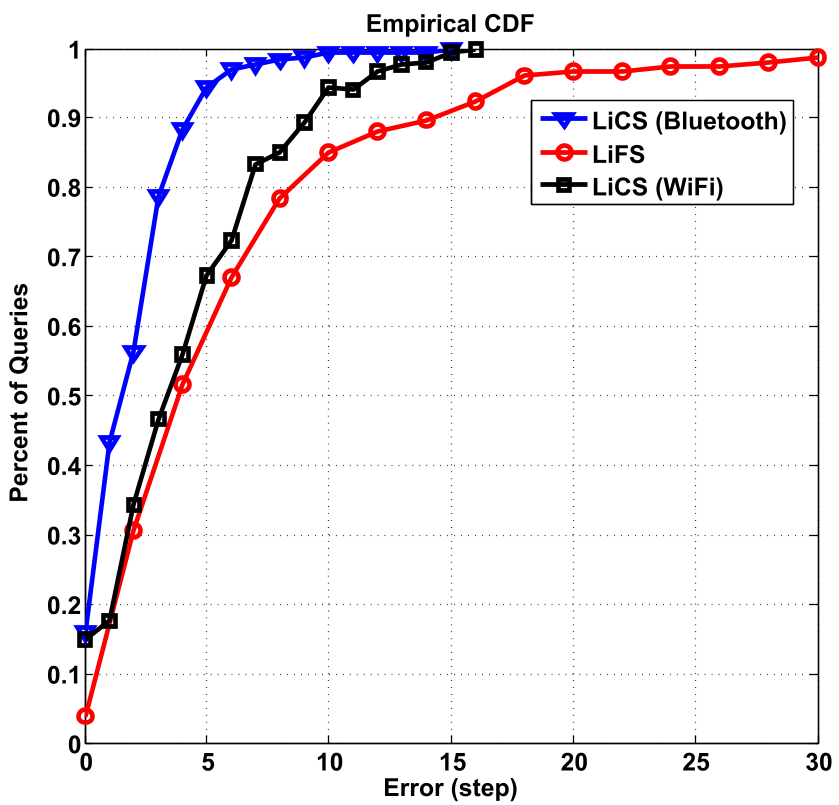 The Cumulative Distribution Function (CDF) shows LiCS consistently outperforming LiFS by a wide margin, especially in the 2-6 meter error range.
Critical Insight: Why Does It Work?
The genius of LiCS lies in its Self-Training capability. Unlike static fingerprint databases, LiCS is "pre-training-free." It treats the fluctuating nature of RSSI not as noise, but as a feature to be smoothed over time through its neural-network-like estimation model. By leveraging crowdsourcing, the model is "alive"—it updates as more people traverse the space.
Conclusion & Future Outlook
LiCS proves that we don't need smarter buildings; we need smarter algorithms that utilize the data we already generate. While the reliance on "social" density means it might struggle in a deserted warehouse, in malls, hospitals, and offices, LiCS offers a path to truly autonomous indoor GPS.
Future research could investigate the Privacy-Utility Tradeoff—how to cluster "crowds" without exposing individual user identities to the Data Analysis Center.