
CROWNS: Bridging the Information Gap in Disaster Management through Community-Sourcing
A Crowdsourcing based Information System Framework for Coordinated Disaster Management and Building Community Resilience
The paper introduces CROWNS (Crowdsourced Information System for Disaster Management), a multiplatform framework that integrates social media crowdsourcing with "community-sourcing" to provide real-time situational awareness. It establishes a coordinated information system to assist agencies in resource deployment and building long-term community resilience.
TL;DR
The CROWNS framework (Crowdsourced Information System for Disaster Management) addresses the chaos of disaster response by combining social media intelligence with verified "community-sourcing." By empowering local volunteers to provide structured reports via mobile apps, the system creates a high-resolution, operational picture of disaster zones, significantly improving the speed and accuracy of resource allocation.
Background Positioning
In the spectrum of Disaster Management Information Systems (DMIS), CROWNS sits at the intersection of Social Informatics and Distributed Systems. It moves beyond the passive monitoring of social media (which is prone to "noise") and establishes a proactive, verifiable network of local stakeholders, marking a shift from top-down governance to a decentralized, resilient community model.
Problem & Motivation: The "Truth" Crisis in Chaos
During a disaster, information is the most precious resource, yet it is often the most corrupted. The authors identify two primary failures in current protocols:
- The Trust Gap: Social media posts (Twitter/Facebook) are fast but often anonymous, subjective, or outright false.
- The Latency Gap: Official agency surveys are accurate but take far too long to conduct, leaving victims in a "dark period" before external aid arrives.
The insight behind CROWNS is that identifiable community members (community-sourcing) are more reliable than anonymous crowds. By organizing local "experts"—such as Self-Help Groups (SHGs)—the system converts raw human observation into actionable data.
Methodology: The CROWNS Architecture
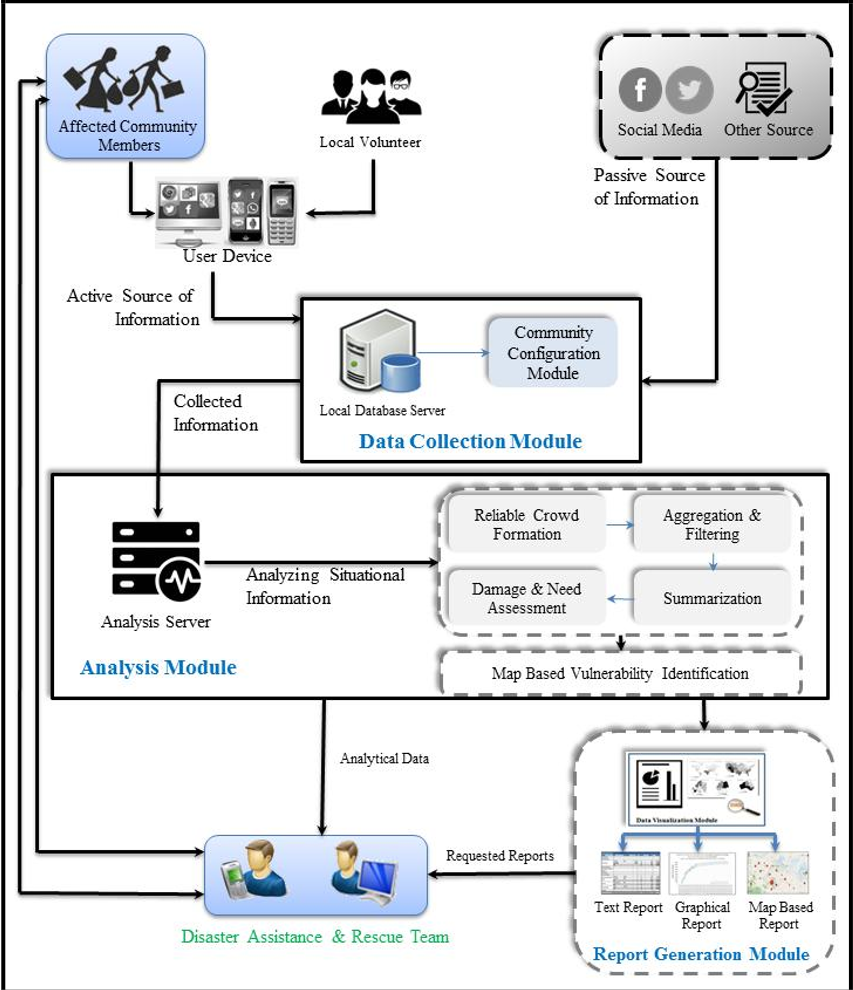
The system is built on a tripartite architecture designed for scalability and reliability:
- Data Collection Layer: Captures structured data from the CROWNS app and unstructured data from social media (WhatsApp, SMS, News).
- Analysis Module: This is the "brain" of the system. It filters duplicates, checks for inconsistencies, and analyzes the "reliability" of the info provider.
- Notification & Visualization Layer: Converts processed data into map-based views and customized reports for agencies.
The "Reliable Crowd" Logic
Unlike open crowdsourcing, CROWNS utilizes a Community Configuration Sub-module. This registers users, allowing the system to track who is providing information. By applying Natural Language Processing (NLP) and topic-based aggregation, it builds a coherent "snapshot" from fragmented local reports.
Field Trial & Results: Proof in the Mud
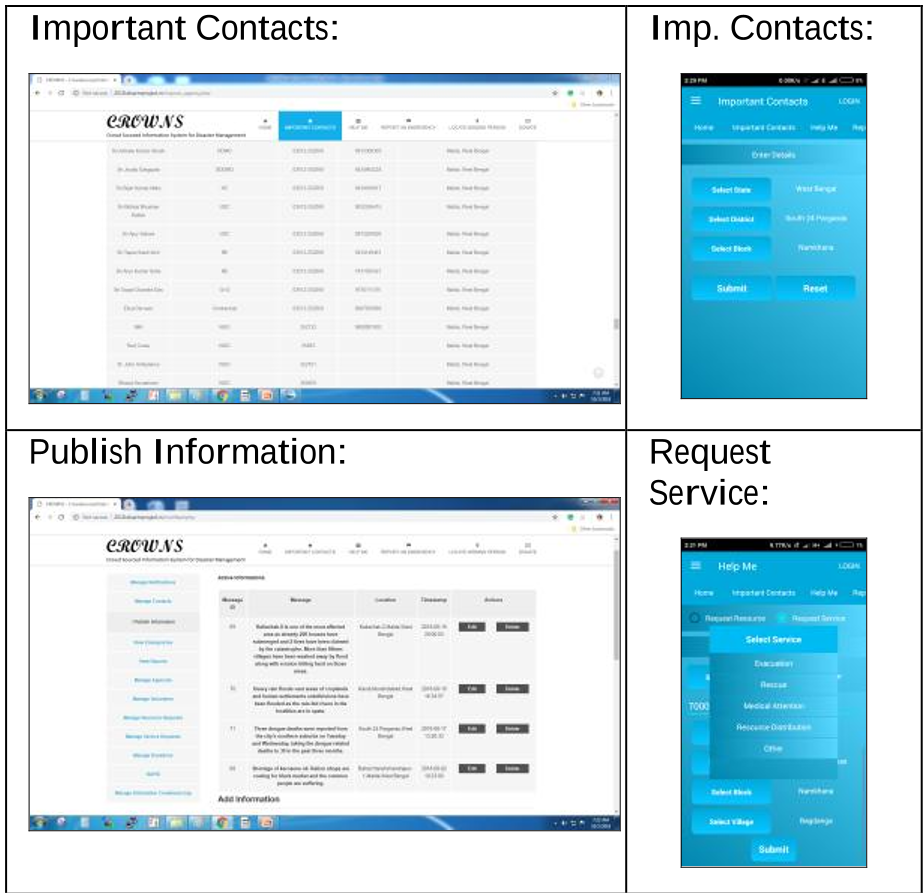
The researchers deployed CROWNS in a remote village in Namkhana, West Bengal. This was a critical test of usability for populations with low literacy and low-end smartphones.
Key Findings:
- Structured Interaction: Instead of open text, the system used multiple-choice questions (e.g., "Status of hospitals?"). This eliminated spelling errors and simplified reporting.
- Granular Insights: The trial successfully mapped that 97% of the community used hand pumps/tube wells, but 55% of these were affected by the disaster, providing immediate targets for sanitation teams.
Critical Analysis & Conclusion
Takeaway
The true value of CROWNS isn't just in the software; it’s in the social capital it builds. By training local groups to use the system before a disaster, the community enters the crisis with an existing infrastructure of coordination.
Limitations
- Internet Dependency: While multiplatform, the system relies on internet connectivity, which is often the first thing to fail in a catastrophic disaster.
- Incentive Structures: The paper assumes altruistic participation; however, long-term engagement (keeping the "local resource inventory" updated) requires sustained community motivation.
Future Outlook
As we move toward 2026, the integration of Edge AI into frameworks like CROWNS could allow for local data processing even when the grid is down. The shift from "gathering info" to "building resilience" through local knowledge is the definitive future of disaster management.