
RAEDS: Toward Intelligent "Calibration-on-demand" for Wi-Fi Indoor Positioning
Crowdsourcing based radio map anomalous event detection system for calibration-on-demand
This paper introduces RAEDS (Radio map Anomalous Event Detection System), a crowdsourcing-based online monitoring tool designed to detect deviations in Wi-Fi radio maps for Indoor Positioning Systems (IPS). By employing an outlier detector coupled with a binomial event discriminator, the system enables Calibration-on-demand, maintaining high localization accuracy while significantly reducing manual surveying costs.
TL;DR
The high cost of maintaining Wi-Fi "Radio Maps" is the Achilles' heel of indoor positioning. This paper presents RAEDS, a system that uses crowdsourced data to automatically detect when a radio map has become obsolete. By distinguishing between short-lived noise and long-term environmental shifts, it achieves detection rates up to 92% with a tiny 3% false alarm rate, paving the way for self-healing navigation systems.
The Motivation: The Maintenance Trap
Wi-Fi fingerprinting is the gold standard for indoor localization because it leverages existing infrastructure. However, it is notoriously fragile. A moved sofa, a closed fire door, or a malfunctioning Access Point (AP) can corrupt the "Radio Map," causing positioning accuracy to plummet.
Currently, operators face a dilemma:
- Periodic Recalibration: Extremely expensive and time-consuming.
- Crowdsourcing: Scalable, but highly susceptible to "dirty data" from uncalibrated user devices.
The authors propose a middle ground: Calibration-on-demand. Instead of guessing when to recalibrate, let the system monitor signal streams and "shout" when an anomalous event occurs.
Methodology: Mining Events from Noise
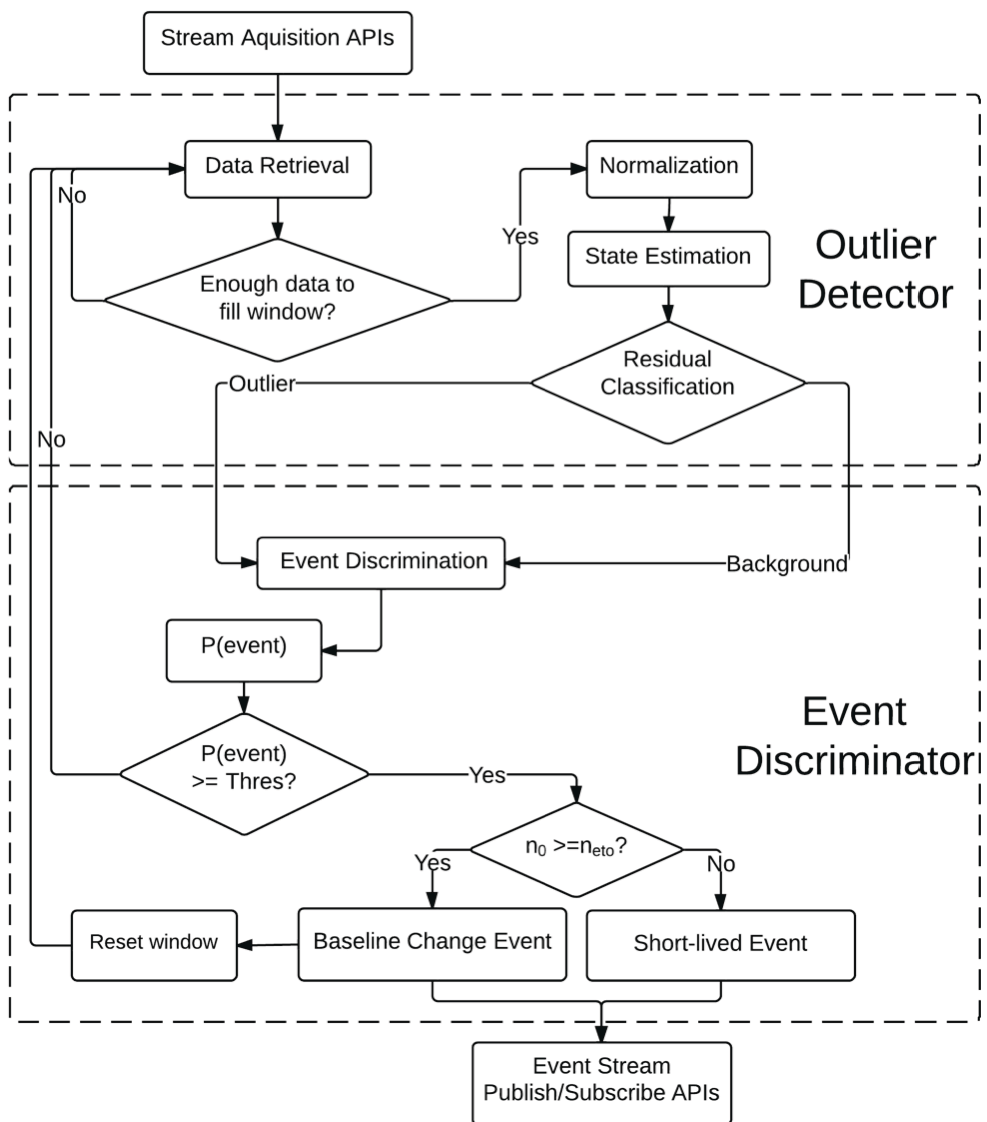
The RAEDS architecture solves the problem in two distinct layers, mimicking the human sensory system: identifying a "stinging sensation" (outlier) and then concluding it's a "bee sting" (event).
1. The Outlier Detector (State Estimation)
Since Wi-Fi signals are non-stationary (they drift over time), simple thresholding doesn't work. The authors test two sophisticated approaches:
- ARPF (Autoregressive Prediction Filter): Uses linear regression on historical data to predict the next RSS (Received Signal Strength) value.
- MVNN (MultiVariate Nearest Neighbor): A non-parametric approach that looks at the similarity between current multi-dimensional signal vectors and historical clusters.
2. The Event Discriminator (The Decider)
One outlier isn't an event; it could be a person walking by. RAEDS uses a Binomial Event Discriminator (BED). It treats the outlier stream as a Bernoulli process. It calculates the cumulative probability: if outliers appear in a window of samples, what is the likelihood that this is a systematic change rather than a random fluke?
Experimental Evidence
The team tested RAEDS in a 42m x 22m office environment using Samsung smartphones. They categorized anomalies into Baseline Change Events (BCEs)—like permanent layout shifts—and Short-lived Events (SLEs)—like a door being left open for 10 minutes.
Key Performance Insights
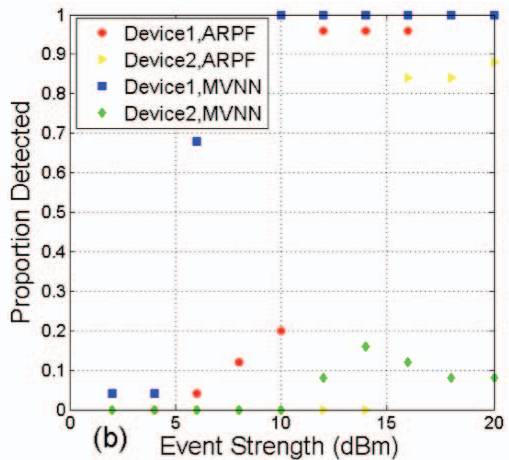
- Heterogeneity Handling: Despite different hardware antennas in the Note 3 and Galaxy S1, the predictive models adapted successfully, showing that the system is device-agnostic.
- ROC Analysis: The system demonstrates a classic trade-off. By increasing the event threshold to 0.95, the system virtually eliminates false alarms (FAR 3%) while still identifying the vast majority of disruptive events.
Critical Analysis & Future Outlook
The beauty of RAEDS lies in its simplicity. By using statistical foundations (Bernoulli processes and AR models), it avoids the "black box" nature of deep learning, making it easier for system administrators to tune.
Limitations:
- Fixed Location: Current tests were at fixed points. Real-world crowdsourcing involves moving users, which adds "spatial noise."
- Low-Strength Events: Events causing small RSS changes (<4 dBm) remain difficult to detect without increasing false alarms.
The Future: The authors aim to transition from "Fixed Location" to "Global Search," using Pedestrian Dead-Reckoning (PDR) to map these detected events to specific coordinates in a building. This would allow an IPS to "self-heal" by surgically updating only the affected parts of the radio map.
Conclusion
RAEDS proves that we don't need a professional survey team to keep indoor maps alive. By listening to the devices already in our pockets, we can build a resilient, context-aware wireless infrastructure that knows exactly when it needs a "tune-up."